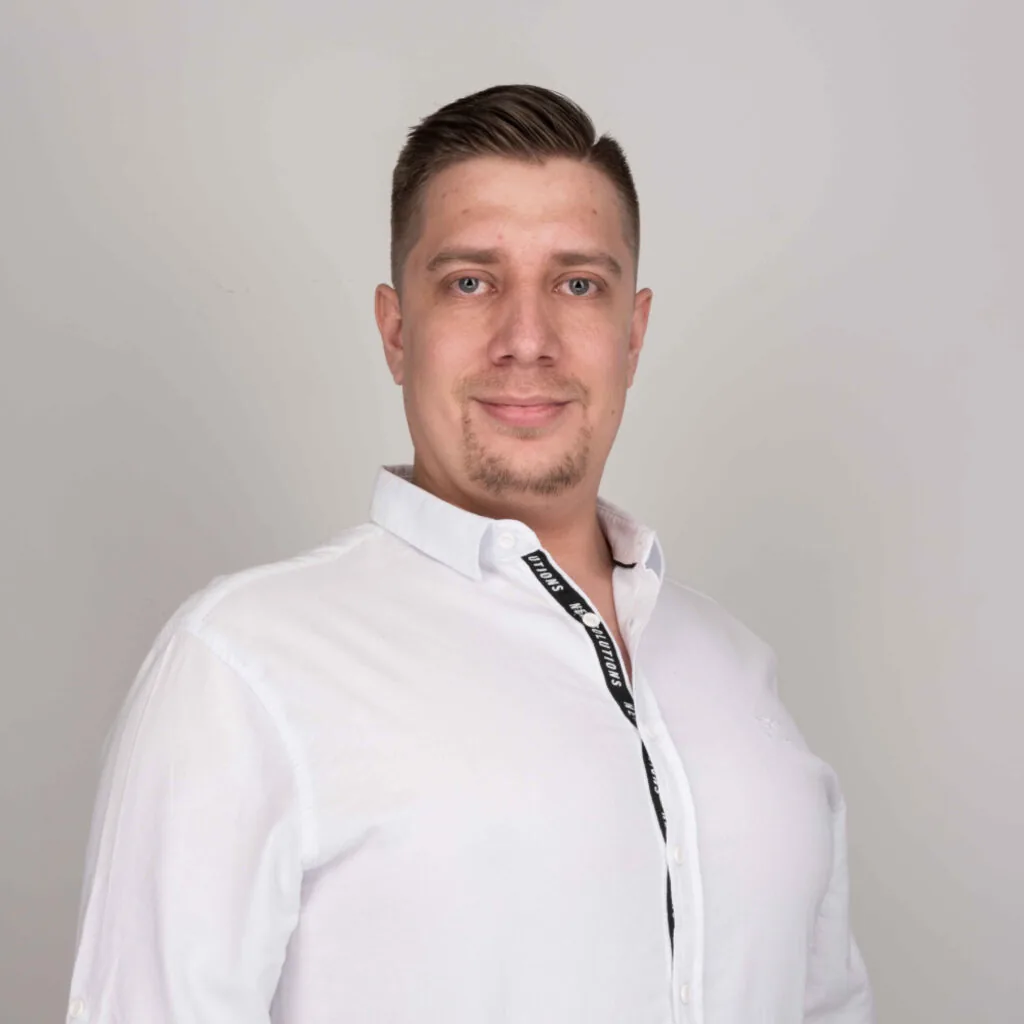
"I restore energy by lying down," says an IT project manager at DevCats about their lifestyle.
In an interview, IT project manager Dmitry Kononenko shared how he manages large projects and integrations, as well as his approach to learning, developing meta-skills, and the specifics of resting after intense workdays.
Author - Mansur Ismagulov

The Tech AI
Get the key points in seconds - a short summary from The Tech AI.
Dmitry Kononenko, a strategic projects manager at DevCats in Bishkek, has been working since 2018. He manages integrations (O!Money and Halyk Bank), establishes PMO processes, and leads the Readagility initiative. His work hours are from 9:00 AM to 8:00–9:00 PM, and he prefers online learning and relaxing with a Kindle Paperwhite.
Dmitry Kononenko, city — Bishkek, Strategic Projects Manager, RMO, Linkedin
About Me
Currently, I work as a Strategic Projects Manager at DevCats. My responsibility is to manage large-scale projects and integrations, such as the “O!Money” and Halyk Bank integration project. In addition to my primary role, I am also involved in establishing a Project Management Office (PMO), aligning processes across teams to enable more unified collaboration.
I have been in management since 2018 and in IT since 2010. I started as a QA engineer, then spent three years in Digital Marketing, working on SEO, contextual and targeted advertising, as well as websites. In 2018, I decided to transition into project management, realizing that communication and working with people were challenging for me: I clearly understood this after trying cold sales. However, I decided that where there is fear, there is also growth, and I fully immersed myself in project management.
My workday usually starts at 09:00 and can end at various times, most often around 20:00–21:00, depending on workload. The last quarter has been particularly busy, with a continuous flow of tasks. The official working hours are from 09:00 to 18:00, but I often have to stay later. If I have energy left, I try to study or read in the evenings.
Additionally, I have an initiative called Readagility, which originated in the Agile Kyrgyzstan community. We read and discuss books on Agile, soft skills, and management—professional literature. Meetings usually take place on Saturdays, and we prepare beforehand to ensure the discussions are more substantive.
Where and How I Learn
I engage in professional learning approximately once a year. For example, last year I studied product management at Netology because I was offered to be a moderator for the course, which gave me the opportunity to learn for free. Those nine months were a real adventure. Every year, I master something new in my professional field.
However, beyond that, I always strive to develop so-called meta-skills—thinking, communication, and analysis. In our Readagility initiative, we studied “A Textbook of Logic” by Georgy Chelpanov. We spent about five meetings going through it, and our experience showed that logic is a foundational discipline for all other fields. The approaches described in the book have been reflected in many tools created later, such as Goldratt’s “The Goal.”
In the TV series “Sherlock,” the main character uses the deductive method and demonstrates how important analysis and attention to detail are. In fact, I believe that the main quality of a man is attentiveness—the ability to notice important details. Being courageous is simple: you just need to be attentive.
Developing meta-skills helps me in my professional activities. For example, the “Ring of Questions” technique is a tool I actively use in my professional life. A well-posed question not only simplifies understanding but also opens up new perspectives in the topic being discussed.
Specific criteria are important to me when choosing an expert or teacher. I focus on whether they have students with real results, rather than just reputation and claims of “I am an expert in the field.” I choose those who can show real examples of their students’ successes.
For example, Ivan Zamesin is an excellent specialist in product management; he not only talks but also teaches with a focus on results. Or the “Stratoplan” team, with whom I have been acquainted since 2010. They teach management, and they also have many successful graduates. I am personally acquainted with their students.
It is important to me to find exactly such people, whose training leads to visible results, not just theoretical knowledge.
There are not many offline events in Bishkek, and I usually prefer to participate in online formats to save time on commuting. However, the High Technologies Park hosts excellent events with invited experts. They often organize talks and workshops on relevant topics such as business analytics, project management, and product management.
One of the recent events I attended was GDG Bishkek. Almaz Chanachev conducted a fantastic workshop on scaled processes. It was useful, and I began to better understand how to organize the work of not one, but a dozen teams at once—it is interesting and engaging.

Environment
I have colleagues with whom I have built friendly relationships, and I continue to communicate with them. But mostly, my circle of acquaintances consists of those I work with now, that is, the development team with whom we are working on the integration. And, of course, my wife and two cats.
I have an old friend whom I have known since kindergarten. We communicate periodically, although he lives in Moscow and sometimes visits Bishkek. He makes cold-pressed oil, for example, from avocados, and sells it. He is not related to IT in any way. Mostly, my circle of acquaintances consists of people from the field. All my acquaintances whom I communicate with are somehow related to this field.
Kyrgyzstan has limited resources that contribute to our development. We must develop through intelligence. Even if we lack competencies and qualifications, we can quickly improve them by organizing meetups and training in small groups. In coworking spaces, you can meet many interesting people: someone draws, someone programs, someone tests. We need to actively participate in events and organize our own.
I gave the example of Los Angeles: its population is about four million people, and approximately 200,000 of them are IT professionals.
Besides this, there are many meetups, workshops, and informal gatherings. We can develop through collaboration. If I have experience in a certain integration, I can share it. Someone has studied an interesting topic and can talk about it in their team. These ideas can grow over time, like in Christopher Nolan’s movie “Inception.” You tell something, and this idea can grow over several years, possibly even leading to the creation of a unicorn, as happened with UZUM in Uzbekistan. We do not yet have such unicorns.
I am convinced that we must work on creating such companies so that specialists come to us for expertise and work on our cool projects. This will contribute to the development of our country. We can read and discuss books in small groups, which increases the qualifications of participants. People begin to apply the knowledge they have gained in practice, which contributes to their professional growth and, consequently, increases their income. The higher the income, the happier the families. This ultimate goal drives me to be an active participant in communities.

How I Spend My Free Time
My rest is simply lying down and watching series or movies. I restore my energy by lying down. I do not have a habit of active rest—some people recharge from running or cycling, but for me, lying down is enough. Unfortunately, I have had quite little free time in the last quarter. I come home at 20:00–21:00, need to find time to talk with my wife, pet the cats, and go to bed to wake up at 08:00 and run to the office again. As a result, I have at most two hours of free time, and in reality, even less.
My hobby is computer games, especially session-based ones. I play War Thunder—it’s arcade tanks. I want to try running, but I approach this gradually so as not to scare myself away from this path. When there is an overload at work, I prefer to watch series. I like quality series with well-developed characters and complex social relationships, such as “True Detective,” “Breaking Bad,” and “Billions.”
Where and What to Buy
I definitely recommend the Kindle Paperwhite. I have the 11th generation, and I like reading on it. Previously, I had a Kindle Paperwhite second generation, which served me for nine years. Kindle is an excellent choice for those who love to read.
As for computers, I still have a MacBook Pro 2020 on Intel, and it sometimes heats up and lags. I understand that it is worth investing in more powerful equipment. Therefore, I am in favor of buying quality devices, even if they cost more. A good device will make your work more comfortable and pleasant. For example, I have the same model of a mechanical keyboard in both offices, and this creates the same working environment. Yes, it cost twice as much as ordinary keyboards, but typing on it is a pleasure.
The approach to selection is important: it is better to endure a little and invest in quality equipment than to buy something of low quality. As for stores, I often buy electronics at Rio Store. Prices there are usually $50 cheaper than in other places. And $50 is $50.
The Tech on Telegram Follow The Tech on Telegram
Keep up with the latest technology and startup news.
Related reading







More from this author

News
zypl.ai begins operations in Japan and focuses on next-generation risk models
Mansur Ismagulov

News
Elon Musk's net worth has exceeded $700 billion for the first time
Mansur Ismagulov

Article Interviews
"Central Asian countries should build a joint ecosystem," — Bekhzod Ismoilov on the development of AI in the region
Mansur Ismagulov

Article Interviews
Bloom's Taxonomy and Engineering Levels: A Practical Growth Model
Mansur Ismagulov

Article Useful
How the IT industry in Azerbaijan developed in 2025: key events
Mansur Ismagulov

News
Tajikistan has become a new member of the regional innovation alliance Central Asian Innovation Hubs.
Mansur Ismagulov