"I want to work only with top specialists who know what they want from life," — Dina Ruslan on the team and the development of the IT industry
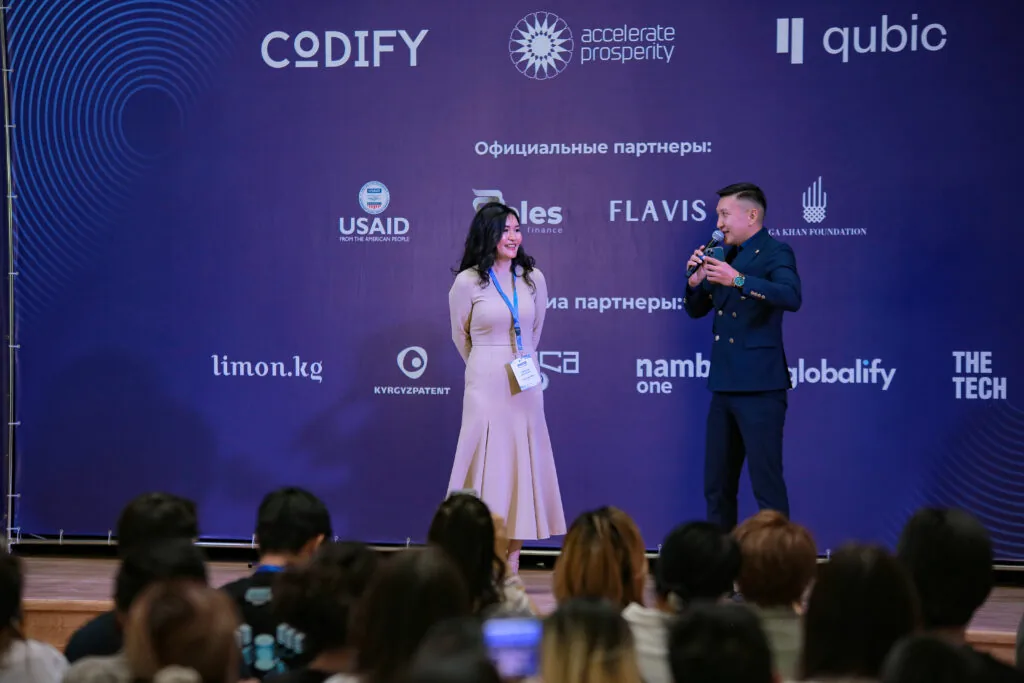
We continue to summarize results and discuss plans with IT leaders from Central Asia. Our next guest is from Kyrgyzstan — Din Ruslan, founder of the CODIFY group of IT companies, shared her views on the future of technology and the role of the company.
Author - Mansur Ismagulov

The Tech AI
Get the key points in seconds - a short summary from The Tech AI.
Dina Ruslan, founder of CODIFY from Bishkek, focused on the Codify App product for teaching children programming in 2024. The company participated in the Accelerate Prosperity and Antler Singapore accelerators, reaching an MRR of $100,000. In 2025, expansion into Kazakhstan and Uzbekistan is planned, with a focus on the B2C segment.
Dina Ruslan, City — Bishkek, founder of the CODIFY group of IT companies, @dinaruslan00
On global changes and trends
In 2019, I worked at Zensoft, and I only had an idea. At the end of 2019, I quit my job, and in January 2020, I started working on CODIFY. Two months later, in March, the COVID-19 pandemic began. From the very beginning, we developed as a startup, focusing on testing hypotheses and innovation, which became the foundation of our concept.
In 2020, we developed our first product — Codify CRM LMS, which automates educational centers. We chose the path of a product-based company rather than a service-based one and immediately began selling subscriptions to our product. In 2021, we launched the outsourcing company Codify Lab, and in 2022, we launched the employment and online learning platform for adults, Let's Codify. In 2023, we focused on automating employment processes and released our fourth product — VAP.
By the end of 2023, we decided to focus on a single product, and in 2024, we fully shifted our attention to Codify App — a platform for teaching digital literacy and programming to children aged 7 to 17. This is our final IT product, and we plan to concentrate our efforts on it.
Every year, we created new products and different directions, including B2B, B2C, outsourcing, and education. This was done consciously to test different markets and hypotheses. In 2020, we won our first acceleration program, Accelerate Prosperity, and received our first product valuation of $1 million. In 2021, we won Antler Singapore, becoming the first startup from Kyrgyzstan, confirming our valuation of $1 million and receiving $100,000 in investment. In 2023, we completed the Google for Startups program at Astana Hub, achieving the highest MRR of $100,000 per month.
As a result of three successful accelerations, we gained valuable experience but also faced the problem of lack of focus, as we launched a new product and entered a new market every year. Now, we have decided to focus on one product — Codify App — to effectively develop the platform for teaching children digital skills and programming.
On new challenges
With the advent of artificial intelligence, much has changed in the startup industry. I was familiar with several startups that operated in narrow niches around process automation. However, with the release of OpenAI, such startups have practically disappeared.
The impact of AI has also affected professions. For example, graphic design is no longer considered a promising profession. With the emergence of tools like Mid Journey, which can create images in minutes, the profession of a graphic designer has lost its relevance. However, more advanced skills in UI/UX design, especially at the intersection of offline and online, remain in demand, as AI cannot replace the complex aspects of design for mobile applications and websites.
Previously, people considered themselves developers by knowing HTML and CSS, but now to work in IT, one needs to know at least one programming language. Web development has become an additional skill, and with the development of AI, other professions are losing their relevance.
Initially, many believed that AI would replace highly intellectual professions, but in practice, simple jobs, such as call center operators and technical support, disappeared first. I have been working in IT for over 10 years, and I believe that for a successful career in technology, it is important to develop not only basic skills but also advanced engineering knowledge.
Recently in San Francisco, I saw a driverless car from Waymo operating as a taxi. It functions similarly to Uber or Lyft but without a driver. I recorded a video observing how it reacts to pedestrians, dogs, and cars, and noticed that it moves smoothly and confidently.
Such technologies are beginning to replace even the lowest-skilled professions. Autonomous cars and drones are already actively used for delivery. The speed of innovation adoption is growing, and if Tesla took 10 years to reach us, autonomous taxis could appear here in just five years.
On the role of new technologies
The development of AI is inevitable, and companies will adopt these technologies. However, it is important not just to use OpenAI or Gemini but to create unique solutions. At the TechCrunch Disrupt 2024 conference, many startups called themselves AI companies, although they used ready-made solutions rather than developing their own models.
This raises questions about their long-term sustainability, because if OpenAI raises prices or changes terms, their business could collapse. Today, 98% of startups worldwide, especially in Central Asia, use third-party AI systems, making them vulnerable.
At CODIFY, we understand the risks associated with dependence on external AI solutions. We actively research new technologies but strive either to develop our own solutions or to minimize dependence on external AI to avoid being in a vulnerable position.

On future employees
In the future, the most important skills and qualities of employees in our industry will be:
1. Meta-skills. First and foremost, this is the ability to learn — learn how to learn. In the world of IT and digital professions, even as the founder of CODIFY, I need to constantly learn. If I stop implementing new solutions, processes, and technologies, my company will lose its ability to develop. The same applies to all specialists: they must be able to adapt, learn new things, and be ready for changes in products, processes, and innovations.
2. Responsibility and discipline. In the modern world of success and social media, especially among young people, there is often a lack of these qualities. For example, employees aged 18-20 might easily not show up for work without prior notice or simply not return after lunch. This is related to burnout and demotivation dependent on mood. However, for a serious career and successful business, discipline is important: the ability to arrive on time, complete tasks, and show responsibility. This does not mean working without days off, but it is important to adhere to the schedule and be reliable.
3. Growth mindset — the desire to grow and build something significant. There are people who simply come to work from 09:00 to 18:00, live from paycheck to paycheck, do not strive for development, and do not want to change anything. It is important that people in the team strive for growth. Moreover, there is a hypothesis prevalent in top IT companies: Quality beats quantity — quality is more important than quantity.
We conducted an experiment where we chose between 10 top specialists and 100 random employees to achieve a result within a month. The theory was confirmed: 10 highly motivated and disciplined people will ensure a quality result. In startups, it is not the number of employees that matters, but the quality of the team.
At CODIFY, we strive to have not 100 random employees, but 10 top specialists in their field — whether it is a marketer, developer, financier, or accountant. Even a community manager should be a true professional, ready to build a community for students and graduates, not just "clocking in" working hours.
On the impact of global trends on company strategy
The influence of the global economy on the growth strategies of our company is always taken into account, but first and foremost, it is important that the mission and goal of the company remain the foundation of everything. Strategy is developed based on these principles, then a business plan is defined, which is divided into specific tasks. These tasks are implemented through processes and tools, and we regularly check their execution — both daily and weekly.
In the future, we plan to expand our presence in the Central Asian markets. Currently, we operate throughout Central Asia, with a primary focus on Kyrgyzstan. In 2025, we plan to expand our presence in Kazakhstan and Uzbekistan through Codify App to cover the entire region. We serve B2B clients, such as educational centers using our Codify LMS for automation. In 2025, we plan to begin active development in the B2C segment.

What a future leader should be like
I like the philosophy of the Infinite Game, which Simon Sinek writes about in his book. This is a leadership approach where the goal is not to defeat competitors but to constantly improve your products, services, and approaches by 1% every day. This is not about big leaps but about constant and gradual progress.
For me, leadership should be based on respect for the individual. I want to work only with top specialists and industry leaders. I am ready to invest in their development, mentor them, and build long-term relationships where their goals and plans are harmoniously integrated into the goals of my company. This is the infinite game aimed at constant improvement.
What the company will be like in 10 years
The ideal scenario for our company in 10 years is 100 million active users, more than $10 million in monthly revenue, and a company valuation of a billion and above. We plan to capture the markets of Central Asia, post-Soviet countries, Africa, and possibly East Asia. This will be the result of our constant improvement of products and scaling into new regions.
On the role of the company in the future
As the founder of CODIFY, I want every child in Central Asia to be able to master digital skills and programming for free. Central Asia is one of the largest migration corridors, and this is related to a lack of education. We want to give children the opportunity to develop skills that will help them find a good profession.
We plan to offer free training in basic digital skills, and through our app, we will offer paid training for future professions, so that school graduates can not only survive in a changing world but also be ready for a successful career, without succumbing to automation and global economic challenges.
We have noticed that cyber fraud and cyber attacks have become relevant problems, especially on the internet. Therefore, we created a free application for children and adults that offers mini-courses on cybersecurity. In these courses, people can learn how to protect themselves and their loved ones from scammers, how to properly create passwords, and other basics of computer literacy and programming. These courses are available absolutely free.
The Tech on Telegram Follow The Tech on Telegram
Keep up with the latest technology and startup news.
Related reading







More from this author

News
zypl.ai begins operations in Japan and focuses on next-generation risk models
Mansur Ismagulov

News
Elon Musk's net worth has exceeded $700 billion for the first time
Mansur Ismagulov

Article Interviews
"Central Asian countries should build a joint ecosystem," — Bekhzod Ismoilov on the development of AI in the region
Mansur Ismagulov

Article Interviews
Bloom's Taxonomy and Engineering Levels: A Practical Growth Model
Mansur Ismagulov

Article Useful
How the IT industry in Azerbaijan developed in 2025: key events
Mansur Ismagulov

News
Tajikistan has become a new member of the regional innovation alliance Central Asian Innovation Hubs.
Mansur Ismagulov