WomenInTech. "Everything I have is not a matter of chance, but the result of choices and efforts," — stories of successful women from AO "Bereke Bank"
Girls from Almaty shared their experiences, talked about the challenges they faced, and gave advice to those who are just starting their journey in the tech industry.
Author - Mansur Ismagulov

The Tech AI
Get the key points in seconds - a short summary from The Tech AI.
Aydana Zholdasova (Tech Lead Manual QA) and Saltanat Nusipova (Head of the Competency Centers Development Department) work at JSC "Bereke Bank" (Almaty). Both entered IT without a specialized education: Zholdasova came from the HoReCa industry, while Nusipova transitioned through the analysis of banking systems. They note the absence of gender discrimination within the company but highlight internal barriers for women, such as imposter syndrome, invisibility, and emotional challenges.
Aidana Zholdasova, city — Almaty, Quality Assurance Engineer at AO “Bereke Bank”, LinkedIn, Instagram
About Me
If I were to describe myself briefly, I am that very “middle child” with a perfectionist syndrome who always strives for victory. As a child, I dreamed of becoming a CIA agent, but in the end, I became a digital agent in QA. Now, my task is to find weaknesses and vulnerabilities not in secret dossiers, but in IT products. In short, the agent career was a success!
Curiosity is my main driver. It led me to sports, where I tried myself in gymnastics, dancing, boxing, karate, tennis, and even rope jumping. This same curiosity made me master the synthesizer and ukulele, despite childhood beliefs that I had no musical ear. Currently, I am actively studying English, as it is the key to new opportunities and travels, which for me are not just a hobby, but a way to explore the world through culture and people.
My career began in the HoReCa sector. Working at Rixos, I progressed from a waiter to a team captain, learning to manage processes, people, and time. I had the opportunity to organize large events, including meetings of presidents. This experience hardened me and provided a solid foundation for developing soft skills, but I realized that I wanted to develop in a different field.
2020 became a turning point for me. The pandemic gave me the opportunity to rethink my path, and I decided to switch to IT. Currently, I am a Tech Lead Manual QA at AO “Bereke Bank”. My job is to prevent errors and improve the user experience. Simply put, if I had tested the “Titanic,” it would not have sunk.
I am always ready to try new things, find non-standard solutions, and adapt to changes. My curiosity, love for excitement, and pursuit of excellence make life brighter and help in work. The main thing is not to stop, but to move forward, using all the opportunities life offers.

How I entered the IT profession
If someone had told me a few years ago that I would become a Tech Lead in IT, I would probably have laughed. I have always had a humanities mindset: interest in languages, dance, and creativity. But fate loves unexpected twists.
When I moved to Almaty, my surroundings turned out to be IT-oriented. I rented an apartment with girls from IT and joined a volleyball team of developers. Their conversations seemed like magical spells to me. Instead of feeling like an outsider, I felt a thrill.
YouTube suggested a video titled “How to get into IT,” and I immersed myself in studying. I found Roman Savin’s book “Testing Dot Com” and realized that QA was for me: attention to detail, analysis, and the desire to get to the bottom of things. I made a study plan and studied for 10 hours a day. In a month and a half, I mastered the basics, gained practice, and prepared for interviews.
I chose between several offers, but stopped at AO “Bereke Bank” — attracted by the strong community of testers and the difficult selection process. In 2021, I joined as a junior specialist, and three years later, I grew into a tech lead, having worked with different teams and stacks — from desktop testing to automated tests. Today, in the QA Competence Center, I am building processes and implementing best practices.
The company gave me not only professional but also personal growth, and an environment that motivates. Now I not only listen to IT conversations but also actively lead them.
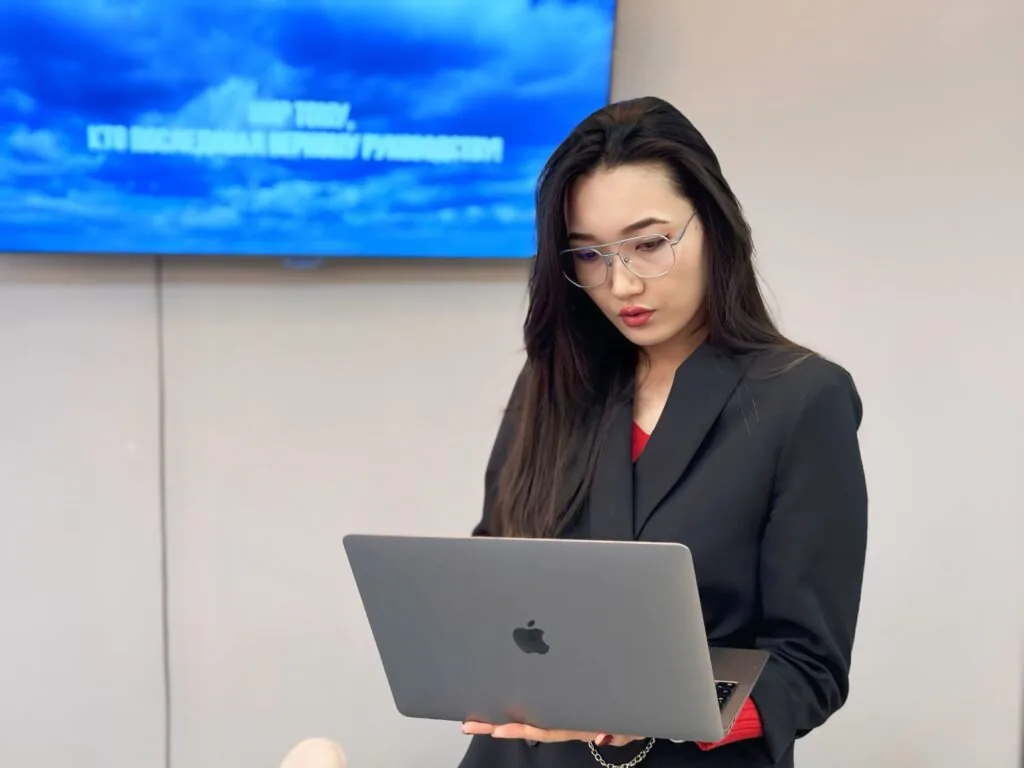
About Stereotypes
Stereotypes in IT still exist. One of them is “IT is not for girls.” Personally, I have not encountered this, but another myth sounds like this: you cannot get into IT without a technical education. This is a misconception, and my path proves it.
The main thing is not a diploma, but the desire to learn and develop. Important are not only technical knowledge but also soft skills: communication, teamwork, and the ability to argue. Companies value flexibility, initiative, and the ability to solve complex problems.
I have always been supported by my environment. Here I found a place where I can grow and propose even the boldest ideas. Instead of skepticism, there is support and confidence that any idea can become valuable.
Sometimes imposter syndrome appears. In such moments, it is important to have people nearby who can help overcome doubts. In our team, I can openly share my concerns and receive support, which gives me strength to move forward.
IT is open to everyone, regardless of gender and education. The main thing is the desire to learn and find an environment that will help you grow. If I had believed in stereotypes, I would not be where I am today.

Obstacles for Women in IT
Although there are no obvious barriers in IT, there are internal obstacles that many girls face. They are not always obvious, but they can significantly slow down growth and development.
1. Imposter syndrome. We often underestimate ourselves, doubt our knowledge, and fear responsibility. It seems that we are not competent enough to handle a new task, but it is exactly these challenges that move us forward. Growth is always associated with discomfort, and if something seems difficult — that means it is exactly what needs to be overcome.
2. Invisibility. There are many talented girls in IT who do their jobs well but remain in the shadows. They do not talk about their successes, do not show their expertise, and as a result, miss opportunities for development. It is important not only to be a professional but also to be able to announce oneself, show achievements, and initiative.
3. Emotional challenges. Pressure, stress, toxic environment — all of this is found in any field, and IT is no exception. It is important to be able to defend your point of view, maintain self-confidence, and not let external factors lower self-esteem. A strong inner core helps not only to overcome difficulties but also to confidently move up the career ladder.
Overcoming these barriers, we not only become stronger — we open up new perspectives and expand our boundaries in IT.
Recommendations for those just starting their path
Be proactive. Simply performing tasks is not enough — strive to improve processes, propose ideas, and show initiative. People who are passionate about their work are always noticed and valued.
Take responsibility. If a task seems difficult — this is a reason to take it on. Waiting for the perfect moment can drag on, and growth begins where you step out of your comfort zone.
Develop soft skills. Technical knowledge is important, but the ability to communicate, negotiate, and present ideas accelerates growth many times over.
Build connections. IT is not only about technology but also about people. Good relationships with colleagues and professional contacts can open up new opportunities.
Learn constantly. In IT, you cannot “finish studying” — the industry is changing, and those who are successful are those who constantly study new things and are not afraid of experiments.
Saltanat Nussipova, city — Almaty, Head of the Competence Centers Development Department in the Technology Development Department at AO “Bereke Bank”, Instagram

About Me
I lead the direction for the development of Competence Centers in the Technology Development Department of AO “Bereke Bank”. My area of responsibility includes coordinating a team of backend and frontend development leaders, analysts, and QA, as well as building effective processes.
We create unified approaches at all stages of the SDLC. We implement best practices and technologies that actually work, not just “hang in the air.” We develop and systematize competencies, select strong specialists, and support over 50 teams, ensuring development at all levels.
We call ourselves “fighters against chaos” — and this is not a joke. Sometimes chaos is just an unstructured opportunity. Our task is to turn it into a clear system where everyone knows where and why they are moving.
Believe me, developing new software solutions is easier than implementing processes. Any system has the property of maintaining stability, so sometimes I feel like I am fighting a huge monster ready to crush me. But it is exactly processes that make teams effective and the result predictable. It is important for me to see how this affects product quality and metrics — this is what gives me strength to move forward.
How I entered the IT profession
It all started with a project to implement a new automated banking system. I was invited as an analyst to the project office — right at the most intensive stage. There was no time to warm up: only a few months were left to implement key functionality, adapt to regulatory requirements, and business requests. My workday started at 07:00 and ended past midnight. At that time, I was implementing the “Credits” module — the most complex due to difficult business logic and high responsibility, where any mistake could be costly. We did not have dedicated testers, and quality control functions fell on analysts.
I even had to study accounting to conduct full-fledged testing. This experience became my personal bootcamp into the world of technology. And you know what? I got hooked.
This project became a real springboard into IT for me and hardened me. Then there were other modules, including treasury with integration of Bloomberg, Reuters, and KASE. I worked as an IT business partner in the corporate block, launched internal IT projects, participated in launching systems for small businesses, projects with Sberbank PJSC, and supervised the development of solutions based on microservice architecture as part of a cross-functional team.

About Stereotypes
When I was just starting, the developers’ language seemed like something from another planet. But thanks to my own perseverance, ability to learn quickly, and support from great guys — I managed. And yes, I did not have a specialized education; while I was mastering the nuances of the profession, I gave birth to two wonderful children and stayed on maternity leave with them, and at the same time, I was able to build a career in IT among strong professionals, mostly men. It was not always easy, but I managed.
I often hear that IT is a male sphere. But personally, I have never encountered either discrimination or preferences. Everything I have achieved is the result of my efforts, not my gender role. No leniency, no bias — just honest work. I worked and work among men, taking on obligations on par with them. Of course, I see that there are few women in IT, especially in management. But this is changing. More and more girls are coming into the profession, growing, and becoming leaders. The most interesting things are yet to come.
We need more women in IT. Not for the sake of balance in the schedule — but for the sake of balance in approaches, decisions, and culture. We, women, have high responsibility and know how to handle multiple tasks simultaneously. This is our strength.
Obstacles for Women in IT
The main barrier is not external limitations, but our own beliefs. We ourselves decide what we are capable of, and often set limits for ourselves that do not actually exist.
Leadership begins with the internal readiness to take responsibility, achieve results, and focus on the main things. Many girls in IT doubt themselves, are afraid to show initiative, and underestimate their contribution. This hinders career growth more than any external circumstances.
It is important not to look for excuses but to act. Be flexible, find solutions, learn to promote your ideas. After all, without an internal desire to move forward, it is impossible to build either a career, a team, or a successful product.
I would like to end with the phrase: “Everything I have is not a coincidence, but the result of choice and effort. I just did not refuse when it was time to move forward.”

Recommendations for those just starting their path
Do not be afraid to take the first step. Do not think that you do not have enough knowledge — in IT, no one knows everything. Here, it is important to be able to learn, be flexible, critical of information, and not be afraid to ask questions.
Yes, sometimes it is scary — especially at the beginning of a new project when nothing is clear. But in a month or two, you will already be “in the know.”
I always learn “as needed”: a task appeared — I started figuring it out. And this is normal. The main thing is not to stop. If you are honest with yourself and do the work, the result will definitely come.
And also — surround yourself with people who support you. IT is a community. And moving forward together is much easier.
The Tech on Telegram Follow The Tech on Telegram
Keep up with the latest technology and startup news.
Related reading







More from this author

News
zypl.ai begins operations in Japan and focuses on next-generation risk models
Mansur Ismagulov

News
Elon Musk's net worth has exceeded $700 billion for the first time
Mansur Ismagulov

Article Interviews
"Central Asian countries should build a joint ecosystem," — Bekhzod Ismoilov on the development of AI in the region
Mansur Ismagulov

Article Interviews
Bloom's Taxonomy and Engineering Levels: A Practical Growth Model
Mansur Ismagulov

Article Useful
How the IT industry in Azerbaijan developed in 2025: key events
Mansur Ismagulov

News
Tajikistan has become a new member of the regional innovation alliance Central Asian Innovation Hubs
Mansur Ismagulov