Tech Heads. CTO of Alif Bank, Habib Safarov: What Actually Makes an Ecosystem Strong
Author - Mansur Ismagulov
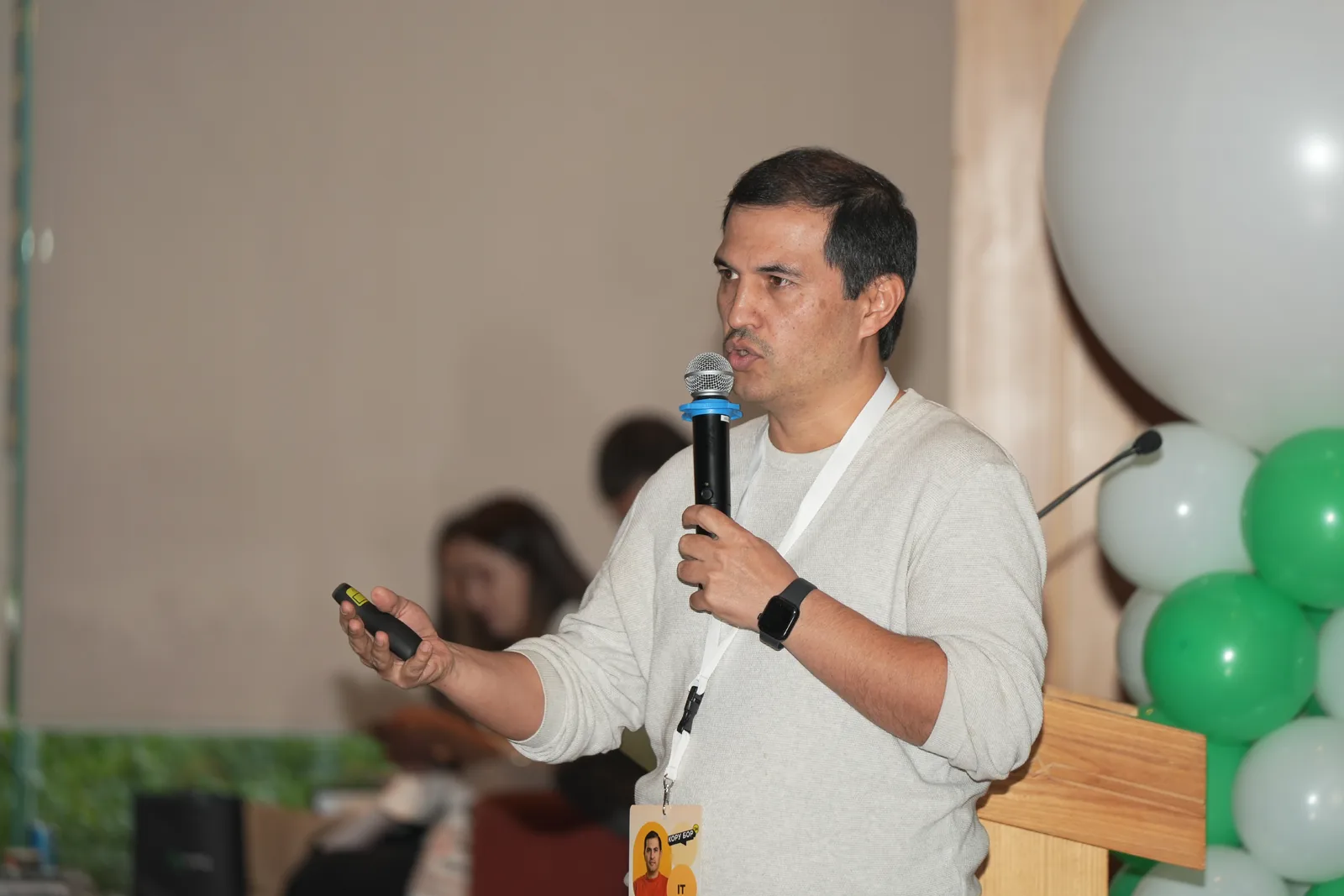
Technologies, teams, and innovation — this is what the work of the Chief Technology Officer at Alif Bank looks like. In this interview, we discuss how a team of hundreds of engineers is scaled and what strategic decisions help the company stay at the forefront of financial technology.
Habib Safarov, City — Dushanbe, CTO Alif Bank, LinkedIn
About the company and role
Today, Alif’s technical team is building a full-fledged ecosystem that includes a SuperApp, a marketplace, money transfer and bill payment services, as well as banking products, including Visa and Mastercard cards. All core banking systems and payment services are developed in-house, so the technical team plays a central role in creating and scaling these solutions.
Currently, our technical team consists of approximately 210 specialists. Of these, about 110 are developers, 18 are QA engineers, 11 are DevSecOps specialists, 8 are UX/UI designers, along with analysts, architects, systems engineers, and other experts who ensure the full development and support lifecycle.
We apply agile development methodologies, including SCRUM and sprints. In the process of restructuring our organization around value streams, this serves as a complement to the Agile methodology.
I have been working at the company for seven years. In the early stages of Alif’s development, I was a “player-coach” — the leader of the SuperApp product team, deeply immersed in the code and daily tasks.
Over time, the team scaled, and strong technical talent and leaders joined us, whom I can fully trust. Today, I certainly remain somewhat of an architect — it is important for me to understand the foundation on which we stand. But the main focus has shifted: now I am primarily a strategist and a hands-on CTO. My task is to see the big picture, define the technological development vector for the future, and synchronize it with business goals.
We have identified four key vectors that we are betting on in the near future:
- AI and Machine Learning: We are expanding the application of ML-driven credit scoring to new verticals. We are also actively improving other AI-based systems: biometric verification, a voice assistant, and the “Gulchehra” chatbot, as well as optimizing internal processes using generative models via OpenWebUI.
- Observability 2.0: We are implementing advanced monitoring systems. This is not just about alerts, but intelligent notification and system health monitoring, enhanced by AI-driven prediction of failures before they occur.
- Platform Engineering: We are transitioning to a platform engineering approach. The goal is to increase developer productivity, improve scalability, and enhance operational efficiency across our entire technology landscape.
- Alif Data Platform: We are investing significant resources into our data platform. We are improving data quality and analytics so that our ML models can operate more accurately, reliably, and predictably.
About challenges and innovations
Like many companies, we face several key challenges:
- System scalability amid constant growth in users and transactions. Ensuring High Availability and Low Latency during peak loads is a constant engineering challenge.
- Cybersecurity and fraud. As technology advances, so do methods of fraud. We need to stay one step ahead by implementing preventive measures to protect user data and funds without compromising the user experience.
- Managing technical debt: With a high time-to-market, it is important to find a balance between releasing new features and refactoring old code to avoid slowing down in the future. There is a rule of thumb — allocate up to 20% of sprint tasks to maintaining technical debt.
- Building high-quality data for ML models and analytics.
For us, people always come first. At Alif, we adhere to the principle of people first: values, a culture of collaboration, mutual respect, and strong engineering mindset are the foundation upon which the company is built.
We are looking not only for specialists with strong hard skills but also for those who share our values, are passionate about the mission, and are ready to grow with the company. It is these teams that ensure long-term success — technologies change, but culture remains.
We also adhere to a practical approach to implementing new solutions: we form small engineering groups and launch POCs (Proof of Concepts) — short experiments that allow us to quickly assess the real value of a technology. This approach is used by leading global technology companies such as Google, Meta, and Netflix. First, an experiment in a small team, then a pilot, and only after confirming effectiveness — scaling.
We avoid “technology for technology’s sake” and implement only those solutions that deliver measurable results and improve products and processes.
About the team and culture
Undoubtedly, assembling a strong team is more difficult than building technology.
It is important to me to build teams that share a common goal, communicate openly, and take responsibility for results. In engineering culture, I value maturity, willingness to learn, respect for colleagues, and a focus on long-term quality rather than just quick fixes. It is also important to create an atmosphere of trust where engineers are not afraid to experiment and bring new ideas.
Technical skills are important, but they come second — they can be improved. What matters more to us is mindset, ethics, the ability to work in a team, and maturity in decision-making. Technologies can be taught, but changing a person’s character or attitude toward their work is nearly impossible.
Relying on our values, we look for people who:
— are honest and principled: trust is the foundation of finance.
— are customer-oriented: we build products for people, not for the sake of code.
— are ready for continuous development: in our field, if you stop learning, you start falling behind. If a candidate aligns with us in spirit, we are ready to invest in their hard skills.
About the path and leadership
My journey began even in school — I seriously enjoyed programming and actively participated in olympiads. This competitive spirit laid a good foundation.
Reaching the CTO level was helped by my diverse development — I never limited myself to programming alone. I graduated with a degree in Computer Engineering in Turkey, which shaped my systemic thinking. Additionally, I completed CCNA courses from CISCO and MCSE from Microsoft. A deep understanding of how networks and servers work “under the hood” has been invaluable for architectural decisions.
The experience of creating my own IT startup taught me the most important lesson — seeing the business value of technology. I learned to speak the language of products and finance, not just the language of servers and code.
The most valuable skill turned out to be “translation.” Specifically — explaining complex technical concepts in simple language to both technical specialists and business teams. This skill helps build trust, design product solutions, and make correct strategic decisions. Global experience shows that a successful CTO is a bridge. The ability to find consensus, influence stakeholders, and sell ideas within the company is often more important than the ability to write the most optimal algorithm.
Basing myself on my experience and observations of industry leaders, I would give the following advice to those who want to become a CTO: do not focus solely on technology. To become a CTO, you must understand the business in which you work. Study how your company makes money, what its pain points are. Develop soft skills and emotional intelligence — you will have to manage people, resolve conflicts, and inspire. Computers write code, but people create great products. Be ready to take responsibility not only for successful releases but also for failures.
About the future and vision
The role of a CTO combines several functions. The CTO of the future is a visionary who understands how technologies are changing, a manager who knows how to build teams and processes, and an architect of change who connects technology strategy with rapid implementation.
The modern CTO works at the intersection of technology, data, AI, and business. Strong technology companies share common traits — a good engineering culture, high-quality data and systems, and the ability to respond quickly to market changes.
The Tech on Telegram Follow The Tech on Telegram
Keep up with the latest technology and startup news.
Related reading







More from this author

News
zypl.ai begins operations in Japan and focuses on next-generation risk models
Mansur Ismagulov

News
Elon Musk's net worth has exceeded $700 billion for the first time
Mansur Ismagulov

Article Interviews
"Central Asian countries should build a joint ecosystem," — Bekhzod Ismoilov on the development of AI in the region
Mansur Ismagulov

Article Interviews
Bloom's Taxonomy and Engineering Levels: A Practical Growth Model
Mansur Ismagulov

Article Useful
How the IT industry in Azerbaijan developed in 2025: key events
Mansur Ismagulov

News
Tajikistan has become a new member of the regional innovation alliance Central Asian Innovation Hubs.
Mansur Ismagulov