Investment attraction strategies: how to raise the first round of funding
Recently, The Tech Telegram channel hosted a live stream with Olzhas Zhiyenkul, founder of Investbanq, discussing investment attraction strategies. We share some interesting insights in text format. Listen to the full podcast via the link.
Author - Mansur Ismagulov

The Tech AI
Get the key points in seconds - a short summary from The Tech AI.
Olzhas Zhiyenkul, founder of Investbanq, shares his experience in attracting investments. He describes the structure of a Data Room for Pre-seed and Seed stages, including mandatory documents: pitch deck, financial models, legal files, and cap tables. Zhiyenkul emphasizes the importance of founders' domain expertise, the quality of the presentation design, and a systematic approach to networking with investors.
Olzhas Zhiyenkul, Investor and Founder of Investbanq
About Me
I am the founder and Chairman of the Board of Investbanq, which provides AI and capital management technologies for financial institutions. We have digitized the wealth management process, from a client’s entry into a financial institution to the receipt of reports. This covers all processes—from compliance to relationship management. In 2015, I began investing at the early stages with personal capital, but since 2022, I have hardly invested, focusing instead on the development of Investbanq. My investment portfolio, however, shows good results; many companies have grown, and some have become Unicorns. Within Investbanq, I initiated the Nomadiq Innovation Hub, which helps startups in our ecosystem scale and develop.
Preparation Strategies
At the Pre-seed and Seed stages, investor metrics and expectations differ from those at growth stages. At later stages, there may be more complex and political aspects. In Kazakhstan, where most startups are at an early stage, it is important to focus on Pre-seed and Seed projects. Although the venture world at this stage is more like an art than a science, it is important to note that investors may interpret stages differently, which creates discrepancies and conflicts in interpretation. In angel investing, I strive to avoid confusion, as it hinders startups. My opinion is based on personal and collective experience.
Pre-seed is everything that happens before the first formal round. Even if the round consists of safes or price rounds, it can still be considered the first formal round. At the pre-Seed stage, investors are mainly business angels. Young founders usually raise capital from local business angels, as more experienced entrepreneurs can bring a project to the seed stage with their own funds. It is important that at the Pre-seed stage, founders have logic, domain expertise, and life logic. Domain expertise is knowledge and understanding of the industry and business operations. It does not have to be perfect, but the founder must confidently demonstrate that they understand what they are doing. This comes from long-term study and refinement of the idea. It is also important to have conversations with potential customers, and ideally, make the first sales. Business logic includes calculations, understanding the industry, and skills in business economics, such as unit economics. Life logic is important because startups require serious effort, investment, and commitment. Founders must understand that startups are a difficult path that can affect personal life and mental state.
At the Pre-seed stage, a pitch deck is considered an important tool, which must be properly prepared, reflecting the business story, team, and business logic. The data room should contain basic financial projections, but complex financial models are not required at this stage. You can also include research that demonstrates how deeply you understand the problems in the industry.
It is important to distinguish between business analytics, the ability to run a business, and domain expertise. A good consultant may not be an entrepreneur, and vice versa. All three components of your business should be present in the data room. At Pre-seed, you should already have a concept, a well-developed business idea, product-market fit, customers ranging from a few to hundreds, and traction. Before approaching investors, ensure that your data room is ready. This should be done for investors with whom you have already had a conversation, and preferably under NDA. It is quite normal practice to ask for an NDA to be signed. If an investor refuses to sign, this is common; you have to choose for yourself.
For the data room, you can use the DocSend platform, which allows not only to provide download access but also to block downloads for different documents. At the early stage, you can use Google Drive. Your data room should include:
— pitch deck: a short version for distribution and a long version with details on finances, product, and analytics for interested investors
— financial data: income statement, balance sheet as of the last date, financial model for the Seed stage
— legal documents: charter, licenses, and other documents confirming legality
— product materials: sales presentations, video materials, demo accounts
— contracts: examples of major deals
— cap table: share distribution before and after investment
— additional materials: publications, recommendations, and other content highlighting strengths.
At the Pre-seed stage, investor attention is focused mainly on the founder. However, at the Seed stage, investors begin to show more interest in the business itself—its structure, financial performance, and team. It is important that your data room contains information that allows investors to get a complete picture of the business, its current state, and prospects.
If people in the team play a decisive role at early stages, then at later stages, when you already have a large team, attention to individual people may be less, but it is still important to show that you have experienced and qualified specialists working on your project.
Archetype 1: Consultant from the Big Four
Overly detailed pitch decks, resembling strategic reports, are overloaded with text and complex terms. Startups mistakenly believe that investors will study all the details, but it is important to leave only the key points. The pitch deck should be clear, concise, and visually appealing to quickly convey the idea and generate interest.
Archetype 2: Presentation in the style of Windows XP
Weak design, despite the availability of modern tools. It is important to use a clean, understandable style without overloading with stock photos and complex interfaces. The design should aid perception.
Archetype 3: Doctor format
A template approach: problem, solution, criticism of competitors. It is better to focus on leadership and transformative effects. An example is Stripe, which changed its approach by focusing on CPOs and product teams, which helped it stand out and rethink the problem solution.
Pitch deck structure:
Adhere to basic principles:
Problem and solution — specify what you are solving and how.
Facts and achievements — demonstrate verifiable results.
Product — 1–2 slides without excessive details to avoid distracting from the idea.
Traction — show this right at the beginning while attention is still high.
Team — important for experienced investors.
Do not overload the product, especially at early stages, and clearly convey key ideas.
Building Long-Term Relationships
There is no universal recipe for building relationships with investors, as this is more of an art than a science. Communication style depends on the market and culture. It is important to remember that the process of building relationships is crucial, rather than some secret approach. The process should be clear and simple, especially when searching for investors through networking. This includes collecting business cards and subsequently processing contacts, whether by photographing and forwarding them to the team or adding them to contacts. It is important to have follow-through—contacts must be processed and sent with the first outreach, followed by a presentation. It seems obvious, but this is often overlooked.
After sending information, it is important to follow up. Remind yourself to follow up in a week, two, or three—regarding the presentation, NDA, data room, or another issue. The entire process should lead to a clear answer: yes or no. If the answer is “no,” accept it politely, but do not be rude to the investor. It is important to be persistently polite and remind them of yourself, even if the answer is negative. Life does not end after a rejection. Investors who said “no” can become warm contacts if you continue to grow. This is possible if you maintain contact and inform them about further development.
It is important to remember that fundraising is a numbers game. In outreach, you should make 100 calls, because the conversion rate is usually small. Without a clear process at such a volume, you risk losing many opportunities. A large volume of leads helps not to take rejections personally, because there are always other potential investors.
Recommendations
— before raising investment, remember: this is a great responsibility. Do not be inspired by examples of other startups, considering the process easy. Capital is raised only when truly necessary and with the readiness to be accountable for every dollar.
— preparation for fundraising: Create a data room in advance, recheck hypotheses, and ask yourself uncomfortable questions. Good preparation will strengthen your confidence when communicating with investors.
— a pitch deck is not just an analytical document. It should tell the story of your business, based on facts, your logic, and expertise. Each part of it should reflect your competence and life logic, which is important for successful communication with investors.
The Tech on Telegram Follow The Tech on Telegram
Keep up with the latest technology and startup news.
Related reading





More from this author

News
zypl.ai begins operations in Japan and focuses on next-generation risk models
Mansur Ismagulov

News
Elon Musk's net worth has exceeded $700 billion for the first time
Mansur Ismagulov
Article Interviews
"Central Asian countries should build a joint ecosystem," — Bekhzod Ismoilov on the development of AI in the region
Mansur Ismagulov

Article Interviews
Bloom's Taxonomy and Engineering Levels: A Practical Growth Model
Mansur Ismagulov

Article Useful
How the IT industry in Azerbaijan developed in 2025: key events
Mansur Ismagulov
News
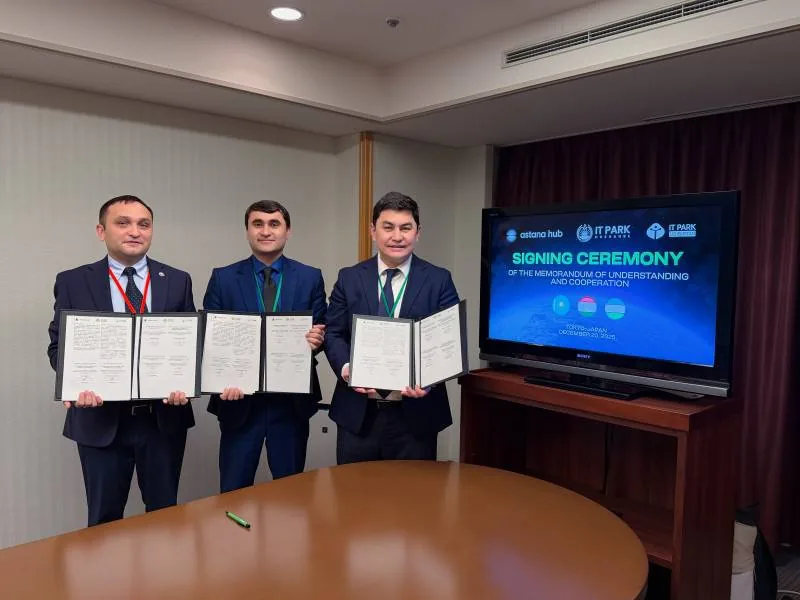
Tajikistan has become a new member of the regional innovation alliance Central Asian Innovation Hubs
Mansur Ismagulov