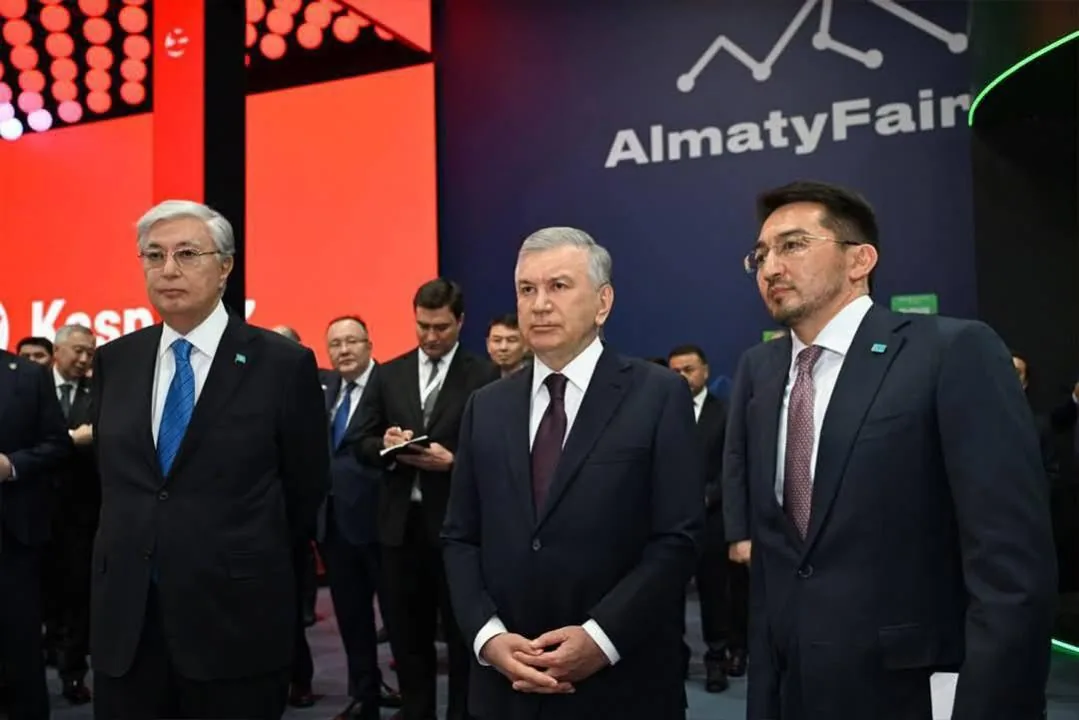
An artificial intelligence ecosystem was presented to the heads of Kazakhstan and Uzbekistan at AlmatyFair.ai
Author - Mansur Ismagulov
The Tech AI
Get the key points in seconds - a short summary from The Tech AI.
At the AlmatyFair.ai exhibition, the presidents of Kazakhstan and Uzbekistan visited the alem.ai center, the National AI Platform, and technology parks. The parties signed a memorandum on the expansion of IT companies into international markets; by 2030, it is planned to create more than eight unicorns and export technologies up to $10 billion. Additionally, the construction of two data centers with a capacity of 200 MW in the Akmola and Karaganda regions was announced, with the participation of GK Hyperscale Ltd.
The AlmatyFair.ai exhibition was attended by the President of the Republic of Kazakhstan, Kassym-Jomart Tokayev, and the President of the Republic of Uzbekistan, Shavkat Mirziyoyev.
Jaslan Madiev, Minister of Digital Development, Innovations and Aerospace Industry of the Republic of Kazakhstan, presented the International Artificial Intelligence Center alem.ai. The center is planned to host the Tomorrow School Junior educational center for students in grades 9-11 and Tomorrow School, which uses a peer-to-peer learning system to train AI specialists based on the 01Edu System platform. Additionally, an AI startup campus for companies participating in incubation and acceleration programs, as well as AI and R&D centers of global technology giants, are planned to be located there.
The heads of state were also presented with the National AI Platform, which allows for the creation of AI assistants without programming skills. Proactive government services and state support measures provided through the social wallet were demonstrated.
Appropriate capacity is required to utilize such AI projects; therefore, two large data centers with a capacity of 200 MW will be built in Kazakhstan, the presidents were told. The data centers will be located in the Akmola and Karaganda regions. The project will be implemented with the participation of the Singaporean company GK Hyperscale Ltd.
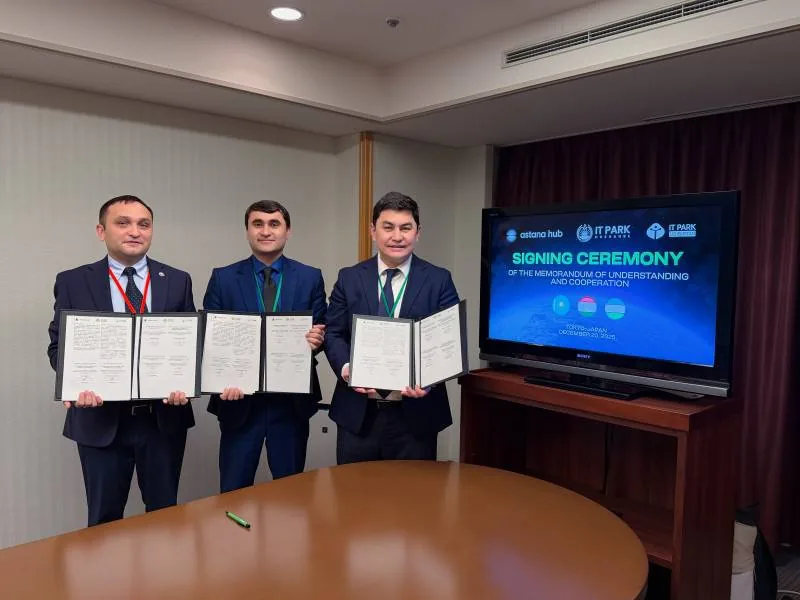
Abdulkhat Kuchkarov, General Director of IT Park Uzbekistan, and Magzhan Madiev, General Director of Astana Hub, presented Central Asian Innovation Hubs — an alliance of the largest technology parks in Central Asia, created to support the region's startup ecosystem. In 2024, technology parks from the two countries united under this brand, promoting innovation on the world stage and presenting more than 40 startups at the INMerge Innovation Summit, Web Summit 2024, and TechCrunch Disrupt 2024. The partnership strengthens regional identity and opens up new opportunities, including a joint hub in Silicon Valley. At the AlmatyFair.ai exhibition, the parties signed a memorandum on the entry of IT companies from Kazakhstan and Uzbekistan into the international market. In 2025, participation in leading international forums and the opening of hubs in the UAE and China are also planned, and by 2030, the creation of more than eight unicorns and an increase in technology exports to $10 billion.
The heads of state were also informed about a large-scale program to train 1 million people in AI skills. Under the world's largest AI program, AI people, 60,000 people in Central Asia are planned to be trained in 2025. Also, under the AI Kyzmet initiative, AI certification for civil servants in Kazakhstan is planned in collaboration with government structures. The AI Corporate initiative, aimed at developing AI competencies in the corporate sector, was also presented.
Promising AI projects demonstrating advanced technologies in various fields were also presented at the exhibition. Higgsfield is developing fundamental AI models similar to those of OpenAI and Anthropic, as well as the mobile app Diffuse for converting text into video. Dereknet presented the Derek Suite platform, which uses AI and mathematical models to create digital twins of deposits. Taisan developed an innovative polymer electrolyte and sodium metal anode, increasing battery energy density at low costs. VR Uniblock presented a next-generation wireless communication system with minimal data transmission latency for critical applications. Codiplay demonstrated an application for teaching children programming in C++, Scratch, and Python through arcade games, combining education and gamification.
The Tech on Telegram Follow The Tech on Telegram
Keep up with the latest technology and startup news.
Related reading



More from this author

News
zypl.ai begins operations in Japan and focuses on next-generation risk models
Mansur Ismagulov
News
Elon Musk's net worth has exceeded $700 billion for the first time
Mansur Ismagulov

Article Interviews
"Central Asian countries should build a joint ecosystem," — Bekhzod Ismoilov on the development of AI in the region
Mansur Ismagulov
Article Interviews
Bloom's Taxonomy and Engineering Levels: A Practical Growth Model
Mansur Ismagulov
Article Useful
How the IT industry in Azerbaijan developed in 2025: key events
Mansur Ismagulov
News
Tajikistan has become a new member of the regional innovation alliance Central Asian Innovation Hubs
Mansur Ismagulov