How to launch a startup in the US: Meruert Sagindyk's experience
Author - Mansur Ismagulov
The Tech AI
Get the key points in seconds - a short summary from The Tech AI.
Meruert Sagindyk, CEO of the startup Tackle, talks about launching a business in the US. The company integrates with calendars and helps agencies track revenue; they have around 400 clients. In Kazakhstan, venture capital investments in 2024 amounted to $71 million, while in the US, they reached billions of dollars.
Meruyert Sagindyk, co-founder and CEO of the startup Tackle, shares her experience launching and growing a business in the US. In a live stream on the Telegram channel The Tech, she discussed key steps in the company registration process, visa selection, and fundraising, as well as shared practical advice for aspiring entrepreneurs.
Meruyert Sagindyk, City — San Francisco, CEO and co-founder of Tackle, Instagram, LinkedIn
About herself and the startup
I am from Pavlodar, received my education in Europe and the US, and am currently fully dedicated to working on the startup. Our startup was founded in the US, and from the very beginning, we focused on the American market.
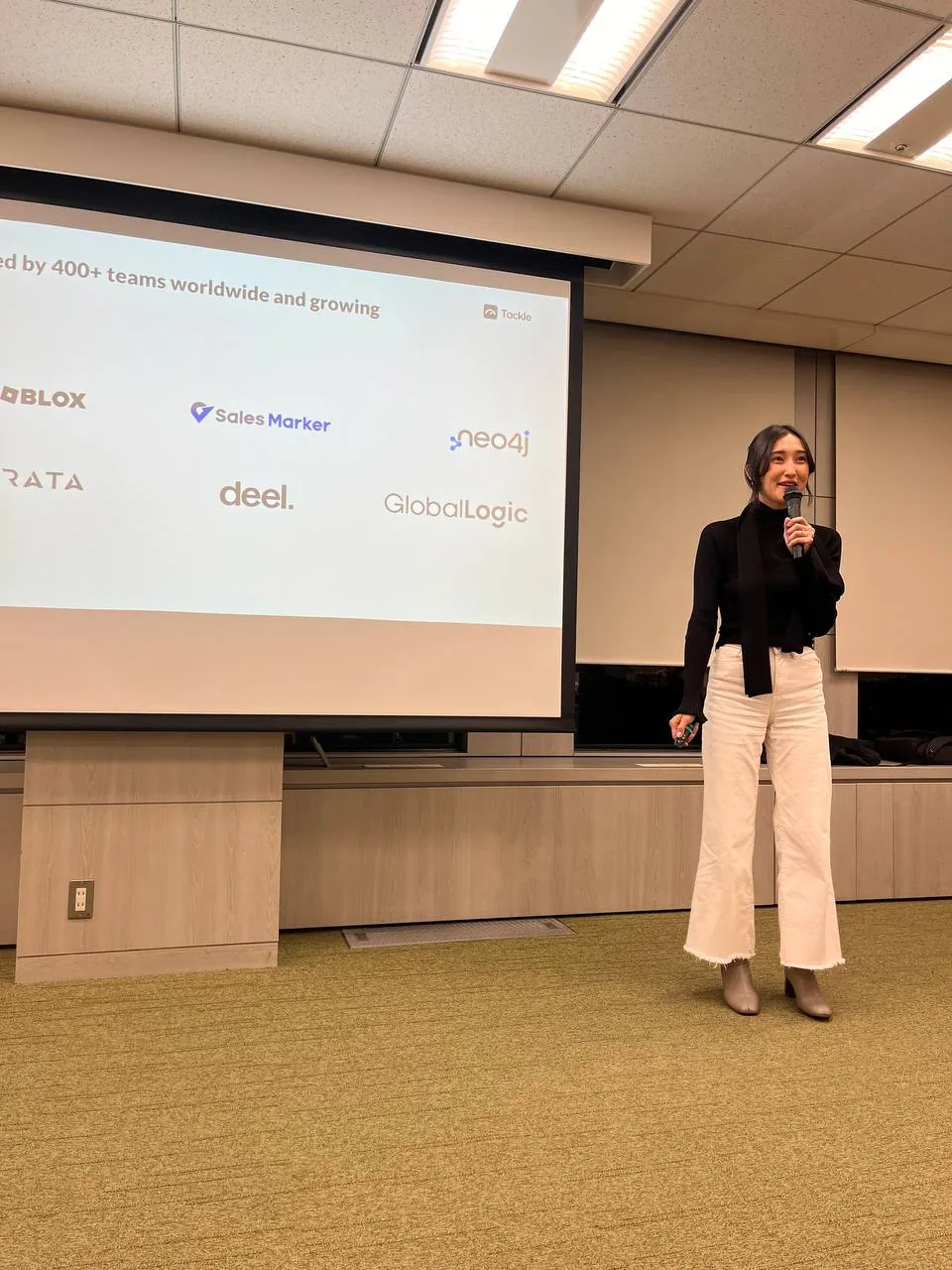
Tackle is a soft product that integrates with calendar workflows, such as Google Calendar. We offer our solution as a browser extension for browsers like Chrome. Our main clients are large companies and startups, but the primary audience is service agencies, including marketing, creative, and legal firms.
The main reason companies use our solution is revenue tracking. Clients can track the time spent on projects or clients, which allows for billing and increases business transparency. The second reason is improving operational efficiency, as users can see which tasks take more time, helping with resource allocation. To date, we have about 400 clients, most of whom are in the US, but we also have clients in Europe and other countries.
About market differences
We started by simply launching the project and then went through the Y Combinator accelerator in Silicon Valley. Also, before launching the startup, I went through the Entrepreneur First accelerator in London. This accelerator invests in people before they start their startup and helps them find a co-founder.
Our startup was launched directly in the US, although I have work experience in Europe, and based on that experience, I can highlight several key differences.

First, the scale of the startup ecosystem is significantly different. In the US, venture capital has existed for decades and originated here, supporting many generations of successful companies. Meanwhile, in Europe and Kazakhstan, venture capital developed much later, especially slowly in Europe, despite the presence of older capital. In Kazakhstan, venture capital began to develop actively only in the last 10 years, leading to a larger number of startups receiving funding. However, in the US, venture capital and fundraising are much easier due to the maturity of the ecosystem.
Silicon Valley is the center of startups from all over the world, with an international atmosphere, unlike Kazakhstan, where Central Asian startup hubs are just beginning to develop, which also opens up new opportunities. In Kazakhstan, business conditions have improved in recent years due to digitalization, while in Europe, processes remain more paper-based.
The main obstacle for startups is correctly assessing the problem and the market. Entrepreneurs often focus on raising capital and building a team, not paying enough attention to evaluating the real need for the solution they offer. It is especially difficult to predict the needs of future markets, for example, considering new technologies such as artificial intelligence. This is one of the most challenging tasks faced by startups worldwide.
About Kazakhstan's startup ecosystem
In recent years, Kazakhstan's startup ecosystem has developed significantly. Initiatives such as Astana Hub and MOST, as well as the growth of venture capital supported by both the state and private organizations, have become important steps forward. A recent report on venture investments in Central Asia confirms the growth in the number of business angels investing in startups, which is a positive factor for the market.
Silkroad Innovation Hub operates in Silicon Valley—an initiative helping entrepreneurs from Central Asia enter the US market. Such hubs play a key role in simplifying startups' entry into foreign markets and expanding business opportunities.
Kazakhstan is experiencing population growth and a high birth rate, which contributes to the formation of a young generation that will drive the economy and the startup ecosystem. Young people are actively adopting new solutions, opening up opportunities for startups and the creation of a qualified workforce.
For further development of the startup ecosystem, it is necessary to:
— develop knowledge and skills among young people through courses, bootcamps, and accelerators, as well as mentoring programs with experienced entrepreneurs
— attract both local and foreign investors to create new opportunities for startups and cooperation with large corporations
— create state initiatives, such as tax incentives, to stimulate demand for startups and ensure their growth.

Features of the US market and what is important to consider
It is also important to highlight two key aspects. The first is the market size and customers' willingness to work with new startups. In the US, there is a high propensity to cooperate with innovative companies, which is related to a culture that values novelty and progress, as well as the concept of the "American Dream," where entrepreneurs receive support and admiration. In Europe, the attitude towards new initiatives is often more skeptical.
The US market has significant advantages: a high concentration of talent, experienced mentors, and a wide choice of advisors, which plays an important role in supporting startups. When we started entering the American market, our strategy was simple. We created an MVP that allowed users to download calendars in another format, launched it on platforms like Hacker News, and began attracting users. Initially, the product was free, and we noticed interest from American users.
Then we added the ability to pay, conducted market research, and found out who might use our solution and why. This allowed us to gradually enter the market.
Regarding bureaucratic processes, everything is simplified in the US thanks to digital infrastructure. We registered the company, Time Tackle Inc., and the process turned out to be fast and simple. Most startups begin registration in Delaware, where the tax and legal systems are most favorable for entrepreneurs. Everything can be done online in a few days: register the company, create a website, and integrate a payment system via Stripe. However, finding a real problem in the market and scaling the solution is a much more difficult task.
The company registration process in the US begins with choosing a state. We chose California because the office is located in Silicon Valley. To work in this state, you need to obtain a business license. It is important to note that legislation in each state may differ.
After registering the company, an individual number is assigned for accounting and reporting. An important aspect is taxation. We work with the tax side, but I recommend understanding this area yourself, as state requirements may differ.
To raise capital in the US, there are two paths: a formal process and a Simple Agreement for Future Equity (SAFE). This process simplifies raising funds from investors. Investors sign an agreement, agree on the startup's valuation and the share they will receive. After that, they transfer money to the company's business account.
Additionally, when opening a business, it is important to consider such points as opening a bank account and preparing the necessary documents, including proof of company registration.
Although bureaucratic procedures may seem complex, in reality, everything can be done quite quickly thanks to the developed digital infrastructure. For this, you can use various online services, for example, for insurance or filing tax returns. AI also helps significantly simplify this process.
Regarding business culture in the US, it is worth noting that the emphasis is on sales and relationship building. Americans often talk about their startups and projects, even if they are only in the early stages. It is important to learn how to build your story, present ideas, and communicate effectively with investors and clients. In addition to technical knowledge, it is important to develop soft skills, such as communication and the ability to build business relationships.
One of the main obstacles for startups in Kazakhstan is the lack of investment for creating innovative companies with a decent valuation. In 2024, the volume of venture investments in Kazakhstan startups was $71 million, while in the US, investment scales are measured in billions of dollars. This makes it difficult to attract capital from foreign investors and complicates business development.
There is also a trend in Kazakhstan where startups receive lower valuations. In the US, investors take a smaller share, allowing founders to retain a larger portion of their company and more easily motivate employees and co-founders.
Cultural differences also affect the success of startups. For example, at the Pre-Seed stage, investors in the US and Europe focus on a strong team and market prospects. It is important to be able to create a strong storytelling that convinces investors of the team's competence.
To attract investors' attention, it is necessary to carefully build your story, for example, by demonstrating experience in a specific industry or field. This allows investors to feel that the team truly possesses unique competencies and an approach that can be successful in the chosen niche.
To attract investors, you need to carefully build your story, showing experience in a specific industry or field. This will help convince investors of the uniqueness of the team's approach. It is also important to set target deadlines to create a sense of urgency and competition among investors, which accelerates decision-making.
Plans
In our company, we have found a promising niche by working with agencies and professionals providing hourly services, including highly qualified specialists and lawyers. This direction allows us to offer solutions ideally suited to their needs. We have already signed several major contracts.
Currently, we are actively developing our product, refining it to maximize satisfaction of this niche's needs. Creating a truly outstanding product is a complex process, and it is important to remember that its real value will be assessed by the market only with proper monetization. We strive to find a balance between quality and price, which helps us more accurately assess the pain points of our market.
Our goal for this year is to triple sales, and for this, we do not require external investments, as current revenues allow us to independently finance development. However, for further growth, we are considering the possibility of attracting investments. The key for us remains a focus on one niche, which allows us to concentrate on developing a high-quality product. In the future, we may expand our activities, but at this stage, our main priority is improving efficiency in the current niche.
Recommendations
The key point is the ability to correctly assess market needs. An incorrect assessment of the problem can lead to working on a solution that is not in demand. The most effective way to assess this is to try to sell the solution immediately. In America, they say "put a dollar behind it," meaning you need to understand how much people are willing to pay for the solution: is it a $10 problem or a $1000 problem.
Evaluating the pain and its size is, perhaps, the most important aspect. Sometimes at the start, it is impossible to determine exactly how much will be paid for it, but if, for example, a product interests a company CEO, this is already an indicator of the problem's significance. It is important to measure the intensity of the pain, understand how critical it is, and set appropriate metrics—how much time a client is willing to spend on a solution and how much they are willing to pay.
Sometimes startups start by selling services and then, having studied the market, move to a product. This path is not always effective, but there are successful examples when a service company turned into a product startup.
The Tech on Telegram Follow The Tech on Telegram
Keep up with the latest technology and startup news.
Related reading







More from this author

News
zypl.ai begins operations in Japan and focuses on next-generation risk models
Mansur Ismagulov

News
Elon Musk's net worth has exceeded $700 billion for the first time
Mansur Ismagulov

Article Interviews
"Central Asian countries should build a joint ecosystem," — Bekhzod Ismoilov on the development of AI in the region
Mansur Ismagulov

Article Interviews
Bloom's Taxonomy and Engineering Levels: A Practical Growth Model
Mansur Ismagulov

Article Useful
How the IT industry in Azerbaijan developed in 2025: key events
Mansur Ismagulov

News
Tajikistan has become a new member of the regional innovation alliance Central Asian Innovation Hubs
Mansur Ismagulov