How Benchmark is structured — a venture fund that doesn’t want to scale its investments
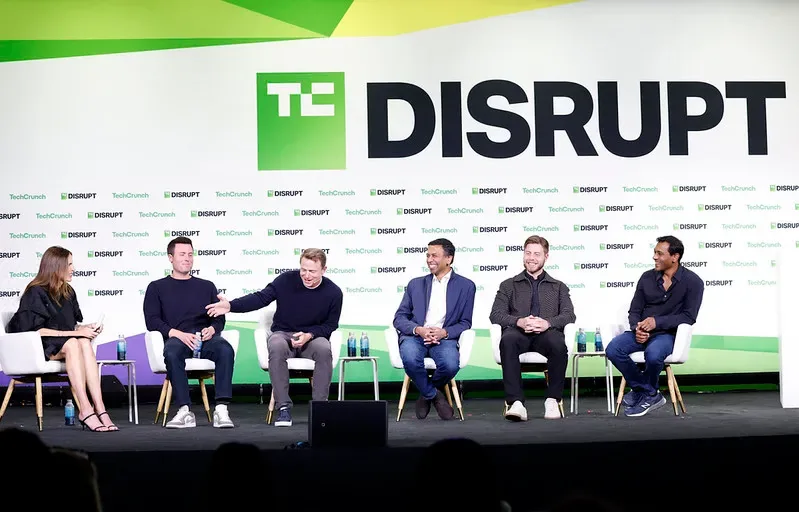
Benchmark raised $2 billion, but each partner still makes only two or three new investments per year. At TechCrunch Disrupt 2026, the firm's partners explained why the company has no intention of chasing its competitors' pace, how the venture capital market is changing in the age of AI, and why the most important tools for investors remain human relationships and personal intuition.
The Tech AI
Get the key points in seconds - a short summary from The Tech AI.
Venture fund Benchmark announced two new funds totaling $2 billion, including a growth fund of $1.25 billion. All five general partners—Peter Fenton, Eric Vishria, Chetan Puttagunta, Ev Randall, and Jack Altman—made their first appearance at Disrupt. The fund invests in early-stage startups, working with founders for 10–15 years, and makes only two to three deals per year.
Benchmark — one of the most well-known venture capital firms in Silicon Valley. All five of its general partners took the stage at Disrupt for the first time: Peter Fenton, Eric Vishria, Chetan Puttagunta, Ev Randall, and Jack Altman.
Big money is not a reason to change the rules of the game
In the summer, Benchmark announced two new funds totaling $2 billion. In its 31-year history, this is only the second time the firm has deviated from its usual practice of raising significantly smaller funds.
According to Peter Fenton, despite the increase in the size of the core fund, the principles of operation have not changed. Benchmark enters companies at the very beginning and works with founders for 10–15 years, so this kind of work cannot be scaled. The core fund of $500 million had not changed for 20 years and was only recently increased to account for inflation, so that it would correspond to current economic conditions. Fenton admits: not doing this earlier was a tactical mistake. At the same time, the new growth fund of $1.25 billion allows expanding the scope of activities and not limiting oneself to the core business at early stages.
Peter Fenton, General Partner at Benchmark
If the fund turns out to be successful, one or two investments will provide 90% of the returns. Therefore, I think we are talking about four to six, possibly seven or eight investments.
Meetings without an agenda and deals without voting
One of the most unusual features of Benchmark is the lack of a formal agenda at weekly partner meetings.
Eric Vishria, General Partner at Benchmark
The lack of an agenda at our meetings is a rather strange convention. In essence, our conversation never stops. In times of rapid change, we try to understand what has become possible now, although it was impossible just six months ago. We discuss which companies we are meeting with, what has attracted our attention and why, as well as what we notice at board meetings. One could try to systematize this process, but one of the advantages of a five-person team is that this is not required.
Partners do not even have clear rules about whether one person can block a deal. Altman explains this simply: the fund closes only two or three deals a year, so it does not need a complex decision-making system. If there were hundreds of investments, it would be necessary to use a CRM and conduct voting.
Fenton emphasizes that Benchmark is not a Shark Tank show, where investors evaluate entrepreneurs and decide whether to invest in them. Everything here is built on personal trust: if a partner does not like a founder, the founder will feel it, and good working relationships will not develop.
Why new partners chose Benchmark
Ev Randall, who previously worked at Founders Fund, Bond, and Kleiner Perkins, was attracted by the opportunity to work in a small team where decisions are made without unnecessary procedures, and partnership is built on mutual trust and respect. According to him, it is these kinds of relationships that allow for open discussion of ideas and faster decision-making.
Jack Altman raised a second fund of $275 million for his own firm a year ago, but at Benchmark he values the opportunity to learn together with a group. He did not have any onboarding. Senior colleagues only advised him not to worry about the first deal: in venture capital, rare big wins decide everything, and it is unlikely that the first one will be the main one. Since February, Altman has already invested in chips, robotics, and infrastructure.
AI market: conflicts, IPOs, and talk of a bubble
Conflicts. AI companies are developing so rapidly that the boundaries between their markets are gradually blurring. Ev Randall admits that under such conditions, conflicts of interest become almost inevitable. According to him, Benchmark’s commitment to a founder is not just an investment, but a willingness to work together over the long term, maintaining confidentiality and trust. At the same time, the rapidly changing market constantly creates new points of contact between companies.
Chetan Puttagunta believes that in the AI era, such situations will arise more and more often. The development of new products is becoming cheaper, which means entrepreneurs have more opportunities for experimentation and entering adjacent markets.
IPO. The Cerebras story shows how unexpected decisions can be in the venture business. Benchmark invested in the AI chip developer as early as spring 2016, although for about 10 years prior to that it had not invested in hardware. According to Eric Vishria, the company’s idea initially seemed unusual even within Benchmark itself. Peter Fenton initially considered this investment contrary to everything he had learned during his years in venture capital, but after the founders’ presentation, he changed his mind.
For Fenton, it is exactly such projects that are of special interest: companies that go against accepted notions and cause controversy.
However, going public creates new risks for such companies. Vishria reminds us that technology company stocks can change value sharply even over a short period. As an example, he cites Cerebras: the offering price was $185 per share, then it rose to $350, and later returned to the initial level.
In this context, an IPO is not only a way to obtain a public valuation but also a tool for raising funds. Vishria emphasizes that for companies that need billions of dollars for development, the ability to raise additional capital is crucial.
Bubble. The question of a possible bubble in the artificial intelligence market is becoming increasingly acute. High company valuations, huge spending on computing infrastructure, and expensive borrowing are making investors think about the likelihood of a serious correction. One of the reasons for concern was the bankruptcy of Character.AI. However, Ev Randall believes that viewing this story as an unambiguous signal of problems across the entire industry would be a mistake. According to him, by the time the company faced financial difficulties, its founders and a significant part of the team had already left for Google, and the company itself was sold for $2.3 billion.
Randall sees the market’s reaction more as a problem of the information environment than as proof of a systemic crisis in AI.
Why San Francisco is still at the center
San Francisco attracts AI companies not only with access to funding. Its main advantage is a dense professional environment in which entrepreneurs, investors, and specialists constantly interact, share experience, and help each other develop their businesses.
At the same time, as Jack Altman notes, physical presence in the city is not a mandatory condition for success. Rather, San Francisco remains a place where many processes of AI company development occur faster due to the already formed ecosystem.
Ev Randall, General Partner at Benchmark
Iron sharpens iron. If you want to be around people who are your equals and who will help you become the best version of yourself, it is hard to imagine a city that, in the current era of AI development, would handle this task better than San Francisco.
What this means for founders in Central Asia
Attention from a large fund is rare. A Benchmark partner makes two or three deals a year. To be among them, a good pitch is not enough. The fund chooses people with whom it is ready to work for 10–15 years, so personal contact and trust decide a lot.
Presence in the Valley is still important. Almost all strong companies that Benchmark partners see open an office in San Francisco or spend a lot of time there. For founders from the region, this means one thing: you need to be where decisions are made.
A strong team can convince an investor. Benchmark did not invest in “hardware” for 10 years, but supported Cerebras after one meeting. The Cerebras story shows that funds take on such projects if they see strong founders.
AI requires big money. AI companies lack computing power, and growth requires large rounds. Founders should understand in advance how much capital will be needed and where to find it.
Useful skills for an investor in the AI era: while the market tries to separate the real prospects of AI from the noise around it, investors have to simultaneously take technological risks, monitor financial performance, and remain ready for sharp changes. And, judging by the words of Benchmark partners, the ability to distinguish these things is becoming one of the main advantages in the current AI race.
The Tech on Telegram Follow The Tech on Telegram
Keep up with the latest technology and startup news.
Related reading



More from this author

News
Now in ChatGPT, you can hide conversations with a PIN code or Face ID
The Tech

News
Anthropic has introduced Claude Duet, a personal AI agent for business
The Tech

News
Autonomous taxis from inDrive, Pony.ai, and NVIDIA will appear in Astana
The Tech
Article Useful
How to choose a startup accelerator: what programs offer besides investments
The Tech
News IT
AICONF-2026: NVIDIA, OpenAI, and SpaceXAI will come to Dushanbe
The Tech

Article Startups
How a startup from Baku combined more than 30 AI tools for moms into one app
The Tech