How did the 10th International EdCrunch Conference 2023 go?
On November 15-16, the two-day large-scale EdCrunch X conference took place in Almaty.
Author - Mansur Ismagulov

The Tech AI
Get the key points in seconds - a short summary from The Tech AI.
The EdCrunch X conference took place in three locations in Almaty, bringing together over 5,000 participants from 25 countries and more than 120 speakers. The event covered tracks on early childhood education, school and higher education, corporate training, and EdTech. Key topics included the implementation of artificial intelligence, higher education reform, and new methods for assessing skills.
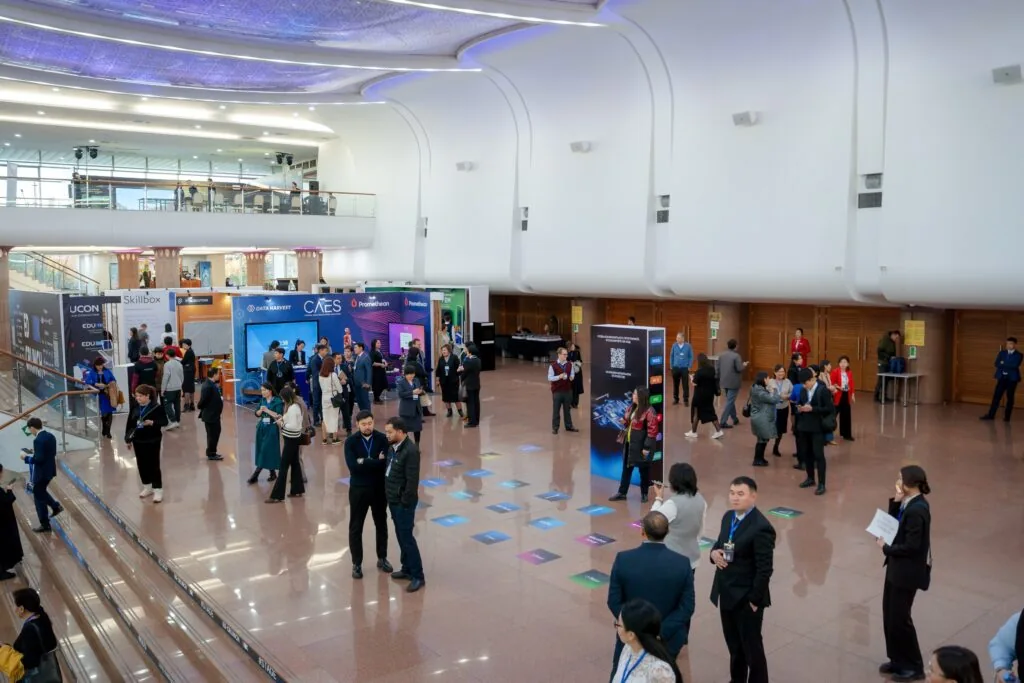
The conference brought together more than 3,000 participants, including preschool educators, teachers from state and private schools, higher education faculty members, and corporate trainers and trackers. EdCrunch X took place simultaneously in three locations within walking distance of the Palace of Republic, the Kazakhstan Hotel, and Caspian University.
The first speaker at the event was Sayasat Nurbek, Minister of Science and Higher Education of the Republic of Kazakhstan. In his speech, the minister detailed the transformations in higher education and the measures being taken to ensure quality, equitable education for every Kazakhstani citizen. To this end, efforts are underway to activate scientific research and transform Kazakhstani universities into centers for preserving socio-humanitarian knowledge and culture.
Discussions and panel sessions covered technologies, systems, methods, and necessary resources for developing quality education, ensuring equal access to it, and integrating artificial intelligence into the educational process.
The conference program was organized around the main tracks of human development: early childhood, school education, higher education, corporate training, and EdTech. Below are some key takeaways and thoughts from the EdCrunch speakers.
Track: Early Childhood
Attendees on this track included educators from preschools, kindergartens, and centers. They discussed options for child development and adaptation.
Anna Yakshina from Russia, Junior Researcher at the Institute of Urbanism and Global Education at Moscow State Pedagogical University (MGPU), spoke on the topic “Architects of the Future: How to Unlock the Magical Chest or Do Future Inventors Grow Up in Our Kindergartens?”
Adults want to eliminate uncertainty. However, we need to prepare children to face uncertainty and ensure that it is not destructive for them,” says Anna Yakshina.
The speaker also believes that through play, children learn to create and assign meaning to things. Adults should not impose anything. For imagination to develop, there must be space for invention.

Track: School Education
Participants discussed the application of artificial intelligence, virtual reality, blockchain, and other tools to enhance the quality of education. They also reviewed successful practices and projects already implemented in various educational institutions. This included new teaching methodologies, subject-specific courses, and assessment systems that stimulate student development.
Artificial intelligence will not change the world on its own; only teachers can achieve this with its help,” asserts Ben Furman, a psychotherapist from Finland, founder of the Helsinki Institute of Short-Term Therapy, and author of over 30 books on psychology.
Learning with AI is like learning with a best friend or an enemy. You need to ask the right questions and not trust everything you hear,” shared Ysıl Boy Ergül from Turkey, founder of ETZ Technology & TeacherX.
Notably, alongside scientists, ministers, and educators, children, school students, university students, and youth also took the stage, offering their proposals and sharing their views with adults. After all, children are the ultimate consumers of educational services.
Track: Higher Education
At Minerva, we built a system ten years ago that leverages all the advantages of artificial intelligence. We hope that universities worldwide will be able to do the same,” reports Ben Nelson from the USA, founder, chairman, and CEO of the Minerva Project, and Honorary Rector of Minerva University.
In his speech titled “The Future of Universities or How to Meet Rising Expectations,” Suzanne Alice Walsh from the USA, President of Bennett College, proposed implementing video games during university admissions interviews. She believes that assessing a candidate’s skills through video games reveals many character traits: teamwork, focus, and responsibility. The college representative asserts that this game-based approach to problem-solving demonstrates how a candidate will handle tasks in the workplace.
Track: Corporate Training
Training today permeates all levels of an organization. The tasks of Training & Development (T&D) extend far beyond merely transferring knowledge or skills. Training is part of the ecosystem, part of business strategy, and an opportunity for collaboration and partnerships. At the same time, one of the key objectives is employee development. Therefore, much discussion focused on technologies and tools, as well as concepts and approaches.
Paul Matthew from the UK, architect of the educational platform “People Alchemy” and an expert in corporate training, shared the following thoughts:
A brand is something you cannot lose; a partnership is like a marriage—if partners do not interact, nothing will happen. A big fire starts with a small campfire, so in T&D partnerships, it is important what the other party thinks of you. Therefore, you must speak the same language as business owners.
Track: EdTech
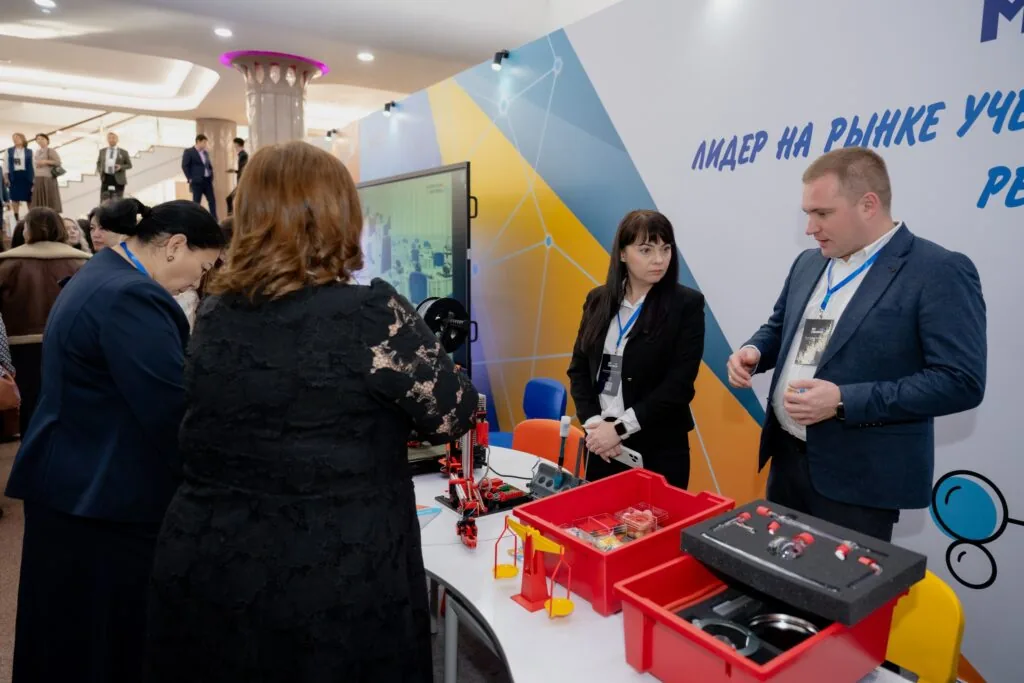
Artificial intelligence was discussed on this track. Speakers concluded in one of the panel sessions that AI should be viewed as an assistant and is by no means dangerous. On the contrary, it is a tool that, once mastered, allows you to use it to solve routine tasks.
In his speech, Dale Johnson from the USA, Director of Digital Innovation at the Institute of Design at Arizona State University, stated:
“I don’t like that artificial intelligence uses data for training from the entire web, including ours. They steal it for their own interests. Has anyone received a bill?” the speaker asked.
Conclusions
In total, more than 120 speakers presented at EdCrunch X, including key representatives of the education sector such as Tom Hobson, Kristof Fenyvesi, Serik Irsaliyev, Kamila Rollan, Zhanseit Tuimebayev, Douglas Lynch, Assi Gol, Victoria Feldman, Mukhitden Ulykbek, Nadezhda Galkina, and many others.
Over two days, the conference was attended by more than 5,000 participants from 25 countries. It served as a community for educators, teachers, and professors, providing them with the opportunity to exchange experiences and gain new knowledge.
EdCrunch is the largest conference on new technologies in education, held since 2014. Over ten years, the conference has brought together IT specialists, developers, teachers, parents, companies, and startups in the EdTech sector. EdCrunch has become a global driving force in education, gathering more than 1,500 recognized experts from 35 countries.
This year, the conference was held with the support of:
— General partners: EA Group Holding, QS University Rankings, Minerva University, Abay National Cuisine Restaurant, Sabi Private Charitable Foundation
— Official partners: AITAS Holding, FURO Education Sustainable Development Foundation, Skillbox Holding, JUZ 40, Design Thinking Center Asia, Koktobe Recreation Park
— Partners: ETU, LENOVO, Caspian University
— Intellectual partners: Ingenious Faces, Singapore Education Network, SYSTEM Foundation, Teacher X, Smart Ranking, GLOBAL NOMAD, KLIMENT-CONTENT, GAUKHAR KIIKOVA, KazAELT, EduSteppe, PENN CLUB.
Organizers: Almaty City Akimat, Ministry of Science and Higher Education of the Republic of Kazakhstan, Ministry of Digital Development of the Republic of Kazakhstan, Ministry of Science and Higher Education of the Republic of Kazakhstan, Education Sustainable Development Foundation, AMAN SULTAN.
The Tech on Telegram Follow The Tech on Telegram
Keep up with the latest technology and startup news.
Related reading






More from this author

News
zypl.ai begins operations in Japan and focuses on next-generation risk models
Mansur Ismagulov

News
Elon Musk's net worth has exceeded $700 billion for the first time
Mansur Ismagulov

Article Interviews
"Central Asian countries should build a joint ecosystem," — Bekhzod Ismoilov on the development of AI in the region
Mansur Ismagulov

Article Interviews
Bloom's Taxonomy and Engineering Levels: A Practical Growth Model
Mansur Ismagulov

Article Useful
How the IT industry in Azerbaijan developed in 2025: key events
Mansur Ismagulov

News
Tajikistan has become a new member of the regional innovation alliance Central Asian Innovation Hubs.
Mansur Ismagulov