How to Get a Job in Germany After 100 Rejections: Adlet Balzhanov on Starting a Career in IT
Senior Software Engineer on how to handle failures, choose your first job, and use AI as a tool for enhancement, not a threat.
Author - Mansur Ismagulov

The Tech AI
Get the key points in seconds - a short summary from The Tech AI.
Adlet Balzhanov, a senior software engineer at Delivery Hero in Berlin, works on high-load systems processing over 10 million orders daily. He graduated from KBTU and NIS FMN, participated in ICPC olympiads, and got his first job at Aviata.kz after an internship at Yandex. The author of the blog The True Engineer advises using AI as a tool, seeking mentors, and choosing a workplace based on the speed of learning.
Adlet Balzhanov, city — Berlin, Senior Software Engineer, Linkedin
About me
I grew up in Karatau, a small town in the Zhambyl region. I graduated from the NIS FMN school in Taraz, where I built a strong foundation in exact sciences. Later, I enrolled at the Kazakhstan British Technical University, majoring in "Computer Engineering and Software" — it was there that I wrote my first line of code. During university, I actively engaged in competitive programming and participated in international student ICPC olympiads. These competitions significantly strengthened my algorithmic and engineering fundamentals, which became a solid foundation for my professional growth.
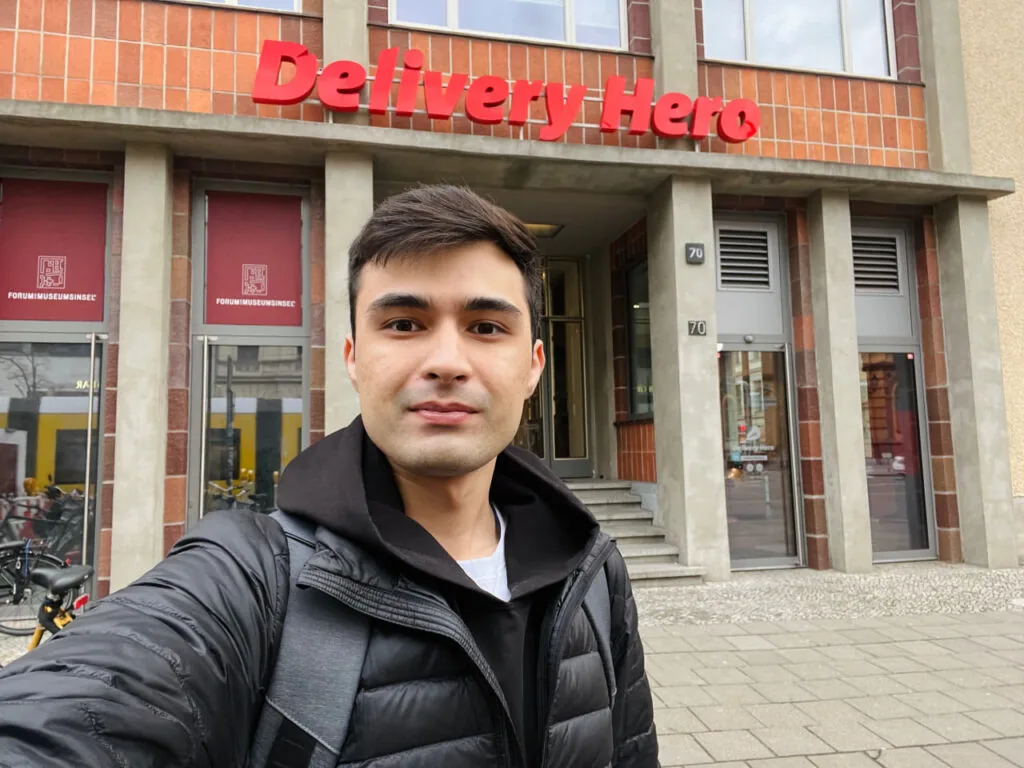
For the past three years, I have been living and working in Berlin. I am a Senior Software Engineer at Delivery Hero, a global company in the FoodTech sector, whose portfolio includes brands such as Glovo, Talabat, Foodpanda, Foodora, PedidosYa, and others. I develop high-load systems that help our users place over 10 million orders daily worldwide — from logistics and ordering to the platform's internal infrastructure. In addition to my main job, I actively run my blog The True Engineer www.thetrueengineer.com, helping experienced engineers grow quickly and effectively in their careers.
About my first IT job
My first full-time job was a Junior Software Engineer position at Aviata.kz. I was 20 years old. I chose this company because it was the market leader for selling airline tickets in Kazakhstan — and I was looking not just for my first job, but for a place where I could grow quickly and learn a lot. Regardless of the starting salary, I was focused on gaining experience — and I was right: it was at Aviata.kz that I gained the experience that became a springboard for my further career.
For me, the most important factor when choosing my first job was the speed of learning. I saw that strong specialists worked at Aviata.kz, and despite the fact that it was a small company, I understood: if I learned from them, I would be competitive not only in the local but also in international markets. The company already had scale and a clear mission. This gave me the opportunity not just to write code, but to see how my work influenced the business and customers.
The selection process consisted of three steps:
1. A home assignment — a small project to demonstrate practical skills.
2. A technical interview with engineers — we discussed architecture, algorithms, and approaches to problem-solving.
3. A short interview with the CTO — focused more on checking values and overall cultural fit.
About challenges
Starting from my second year of university, I actively applied for internships at foreign companies. There were over 100 rejections — and that is absolutely normal. My logic was simple: if I got an internship abroad, I would definitely be able to get a good offer in Kazakhstan. And in the end, it worked out. After my third year, I was accepted into "Yandex," in the Moscow office, for an internship in the "Yandex.Search" team. This experience turned out to be decisive — I worked with production code in Python and C++ for the first time, in a team of true professionals. This gave me my initial boost.
Since I already had an internship at a foreign company, finding my first job in Kazakhstan was not difficult.
The hardest part was learning how to pass interviews. Universities teach technical skills, but not how to structure answers correctly, how to understand what the interviewer wants to hear, and how to "sell" your experience. This is a skill that comes only with practice. The main thing is not to give up and draw conclusions after each stage. The more interviews you do, the higher your chances. Interviewing is a separate competency that needs to be trained.

3 tips that will help you find a job in IT
1. AI is not a threat, but an amplifier. Artificial intelligence will not replace programmers; it will replace those who do not know how to use it as a tool. The best developers already use AI to generate code templates, debug, and find solutions. Master it, experiment — and you will become 10 times more productive.
2. Seek advice from those who are two to three years ahead of you in your career. They still have fresh memories of their first steps, but already have practical experience. These are the best mentors because they speak "your language." Do not be afraid to write to them on LinkedIn or talk to them at conferences — most are happy to help.
3. Choose internships and your first job not by brand, but by the speed of learning. At the beginning of your career, it is important to get into an environment where you grow quickly. This is an investment that will pay off many times over. Do not be afraid of startups or small teams — often it is there that you get real battle-tested tasks, rather than being assigned documentation.
The Tech on Telegram Follow The Tech on Telegram
Keep up with the latest technology and startup news.
Related reading







More from this author

News
zypl.ai begins operations in Japan and focuses on next-generation risk models
Mansur Ismagulov

News
Elon Musk's net worth has exceeded $700 billion for the first time
Mansur Ismagulov

Article Interviews
"Central Asian countries should build a joint ecosystem," — Bekhzod Ismoilov on the development of AI in the region
Mansur Ismagulov

Article Interviews
Bloom's Taxonomy and Engineering Levels: A Practical Growth Model
Mansur Ismagulov

Article Useful
How the IT industry in Azerbaijan developed in 2025: key events
Mansur Ismagulov

News
Tajikistan has become a new member of the regional innovation alliance Central Asian Innovation Hubs.
Mansur Ismagulov