How corporate venture capital helps investors and startups
What is corporate venture capital, what benefits does it bring to Kazakhstani companies, and what do startups gain from it? Gani Kasymov, investment partner at EA Ventures, explains.
Author - Mansur Ismagulov

The Tech AI
Get the key points in seconds - a short summary from The Tech AI.
In 2023, Kazakhstan led Central Asia in venture investment volume ($80 million), surpassing Georgia and Uzbekistan. The number of startups in the region grew from approximately 1,000 in 2018 to approximately 6,000 in 2023. Corporate venture capital (CVC) enables companies such as EA Ventures and Freedom Holding Corp. to invest in projects to advance technologies and the ecosystem, gaining strategic advantages and access to innovation.
Gani Kasymov, EA Ventures
In Kazakhstan, there are an increasing number of companies practicing CVC investments, or corporate venture capital (CVC). For large organizations, this is one of the ways to grow and adapt in the constantly evolving business landscape, while startups receive not only funding but also mentorship and the opportunity to enter new markets.
I would note that the venture market in Central Asia is growing actively, and Kazakhstan is the leader in the volume of venture investments in the region. According to the latest research conducted by Rise Research, BGlobal Ventures, and EA Group, in 2023, Kazakhstan took first place in the total volume of venture investments at $80 million. For comparison, Georgia holds second place with $21.6 million, and Uzbekistan is currently in third place with $6.3 million. The prospects for market growth are also confirmed by the number of startups in our country: if there were about 1,000 startups in the region in 2018, there were already about 6,000 in 2023.
What is CVC
Corporate Venture Capital (CVC) is a form of investment carried out by large companies through their own investment divisions. That is, corporations create their own funds and invest in startups through them. One such example is our EA Ventures division within the EA Group holding. Within EA Ventures, we have invested in Kazakhstani projects such as S1lkpay, Hero’s Journey, and Parqour.
There is an important feature: although any investors expect to recoup their investments, in the case of CVC, both sides are focused on technology development and ecosystem formation. A large company receives ready-made solutions useful to itself through partnerships with specialized startups, while the startup itself receives resources for growth.
There are fundamental differences between traditional venture capital funds (Venture Capital, VC) and corporate venture capital (CVC). VC usually pools capital from a group of investors who invest in projects and expect to sell their stake later at a higher price. The focus of VC is on rapid revenue growth and business scalability.
In the case of CVC, the funds are not personal but corporate, so startups can potentially receive much more resources for development than when cooperating with a group of private investors. The main goal is also different — not direct financial profit, but strategic benefit for the company that formed the fund. Therefore, the selection of projects for investment is more specialized; it must align with the strategy and the technologies currently needed by the parent company.
What investment companies and startups receive

There are many advantages for investors in CVC, here are a few:
— access to trends. CVC allows tracking trends, conducting technological scouting, and improving the process of internal research and development.
— attracting talent. Following from the first point: searching for useful technologies also leads to talented personnel. This is possible through special formats such as incubators and accelerators.
— financial benefit. This refers not only to the recoupment of investments but also to savings on internal research.
— market expansion. The investing company gains the opportunity to enter new markets through the implementation of technologies, while startups gain access to resources and attract attention through partnerships with a major player.
Corporate venture capital is also useful for startups for development. Here is what a startup founder receives:
— evaluation of startup potential. Startup founders will be helped to assess the viability of the project, identify growth points, and receive resources for its refinement.
— communication with top experts in the field. Communication with mentors can give a serious boost to project development. In the case of cooperation with CVC, the startup founder gains direct access to the best experts. They can provide professional advice on project development.
— new clients and markets. This refers to access to client databases and supply channels. CVC can become a source of new clients, help enter new markets, and often the investing company itself can be the customer.
— participation in special investor programs. Large companies often launch special programs to support startups. They may include individual terms of cooperation with third-party companies, additional conditions for startup development, and assistance from third-party experts. By cooperating with CVC, a startup can also take advantage of this option.
— a "life jacket". If something goes wrong, for example, if the startup founder decides to abandon the project or the project team disbands, the investor can buy out the project. This minimizes the loss for the startup founder itself.
Despite all the benefits, there are also drawbacks for startups in CVC that are important to consider:
— risk of investor interference in management processes and decision-making
— possible divergence of strategic goals
— formation of dependence on the investing company
— reduction of the founders' share in the project.
To minimize risks, it is important for a startup to evaluate in advance how its goals align with the investor's plans, learn how the investor operates, and agree on boundaries.
What CVC investments look like in practice
How CVC ensures technological cooperation can be assessed using examples from global practice. For instance, Intel's corporate venture fund actively invested in companies developing software and hardware for video, audio, and graphical computing. Data processing speed correlated with the processor's computing power. Thus, purchasing this company's products led the client to purchase Intel processors. These are so-called developmental investments.
Another good example with the same Intel: the company invested $45 million in Docusign, a platform for electronic document signing. At that time, the startup's capitalization reached $3 billion; now it is four times higher, at $12.2 billion.
Another bright example: Qualcomm Ventures was among the first to invest in Zoom. At that time, the valuation of the video calling service was $9.2 billion, and the current market capitalization exceeds $19 billion.
The role of CVC for the market
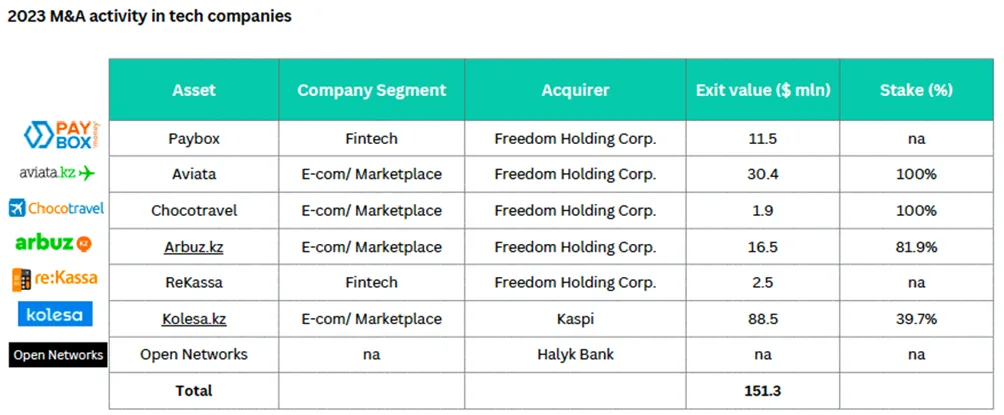
It is hard to argue with the fact that CVC investors influence the economy. They contribute to the development of innovations and the formation of an ecosystem in their field of specialization. Kazakhstan is no exception. A vivid example is Freedom Holding Corp. According to statistics on mergers and acquisitions in the technology sector for 2023, they conducted five out of seven major deals.
Timur Turlov, CEO of Freedom Holding Corp., speaks about the organization's strategy: "We tried to strengthen our ecosystem and utilize the potential of all data. The integration of government and commercial databases had a significant impact. Investments also provided access to highly qualified talents in the country."
Conclusions
Corporate venture capital is an effective tool for technology development. The investing company gains the opportunity to use the latest products while minimizing research costs, and the startup is provided with all necessary resources for growth, from funding to expert consultations and assistance in entering new markets.
There are certain risks for startups in CVC cooperation: investors may try to excessively influence the project management's decisions, and potential problems may arise from possible divergence of strategic goals. Therefore, it is important to evaluate the investor's plans and working style before closing the deal.
CVC has a significant impact on the economy by stimulating innovation. Considering that the number of startups in the Central Asia and Caucasus region is growing, and the volume of CVC deals is increasing, there remains great potential for cooperation between major players and small projects in this field.
The Tech on Telegram Follow The Tech on Telegram
Keep up with the latest technology and startup news.
Related reading







More from this author

News
zypl.ai begins operations in Japan and focuses on next-generation risk models
Mansur Ismagulov

News
Elon Musk's net worth has exceeded $700 billion for the first time
Mansur Ismagulov

Article Interviews
"Central Asian countries should build a joint ecosystem," — Bekhzod Ismoilov on the development of AI in the region
Mansur Ismagulov

Article Interviews
Bloom's Taxonomy and Engineering Levels: A Practical Growth Model
Mansur Ismagulov

Article Useful
How the IT industry in Azerbaijan developed in 2025: key events
Mansur Ismagulov

News
Tajikistan has become a new member of the regional innovation alliance Central Asian Innovation Hubs
Mansur Ismagulov