How an Armenian FinTech startup Text'nPayMe conquered the international market: from idea to first clients

The Tech AI
Get the key points in seconds - a short summary from The Tech AI.
Arthur Karapetyan, founder of the FinTech startup Text'nPayMe (Yerevan), has developed a solution for instant transfers within messengers. The company collaborates with telecom operator Orange, leveraging its user base of 110 million across 17 African countries, and has participated in accelerators 500 Global and Plug and Play. In 2024, the startup secured its first B2B clients; currently, negotiations are underway for fundraising to launch a B2C solution featuring fraud protection.
In our new interview, we spoke with Arthur, the founder of the FinTech startup Text'nPayMe. He shared his experience in building the company, participating in international accelerators, and future plans that could change financial decisions for millions of people.
Arthur Karapetyan, City: Yerevan, CEO and co-founder, LinkedIn
How It All Began
The idea for the startup came to me at a young age—when I was 15. At that time, Armenia had an educational program called Junior Achievement of Armenia. It helped package ideas into business projects and supported participants at every stage: from registering a legal entity to launching the product. From the age of 15, I realized that I wanted to dedicate myself to creating products and companies.
I have been doing origami since I was four years old—24 years in total—and this hobby unexpectedly opened up business opportunities for me. This approach allows you to look at tasks in a new way and find non-standard solutions. Origami is an excellent tool for developing thinking, comparable to chess.
In FinTech, it is often assumed that founders are exclusively rational people without hobbies other than counting finances. In reality, this is not the case. Financial technology requires flexibility, and my passion for art helps me as an entrepreneur find non-standard solutions—both in product development and in negotiations.
Launching the Startup
My professional experience in the IT sector began about 10 years ago. I worked on automating business processes, developing CRM and ERP solutions. At that time, I combined freelance work with participation in internal company projects. This experience became the foundation for creating my current startup.
We noticed a niche among clients who use messengers for communication but face the need for instant transfers. Based on this idea, the Text'nPayMe project was born.

The Team
I founded the company in 2021. I assembled the team based on the principle of cultural diversity. The less similar they are in mentality and habits, the better. This decision helped minimize the influence of human and cultural factors on work processes. In our region, friendly and professional relationships often overlap, which hinders effective teamwork. A diverse composition helps shift the focus from personal matters to results.
Today, the team includes specialists from Armenia, the USA, as well as representatives from African countries. We are distributed across different geographic locations. This helps establish a work rhythm without being tied to local specifics and allows for faster adaptation to the characteristics of our target markets—primarily African countries.
Target Audience
Initially, our idea was to offer a solution to telecom operators and banks. Through integration with their existing applications, we planned to distribute the product in a B2B format. However, the end user remains the customers of banks and telecom companies.
In 2023, we entered negotiations with our first major potential partner—European telecom operator Orange, which is developing its own payment solutions in African markets.
Currently, with Orange, we are in the pilot project phase. The project is being implemented on Orange's customer base, which includes approximately 110 million users in 17 African countries—including Egypt, Botswana, Congo, and others.
Why should telecoms and banks integrate our product? We increase average revenue per user, enhance transactional activity, and help companies reduce costs associated with engaging customers in mobile apps—so-called digital adoption. This directly impacts key metrics in retail banking and retail segments of telecom companies.
Incubation Programs
We have participated in two international accelerators: 500 Global and Plug and Play. The main advantage of such programs is the opportunity, which depends directly on how clearly the founder formulates their goals. If the task is formulated vaguely, the result will be unpredictable. This is one of the key points that, as practice shows, many founders underestimate.
The 500 Global accelerator program took place offline in Tbilisi. Startups from different countries participated in our cohort, creating an environment that required founders to understand their goals and products.
500 Global and Plug and Play differ significantly in approach. 500 Global is an industry-agnostic accelerator that helps founders understand themselves, their product, and achieve realistic metrics within the accelerator program. Their standard investment check is $100,000.
Plug and Play is focused on the B2B sector. For us, it turned out to be the ideal accelerator in terms of networking and opportunities for partnership integrations. During our participation, we were organized 19 meetings with major European telecom operators, regional banks, and specialized companies.
The experience of participating in both programs proved valuable: both accelerators helped us build a more objective, less emotional perception of the business and clearly define the value of our solution. 500 Global taught me as a founder how to correctly choose priorities, formulate questions, and properly convey expectations and requirements to mentors, clients, and partners. Plug and Play provided an understanding of the specifics of the corporate segment, its bureaucracy, and showed effective approaches to reducing the sales cycle from 18 to 10 months.
Challenges
One should never perceive the Pre-seed or Seed round as the final stage of fundraising for a startup. When a founder raises $100,000 for the first time, it may seem that this amount is sufficient for two to three years of work. However, real practice proves otherwise.
Geopolitics directly affects business in our region. Due to inflation and currency fluctuations, we lost about 30% of our investments—critical for a startup. But my experience in engineering and risk management helped forecast the exchange rate in advance and react in time.
The main thing is risk management at all stages. Instead of long-term forecasts, a clear plan for 1–12 months is important—it helps assess and mitigate risks. Ignoring them often leads to startup failure.
The second important conclusion is that a strong idea is important, but the ability to convey it to the audience is even more important. Effective communication is about adaptation: one pitch will not suit everyone. You need to understand your interlocutor and speak their language.
Achievements
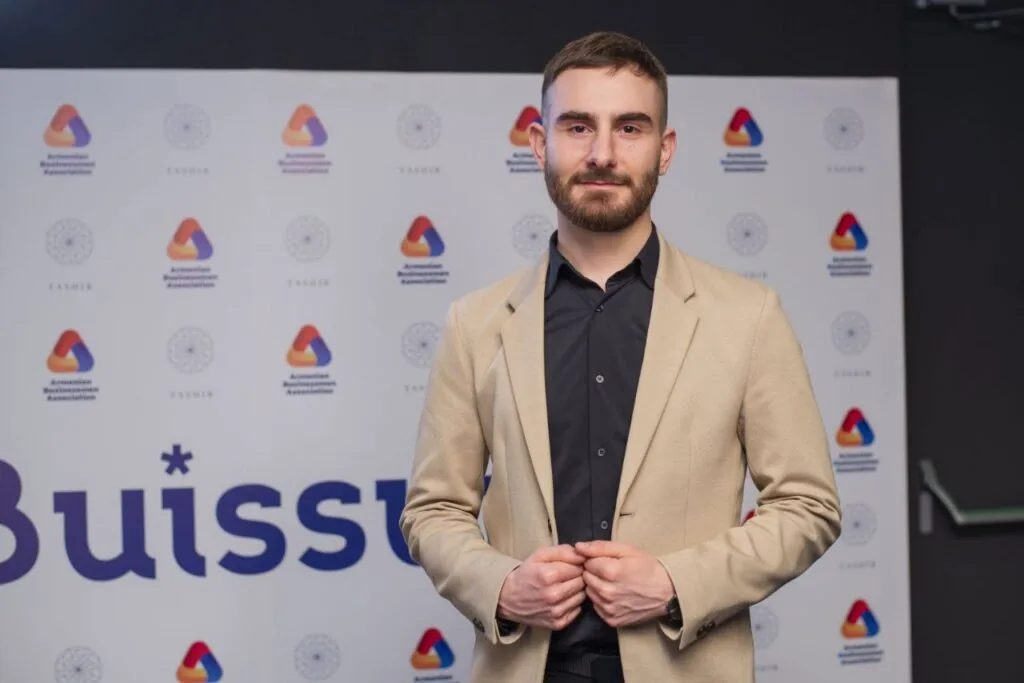
At the idea stage, we became the fastest-growing FinTech startup in the local market and won the Buissup competition. In 2022, we were presented at MWC—the largest European exhibition—where we were recognized as Innovation of the Year. That same year, we won the national final of the Entrepreneurship World Cup.
These achievements led to the fact that in 2022, we were noticed by 500 Global, and after submitting an application, we were accepted into their accelerator program. In 2023, we presented the company again at MWC, London Tech Week, and VivaTech, where we met our first major client—Orange.
2023 was a transitional year for us when we pivoted. In 2024, we acquired our first B2B clients. Also in 2024, we were presented at WCIT—World Congress of Information Technology—an event that is something between the Oscars for IT companies and the Cannes Film Festival. At the Global Pitch Competition, we reached the global final among approximately 2,000 companies from around the world.
The most important achievement of 2024 was that our company became part of the Plug and Play accelerator, which gave us a significant boost in terms of intros to potential clients and allowed us to establish connections with high-level mentors, including from Kazakhstan.
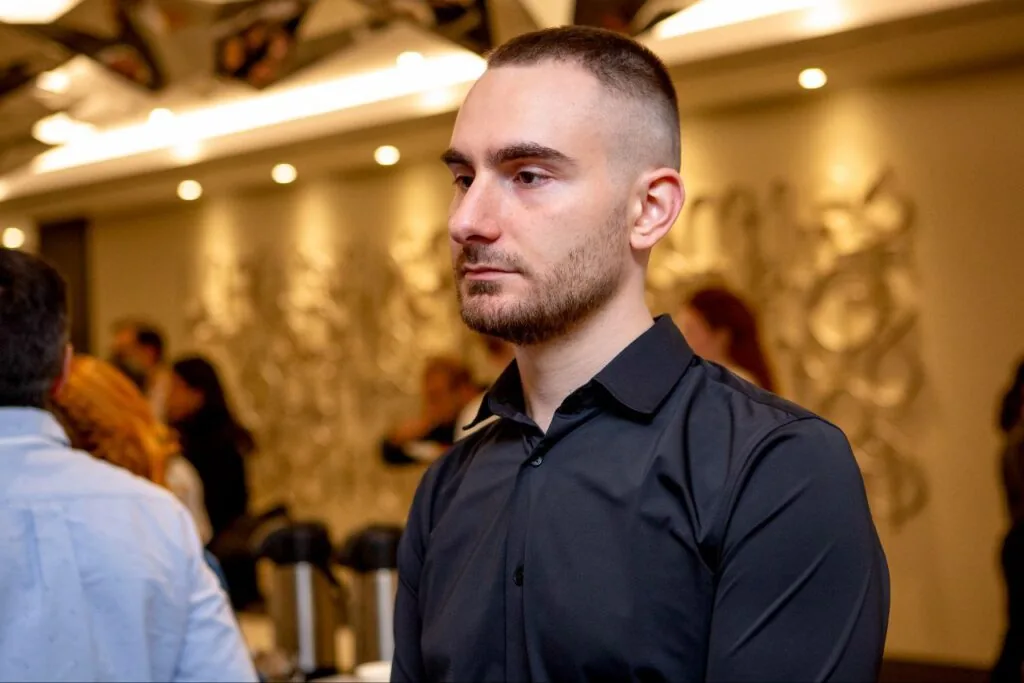
In 2025, a significant news for me also occurred: I was selected as a member of the board of directors of the largest Armenian association of IT and telecommunications companies, UEICT. Our association includes large companies such as Synopsys, Unicomp, local telecoms, and banks. This became another achievement that confirms the correctness of the chosen path.
Plans
This year, we plan a major fundraising round, and we are already in the process. Currently, negotiations are underway with a major venture capital fund. This will give us the opportunity to obtain a financial license in certain regions and countries where we plan to launch as a B2C solution.
I see our company as a daily assistant for people. We want everyone to be able to quickly and safely transfer money directly in messengers using our payment keyboard—without extra apps and more reliably than through regular banks.
With the development of AI, the threat of fraud is increasing—especially through social engineering techniques. For example, when you receive a fake message from Amazon with an attractive offer, and you yourself, without noticing, pass data to scammers. Our keyboard is built directly into the communication process and becomes a buffer between you and the threat. It can identify the risk in advance and warn you earlier than a bank would after a suspicious operation has already been completed.
We want to become a safe companion for people on a daily basis.
The Tech on Telegram Follow The Tech on Telegram
Keep up with the latest technology and startup news.
Related reading







More from this author

News IT
Google has solved one of the main problems in quantum computing
The Tech
News IT
20 startups from Central Asia presented their projects at TechCrunch Disrupt 2026
The Tech
News IT
Kyrgyzstan and Armenia will consider the possibility of creating a joint AI enterprise
The Tech
News IT
Now on Kaspi.kz, you can trade in your old iPhone for a new one
The Tech

News IT
IT Park Uzbekistan became the best knowledge zone in the Asia-Pacific region
The Tech

Article Useful
How to protect your accounts from hacking: 8 settings you should check today
The Tech