DigitalAlmaty 2024. How Kazakhstan Can Launch 1,000 Startups and Why It’s Worth Entering the Southeast Asian Market
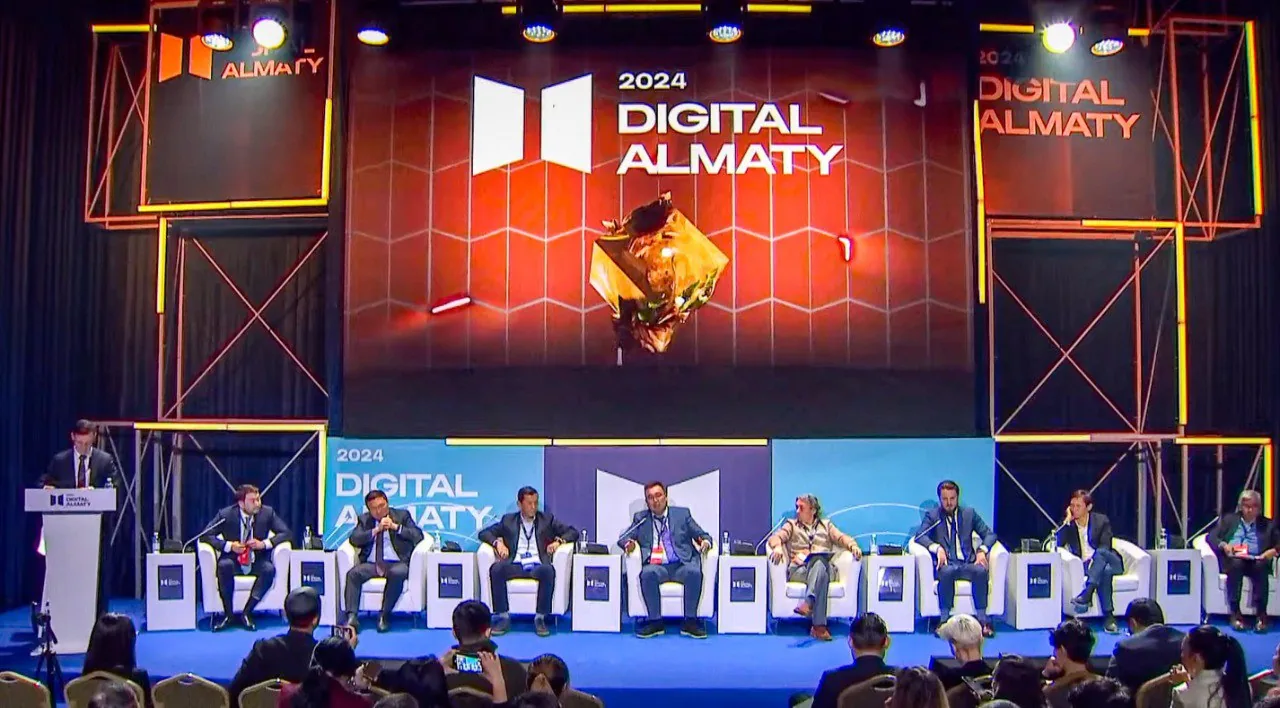
One of the most interesting sessions of the international forum Digital Almaty 2024 was the discussion on the startup industry of Kazakhstan and other countries around the world. We share the text version of the most interesting thoughts.
Author - Mansur Ismagulov
The Tech AI
Get the key points in seconds - a short summary from The Tech AI.
Sanat Akhanov (Qazinnovations) and Ibrahim Niyaz (Saudi Arabia) announced large-scale grant programs: up to 800 million tenge from Kazakhstan and a $700 million fund in Saudi Arabia to support startups at all stages of development. Google, Yandex Cloud, and E27 provide resources, mentorship, and access to global markets, including accelerators and cloud services. Arman Suleimenov proposes increasing venture capital through a state fund and combining training with funding to launch more than 1,000 startups.
Sanat Akhanov, Chairman of the Board of JSC “National Agency for the Development of Innovations Qazinnovations”
Digital technologies are changing the landscape. For instance, the Astana Hub ecosystem is actively developing in Kazakhstan. We are entering global markets, selling GovTech technologies abroad. We recently opened the Silk Road Innovation Hub in the US and plan to open the Al-Farabi Innovation Hub in Saudi Arabia. We have succeeded in the process of digitalization. Every sector of the economy has its own Vice Minister of Digitalization, and the President has set the goal to “Create an IT country.”
For Qazinnovations, it is important to develop this ecosystem not only in Almaty and Astana, but also in the regions. Historically, IT events here were not held regularly—they only took place when supported by the local akimat or when a private investor was attracted. We have put everything on a systematic basis. Last year, we supported 19 business incubators. We realized that there is demand and good human capital in the regions. This year, we decided that the ecosystem will continue to be developed under the Astana Hub brand.
It is important that previously, a person would study, complete a course, receive a certificate, and that was the end. Now, they can immediately receive a grant to develop their project. Grants are non-repayable, interest-free, and collateral-free financial support from the state.
If venture investors, fundamentally, invest in startups that have already shown traction, we help projects get through the “Valley of Death,” where up to 90% of founders stop. We issue a grant for “Technology Commercialization” in the amount of 20 million tenge even when there is no MVP yet. If you refine the project and show results in six months, we will give another 80 million tenge for new functionality, advertising, and promotion. Higher-level grants are related to technology transfer and the creation of new production lines—we issue 400 million tenge here. Another type of grant assistance is for projects that can influence cross-sectoral economic development—800 million tenge.
The state invested approximately 13.5 billion tenge in 370 startup industry projects, which produced goods worth 200 billion tenge. From this amount, 30 billion came into the budget in the form of taxes.
We plan to increase grant funding for the startup market. We will invest about 6 billion tenge in 300 startups annually. We will expand the range of grant types: creating step-by-step funding, under which we will provide funds, for example, first for market research, then for a financial model, and continue as long as there are successful results at each stage.
We will conduct foresight research on a regular basis. They will allow us to monitor global trends, find similar projects in Kazakhstan, and help them. We are creating prototyping laboratories where scientists can create something, rather than going to business with only paper calculations for funding. If you have a good idea and product—come to us.
Askar Aytuvov, DevRel Coordinator at Google
Let’s imagine a person who has some free funds and wants to earn money. He buys a truck with refrigerators, loads vegetables and fruits in Tashkent, and sells them in Omsk. Investing $100,000, he gets $200,000. That was last year. A month ago, to earn money, one had to buy eggs. And what is currently in demand—no one knows. There is no real-time dashboard that would show such information. You can create an Excel table with all the data, but it will inevitably lag. Therefore, it is best to turn to the Google Developers Ecosystem, find developers, create a database, and implement artificial intelligence. But servers are expensive and need to be maintained. Therefore, Google provides $350,000 for the necessary software. This way, you can create your own startup.
The Google Developers Ecosystem conducts regular free meetups, hackathons, and events. A person living in any city in Kazakhstan can gather a small community and contact us. We will assign a cool speaker or provide our merch. Thus, the largest DevFest in Central Asia recently took place in Tashkent—it gathered 3,000 people. In Almaty, such an event took place with 1,500 participants.
Together with Astana Hub, we launched the Google for Startups Accelerator, which will soon be two years old. This is a great opportunity to learn from good mentors and attract investors’ attention. We work for the entire region—if you are from Kyrgyzstan, Uzbekistan, or Georgia, come to us.
For experienced specialists, there is the Google Developer Expert program—you can travel the world for free and speak at events. For those who want to learn for free, there is the CloudSkillsBoost platform, where you can take short courses and lab work. And new events from our community can be found at gdg.community.dev.
Taddeus Koh, co-founder of E27 with Echelon and TOP100 projects
I have been coming to Almaty for the last 10 years at least twice a year. The first time I attended a panel session—the event was attended by about 60 people. Now I see that Kazakhstan has managed to build a whole ecosystem, and this is impressive.
Echelon and TOP100 are platforms for startups. We started the initiative 10 years ago and initially focused only on Singapore. But later we decided to expand into Southeast Asia, as we saw great opportunities in the region with a population of more than 660 million people. We began searching for startups and were amazed at how similar things industry representatives in different countries are doing. Therefore, we created a website that unites all our colleagues. We accept everyone who wants to join.
Our idea is to make startups succeed. We provide informational support, connecting founders with investors. There is a lot of money in our region, but it needs to be invested correctly. Therefore, we decided to expand our activities to Central Asia. We see active development here and are ready to accept startups that have clients and a good product.
Amazing startups are being created in Kazakhstan that amaze the imagination. Therefore, we always urge local founders to enter the Southeast Asian market. And we will help with various programs—we have many of them.
Nikita Razhev, Head of Startup Relations at Yandex Cloud
We have the Yandex Cloud Boost program. It includes:
— cloud resources for various amounts, depending on the stage
— access to various Yandex B2B services
— technology support: consultations from specialists, training
— promotion: joint PR campaigns, community, and events.
Startups need cloud resources to save on purchasing servers and maintaining infrastructure. They allow for faster experimentation and scaling when business grows or during seasonal demand.
For very small companies that have only an idea, we give 300,000 tenge for cloud resources. For those who migrate large products to us, we give up to 6 million tenge. The best conditions can be obtained through our partners—Astana Hub, MOST Ventures, Terricon Valley, NURIS, KBTU: from 2.4 to 30 million tenge for long terms.
Aside from Yandex Cloud, we help in selecting IT specialists among graduates of Yandex Practicum. We provide grants for the Toloka service and the Yandex Tracker project management system.
With selected projects, we publish joint cases, help with sales and joint lead generation through our marketplace, and introduce them to investors.
Also, for technology companies with a product or service at the MVP stage, there is the Yandex Cloud Boost AI grant. We are developing our own AI language model that works in Russian and Kazakh. We provide a grant for its use for six months and a 50% discount for the following six months. All that is needed is to describe your user case. Therefore, we are waiting for your applications.
Ibrahim Niyaaz, Managing Director of the National Technology Development Program of Saudi Arabia
The National Technology Development Program is part of a fund totaling $700 million. We unite entrepreneurs, startuppers, business angels, incubators, and accelerators into an ecosystem that operates not only in Saudi Arabia but also abroad. We help startups from the idea stage until they become unicorns. We want Saudi Arabia to be in the top 10 countries for startup development by 2030.
Currently, there are 14 programs in our fund. One of the first is MVP Lab, under which we provide grants to young entrepreneurs from $40,000 to $133,000. Currently, 15% of startups have turned into sustainable companies.
Each of the other programs provides assistance at a certain stage of development: if a startup needs a bank loan, we act as collateral. If necessary, we give founders the opportunity to leave their jobs and fully immerse themselves in the startup, paying them a salary. We conduct business training for those who want to become the best leaders. We help enter foreign markets by providing 5 million Saudi riyals for promotion. We select potential unicorns and provide them with all the resources necessary to achieve a valuation of $1 billion.
2023 was a difficult year in terms of investments. The entire market fell by an average of 35%. Despite this, in Saudi Arabia, we closed the year with $3 billion. At the economic level, our program led to an increase in the country’s GDP by 5.4 billion Saudi riyals. We created 7,300 jobs. Commercial banks provided loans totaling $2.8 billion. 309 new startups were launched. We brought five new accelerators to Saudi Arabia. We regularly hold meetings and conferences attended by approximately 17,000 people.
We also focus on international startups. We create the best conditions for the relocation of talented startuppers. Last year, representatives from 18 countries relocated to us. Their revenue reached 27 billion Saudi riyals. Therefore, we invite Kazakh startups to become our residents.
Arman Suleimenov, Founder and CEO of nFactorial School
I want to discuss such a question: “How can Kazakhstan launch more than 1,000 startups?” To share problems and offer potential solutions.
Problem 1. Venture funds invest in startups that already have sales. Few are ready to invest at the idea stage. We have many talented specialists, but few AI startups. Most projects are created for Kazakhstan, not for the international market.
Solution. In Kazakhstan, there are programs that provide grants and those that only provide training without funding. It is necessary to combine these two directions. Make it so that accelerators also allocate money. Small amounts, maybe $20,000. For just $20,000,000, it will be possible to launch 1,000 startups.
Our nFactorial Incubator can help with distribution—introducing the audience to the project through a podcast, establishing connections with venture funds, finding suitable specialists who have graduated from our school, and attracting the next round of funding.
A young startup needs only two people in the team who will work on marketing and technology. For $2,000, you can connect the OpenAI API, spend another $6,000 on developing a client base, and distribute the remaining $12,000 as salary for six months.
We currently do not have enough people who could act as founders, but this is also a solvable issue—you can create four-week training programs similar to those conducted by Antler or On Deck.
Problem 2. There is little venture capital in the country. In the US, there are about $700 in VC per person, in China—$74, and in Kazakhstan—$5.
Solution. Create a government fund that will invest $100 million annually into 10 venture funds. They, in turn, will be required to raise $5 million in annual income, which will ultimately give the market $150 million in venture capital. This is a small amount for the state, but the impact can be huge. This is already happening in the US, China, and India. After all, the more attempts there are, the higher the chance of success.
Focus on your weaknesses. Because artificial intelligence is a new field for everyone, where everyone is equally a beginner. The industry is actively developing, new companies are appearing. For example—Perplexity, which opens new opportunities for internet search. Artificial intelligence gives an answer immediately, without the need to read text in 15 different links. It was created in August 2021, and already poses a threat to Google.
Every 10 years, a new paradigm for competition appears: first there were computers, then the internet and phones. Recently, blockchain was hyped. I think the modern Steve Jobs will build his company not on computers or mobile devices, but on new platforms, like Apple Vision Pro. And, as always, the advice: “Be so good that they can’t ignore you.”
The Tech on Telegram Follow The Tech on Telegram
Keep up with the latest technology and startup news.
Related reading







More from this author

News
zypl.ai begins operations in Japan and focuses on next-generation risk models
Mansur Ismagulov

News
Elon Musk's net worth has exceeded $700 billion for the first time
Mansur Ismagulov

Article Interviews
"Central Asian countries should build a joint ecosystem," — Bekhzod Ismoilov on the development of AI in the region
Mansur Ismagulov

Article Interviews
Bloom's Taxonomy and Engineering Levels: A Practical Growth Model
Mansur Ismagulov

Article Useful
How the IT industry in Azerbaijan developed in 2025: key events
Mansur Ismagulov

News
Tajikistan has become a new member of the regional innovation alliance Central Asian Innovation Hubs.
Mansur Ismagulov