WomenInTech. Successful women from Almaty on stereotypes in IT
In this episode, women from Kazakhstan share stories about how they overcome stereotypes and achieve success in IT.
Author - Mansur Ismagulov

The Tech AI
Get the key points in seconds - a short summary from The Tech AI.
Zhenis Izmagambet (Almaty) is a startup founder and IT blogger who has worked at Bosch GmbH and Astana Hub. She notes the lower trust investors have in women founders but is confident that stereotypes will change. Zholdyz Saulebekova (Almaty), CEO of Almaty Air Initiative, launched Uber in Kazakhstan and Binance Kazakhstan. She describes the challenges of "bro culture," the "authority gap" in leadership perception, and discrimination against mothers at work, recommending proactivity and choosing strong leaders for career growth.
Zhenis Izmagambet, city — Almaty, startup founder, IT blogger, Instagram
About Me
I am a startup founder and an IT blogger. Within a classic startup team, I play the role of a hustler, responsible for strategy, growth and development, as well as fundraising.
I have two startups under my belt, dozens of commercial projects, participation in the Google for Startups Poland program, and reaching the European final of the UN Women Entrepreneurship Expo by UN Women.

How I entered the IT profession
After working at Bosch GmbH in Stuttgart, I returned to my homeland. Specifically to Astana, where I joined the initial team creating the Astana Hub tech park. This was invaluable experience and the beginning of my long and interesting career in IT.
About stereotypes
Stereotypes, if they occur, are most often encountered before men start working with female executives; women are a priori fewer in C-level positions in IT. During professional interaction, these barriers disappear, and it becomes clear what kind of personality one is dealing with.

Obstacles for women in IT
In my career as a specialist, I have not encountered gender restrictions.
However, when creating IT startups, I noticed that some investors sometimes trust female founders less. Therefore, girls have to prove their legitimacy more and fight for their place in the sun. I am convinced that our generation of founders is already actively changing these established stereotypes with their example.
Recommendations for those just starting their journey
Explore various directions and work formats in areas of your interest and education, taking into account global economic changes. Ultimately, you will be able to find your craft, to which you will dedicate more than 10,000 hours of practice and become a true professional in your field.
Zhuldyz Saulebekova, city — Almaty, CEO, Almaty Air Initiative, Instagram

About Me
I am a top manager with experience working in large IT companies. Almost all my projects are related to launches "from scratch" and industry transformation. In 2016, I led the launch of Uber in Kazakhstan, and later coordinated the operational aspects of the merger of Yandex and Uber in the CIS countries. At Binance, I led the launch of the first local crypto exchange.
I am the CEO of Almaty Air Initiative, where together with Arsen Tomsky, founder and CEO of inDrive, and Kairat Akhmetov, co-founder of Sergek Group and CEO of Freedom Telecom, we apply a business approach to solving Almaty's environmental problem.
How I entered the IT profession
I got acquainted with the world of IT at the beginning of my career — at the insurance company London-Almaty. Although it was not an IT company, participation in a project to implement new software based on Oracle introduced me for the first time to such concepts as backend, project, scrum. I saw how technologies make business processes faster and more efficient. It was an amazing experience.
In 2012, I received a master's degree from the University of St Andrews, ranked #1 in the UK by the Guardian, in Applied Statistics & Data Mining. At that time, data science, neural networks, and machine learning were rarely discussed in Kazakhstan, and there were few opportunities for a specialist proficient in R and SAS.
In 2015, I saw a Forbes news story about Uber's entry into Kazakhstan — and applied. After a tough selection process, I became the first employee, launching the service from scratch. In San Francisco, I met Uber CEO Travis Kalanick. I remember his words: "You have no idea what kind of industry transformation experience you are getting now." He was right. Then taxis were caught on the street or waited for by call for 15–20 minutes. Today — the industry standard is two minutes. I am proud to have been at the origins of this transformation.
Later, I moved to Yandex, where I was involved in scaling Yandex.Taxi not only in Kazakhstan. In 2018, Uber and Yandex.Taxi completed the business merger. It was an interesting experience when it was necessary to build processes and teamwork of two former competitors. The most difficult part of the merger was related to the merging of teams.
After maternity leave in 2021, I wanted to try myself in a new industry. At this time, CZ, CEO of Binance, flew to Kazakhstan and announced plans for an official launch. I already had experience launching projects from scratch in e-commerce and ridetech, and I thought: "Why not apply this experience in the crypto industry?" So I became the COO of Binance Kazakhstan, working under the leadership of Zhaslan Madiev — Minister of Digital Development.
When I saw Arsen Tomsky's post last year, CEO and founder of inDrive, about Almaty Air Initiative, I instantly saw an opportunity to do something truly significant — something that has a real impact. Air pollution in Almaty seriously worried me; I even considered relocating.
We met with Arsen and talked for an hour and a half. Arsen inspired me so much that I decided on a step that was unexpected for myself: to leave Binance and devote myself to fighting for clean air.
At the moment, my work combines technology, data, science, creativity, PR, and GR — a rare and incredibly interesting mix. This is a new experience and a challenge of a different scale, but perhaps one of the most significant in my career.
About stereotypes
My colleagues and managers were mostly men — professionals from whom I learned a lot. But stereotypes also occurred — mostly unconscious, conditioned by socio-cultural norms.
Once I gave feedback to a young employee who was missing deadlines and allowed himself a childishly provocative tone of communication. His boss, also a man, replied: "Didn't boys pull your pigtails in school? Don't take it to heart." For him, this was normal — just as it was back then, in childhood. He expected tolerance from me towards his subordinate's unprofessionalism instead of sorting out the situation.

Obstacles for women in IT
In the IT industry, there is so-called bro culture — a corporate environment where success is built according to rules tailored to male styles of communication and behavior. Here, hard ambition, aggressive growth, and informal male connections are valued. This creates barriers for those who do not fit into this template. Women in such teams find it harder not only to compete but also to "become one of their own." I know women who hid their femininity and behaved somewhat differently than in real life — all for the sake of being "accepted into the club."
As a female leader, I also want to note such an interesting phenomenon as the authority gap — the difference in how men and women in leadership positions are perceived. Confidence and even aggression in a man strengthen his image as a leader, while a woman with the same behavior risks getting the label "aggressive" or "hysterical." Women are expected to behave more compliantly, which puts them in a disadvantageous position from the start. Therefore, women always have to maintain this delicate balance between confidence and softness.
Also, the "motherhood penalty," which entails not only loss of income and career opportunities but also the need to prove one's competence again after returning from maternity leave.
Research shows that employers perceive mothers as less committed to work and less competent compared to childless women.
At the same time, fatherhood entails not a "penalty" but a "fatherhood bonus" — their employers consider them more responsible and stable. Fathers not only advance up the career ladder faster than mothers but also outpace male colleagues who do not have children.
Recommendations for those just starting their journey
1. Carefully choose your first workplaces and your first managers. Go where there are complex tasks, a high bar, and a strong leader. The first years are about working at maximum capacity, full immersion, and growing expertise.
2. Young specialists often do not want to go beyond the instructions, but it is precisely proactive individuals who grow faster. Do not be afraid to learn and do things you have never done before. Take responsibility, solve "ownerless" tasks, suggest improvements, work faster than others, exceed expectations — and you will definitely be noticed.
3. Your relationship with your manager is your career elevator. The better you understand his expectations and priorities, the faster you move up.
4. Your reputation is your capital. Develop communication skills, work with people, and build trust. Be someone who can be relied upon — and you will be promoted forward.
The Tech on Telegram Follow The Tech on Telegram
Keep up with the latest technology and startup news.
Related reading




More from this author
News
zypl.ai begins operations in Japan and focuses on next-generation risk models
Mansur Ismagulov

News
Elon Musk's net worth has exceeded $700 billion for the first time
Mansur Ismagulov
Article Interviews
"Central Asian countries should build a joint ecosystem," — Bekhzod Ismoilov on the development of AI in the region
Mansur Ismagulov
Article Interviews
Bloom's Taxonomy and Engineering Levels: A Practical Growth Model
Mansur Ismagulov

Article Useful
How the IT industry in Azerbaijan developed in 2025: key events
Mansur Ismagulov
News
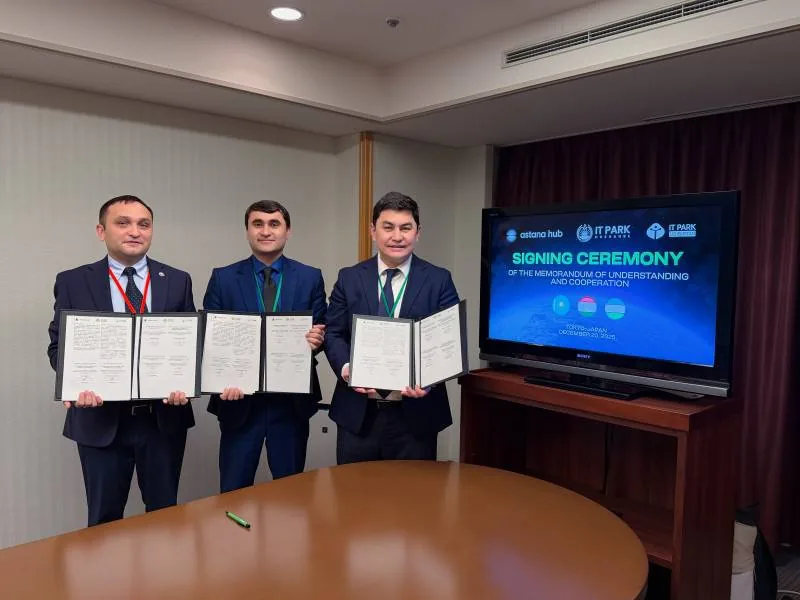
Tajikistan has become a new member of the regional innovation alliance Central Asian Innovation Hubs
Mansur Ismagulov