WomenInTech. "We have strong ideas and the courage to implement them," — Kazakhstani girls on their journey in IT
These are the stories of women who are changing Kazakhstan's IT industry — boldly, intelligently, and in their own way.
Author - Mansur Ismagulov

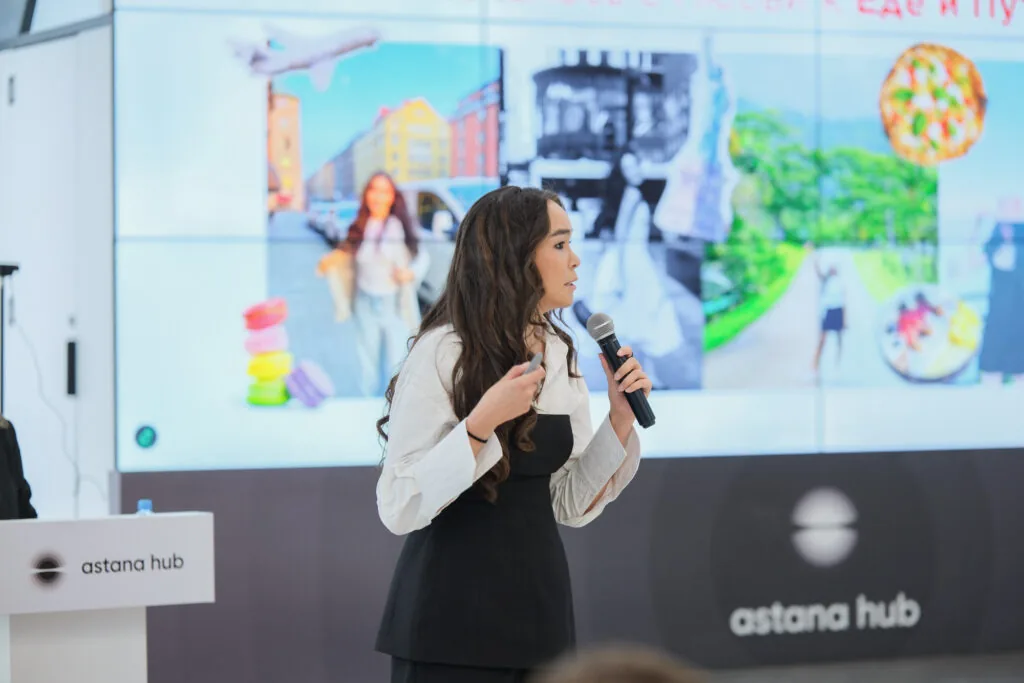
Camila Dautkanova, city — Almaty, founder of BookEat, Instagram, Linkedin

About Me
I am the co-founder of BookEat, a technological platform for the restaurant business that helps automate and optimize processes.
With BookEat, guests can reserve a table in advance, choose and pay for dishes, while restaurants can reduce manual operations, minimize losses, and improve service efficiency.
At the same time, I work full-time at an international food delivery company. This experience helps me better understand the market and user behavior, while also providing stability for my team and the development of BookEat.
Combining a startup with a main job is not easy, but it is precisely the balance of practical corporate experience and entrepreneurship that allows me to grow as a professional and founder.
My career path began in Kazakhstan, where I studied Marketing Communications at KIMEP. Even during my studies, I completed an internship at The Ritz-Carlton, and later worked at Coca-Cola and British American Tobacco. These companies gave me valuable experience working in an international environment, an understanding of global marketing principles, and the ability to find creative solutions even under strict constraints.
The next step was a master’s degree at the University of Southern California in Los Angeles. After graduating, I received an offer from a large American company listed in the Fortune 500 and moved to Chicago. There, I became the first foreigner in the department, coordinated projects across North and South America, and practically confirmed that I could work effectively in a multicultural and competitive environment.
It was this experience—the combination of corporate marketing and international business—that became the foundation for the next stage of my career: launching my own startup.
How I Entered the IT Profession
My journey into IT began with a desire to create a more efficient tool for restaurants. I saw that establishments mainly relied on lead generation through Instagram and other channels, where guest attention quickly scattered. I wanted to build a platform that would be something more than an advertising showcase—a kind of social network that brings people together around their favorite establishments and dishes.
Thus, the idea for BookEat was born: a service that helps restaurants optimize processes and attract guests directly, while allowing users to share experiences, reserve tables, and order food in advance. For me, IT was not an end in itself, but a tool for transforming the industry and creating new value for the market.
About Stereotypes
In Kazakhstan, there are still expectations that a woman should primarily focus on her family, with career ambitions being secondary. In conversations with different people, I sometimes heard doubts: whether a girl can handle serious projects or take on a leadership position. This was not about my company, but rather about the general perception I encountered.
For a long time, I didn’t even dare to tell my colleagues at my main job that I had a startup. I was afraid it might be perceived ambiguously.
But after an article about me was published, the CEO personally approached me, congratulated me, and offered her support. Moreover, she offered to recommend me for participation in an internal startup competition.
This moment was important to me—I truly felt how much support means, especially from female leaders.
At the same time, I sincerely admire women who manage to combine their careers, personal development, and still remain wonderful mothers and wives. For me, they are true role models, and I take inspiration from them. Such stories show that women can indeed do everything, and the main thing is to have the right to choose and support along the way.
Obstacles for Women in IT
One of the main difficulties is internal doubts. Sometimes it seems that you need to be “twice as good” to prove your competence.
Another challenge is the perception of women’s support programs: sometimes it creates the impression that women are invited for the sake of representation.
Such initiatives are important, but I want us to be evaluated on par with men—not “because we need to support,” but because we have strong ideas and projects.
I coped with this thanks to self-belief and a supportive environment. It is important to find those who inspire. When you meet women confidently walking their own path, you understand: you can continue to grow without conforming to others’ expectations and still remain yourself.

Recommendations for Those Just Starting Their Path
- Don’t be afraid to try and don’t put off your dreams. Mistakes are normal; they move you forward. It is important to remember: you are valuable not because you are a “woman in IT,” but because you have ideas that can change the world.
- Seek people who will inspire and support you, but don’t expect special treatment. True strength comes when you are evaluated based on your results, not stereotypes and gender affiliation. And if inside you feel that “you can do more”—follow that feeling. This feeling rarely lets you down.
- I am in favor of giving women more opportunities in IT, but not for the sake of special treatment. We should not win just because “women’s success stories” are needed. We should win because we have strong ideas and the courage to implement them.
Adel Aitym, city — Stockholm, Security Systems Developer, Instagram , Linkedin

About Me
I am a cybersecurity systems engineer at Ericsson, working at the headquarters in Stockholm, as well as the co-founder of the BookEat startup—a digital platform for restaurants and guests.
My path is just beginning, but it has already proven to be rich. It all started with a master’s degree in Information Security at Stockholm University. Before that, I did not have formal IT education, and the first semester was particularly difficult—I literally learned the basics from scratch.
During my studies, I managed to participate in the Tech Talent of the Year competition for students from all over Sweden, organized by SEB Bank in collaboration with Google. Out of hundreds of applications, only a few people made it to the finals—and I was among them. I also won an international grant from Palantir worth $7,000 for high academic achievements. This was not just financial support, but recognition at a global level.
Later, I completed an internship at BCG and received an offer a year before graduation, but I declined it because I saw a different path for myself.
A key stage was my internship at Detectify, where I worked in the Security Research Team—validating vulnerabilities, developing modules in Go and JSON DSL, and working alongside world-class experts. This experience gave me deep practical knowledge in AppSec and the opportunity to work next to world-class hackers. My manager was an expert who helped Google, the UN, and the US Air Force, and was included in the Google Security Hall of Fame.
In December 2024, I received an offer from Ericsson, and since June 2025, I have officially been working as a cybersecurity engineer in the Cloud RAN division, responsible for the security of 5G network solutions used by millions of people around the world.
At the same time, my friend Camila Dautkanova and I launched BookEat, entered the top 15 projects of the Startup Garage program by Astana Hub, and created an MVP. This was an incredibly intense period: simultaneously, I was writing my thesis, completing an internship, and working part-time in a café and supermarket to invest in the project.
How I Entered the IT Profession
My experience is non-standard—I did not study to be an IT specialist or a cybersecurity expert. At NIS, my profile subjects were mathematics, ICT, and physics. I liked them, and I still remember creating my first landing page. But then I decided that I was not smart enough for an IT career: I only knew about the developer profession and thought that to code, you had to be almost superhuman.
Therefore, I enrolled at KIMEP in the Foreign Languages program. I have always liked English, and I believed it would open new opportunities for me—and it did. In my second year, a professor was looking for a research assistant with web development experience. I had some experience, and I was chosen. I built websites for her research projects, and we continued to collaborate even after my graduation.
One day, one of the sites was hacked—suspicious code and spam appeared on the pages. Later, I realized it was an XSS attack. This case became my “entry point” into cybersecurity: that was the first time I saw how vulnerabilities turn into real threats, and since then, this topic has truly fascinated me.

About Stereotypes
I have not had to face strong stereotypes on my career path, despite working in a predominantly male field. In Sweden, you are treated with respect and on equal terms: no one pays attention to the fact that you are a woman in cybersecurity. Hiring conditions and workplace conditions are the same for everyone—without special treatment or restrictions.
Unfortunately, in Kazakhstan, I did hear such comments. For example, when I applied for scholarships to enter a master’s program, a man asked during the interview: “What are you planning to do in such a male-dominated field?” This surprised me because I have never divided professions into “male” and “female.” At NIS and KIMEP, where I studied, people had progressive thinking. In high school, I was actually the only girl in my class who chose mathematics and physics, but I never felt “unequal.”
While working in Kazakhstan, I also heard phrases from men like: “I wouldn’t hire a woman because she will eventually go on maternity leave anyway.” I don’t argue—I just continue to do my job. Now, having worked for only a few months, I am already leading important projects, and my manager considers me a candidate for the role of team lead. Despite stereotypes, the results speak for themselves.
Obstacles for Women in IT
I cannot speak in detail about the entire market in Kazakhstan, but I see that thinking about gender roles is gradually changing. Participating in acceleration programs, I noticed many successful female entrepreneurs in IT. They create strong projects, and the community itself is friendly and supportive. In the startup environment, I have never heard sharp comments about gender.
In the corporate environment, perhaps there are slightly more such stereotypes because old views are more deeply rooted there. But I believe that it is not worth defining yourself through the prism of these prejudices, and even less so wasting energy on them. After all, they will not do your work for you.
If you like what you do, it is important to simply see your goal and move toward it, without being distracted by outside noise. I am convinced: it is better to direct time and energy toward your own development rather than “re-educating” others. The responsibility for their thinking lies with them, and mine is to grow professionally and enjoy what I do.

Recommendations for Those Just Starting Their Path
- Find a field that fascinates you
For me, that field is cybersecurity: I like figuring out systems, finding vulnerabilities, and building more reliable solutions. It is like detective work—which is why I start each day with pleasure.
Yes, this field offers excellent salaries and conditions, but for me, it is more important that I derive genuine pleasure from my work. Therefore, my main advice is to look back at your “little self” and remember what you liked doing as a child: building, exploring, developing strategies? These hints can help you choose the right direction.
- Not be afraid to be visible and take up space
I always actively participate in meetings and calls, even if the topic is not directly related to my tasks: I ask questions, offer help, and show initiative. My manager appreciates this and often says that I am his “right hand.” This approach helps me grow and find new opportunities faster.
- Continuous self-education
I did not have specialized IT education, so I started with YouTube and online courses, reading books on cybersecurity. I believe the main thing is to master the basics, and then build on that knowledge. For practice, I participate in CTF competitions and train on platforms like Hack The Box. My job does not require this directly, but this approach distinguishes me and helps me grow as a specialist faster.
- Strength of character
In work and in a startup, it is important to “show up” every day, despite fears and failures. You need to persistently move toward your goal, like a tank, but at the same time, do not forget to enjoy the process itself.
The Tech on Telegram Follow The Tech on Telegram
Keep up with the latest technology and startup news.
Related reading







More from this author

News
zypl.ai begins operations in Japan and focuses on next-generation risk models
Mansur Ismagulov

News
Elon Musk's net worth has exceeded $700 billion for the first time
Mansur Ismagulov

Article Interviews
"Central Asian countries should build a joint ecosystem," — Bekhzod Ismoilov on the development of AI in the region
Mansur Ismagulov

Article Interviews
Bloom's Taxonomy and Engineering Levels: A Practical Growth Model
Mansur Ismagulov

Article Useful
How the IT industry in Azerbaijan developed in 2025: key events
Mansur Ismagulov

News
Tajikistan has become a new member of the regional innovation alliance Central Asian Innovation Hubs.
Mansur Ismagulov