WomenInTech. How girls from Kazakhstan are building innovations and breaking stereotypes
In this interview, successful women share their stories — about how they started their careers, the challenges they faced, how they balance work and family, and why they believe that technology is a space for everyone, regardless of gender and stereotypes.
Author - Mansur Ismagulov

Anar Tuleubayeva, city — Astana, Deputy Chairman, OYU «Association for the Development of Artificial Intelligence in Kazakhstan», Linkedin, Instagram
About Me
I am the Deputy Chairman of the Association for the Development of Artificial Intelligence in Kazakhstan. I am a mother of two wonderful daughters, whom I raise on my own.
Every day at the Association, we generate ideas for projects and training courses, consult on AI implementation issues, develop professional skills, and strengthen networking.

How I entered the IT profession
My career began in 2008 in the civil service at the Agency for Statistics of the Republic of Kazakhstan. I was motivated by my young daughter and my parents, who had recently moved from a small town to the capital.
At first, I did not fully understand the essence of civil servants' work — I thought my task was limited to document management: approving documents and responding to letters. But my first mentors taught me to think analytically.
Thus, I was noticed by the IT department and invited to the position of Chief Expert in Metadata Management. This marked the beginning of my immersion in the world of IT in 2011. At that time, there was a sharp shortage of personnel, and I was hired thanks to my analytical thinking, soft skills, and technical specialty. I believe that the shortage of IT personnel in the civil service still exists today.
Next came projects on the development of information systems, equipment modernization, passing certifications for compliance with information security requirements, independently conducting seminars for branches, and career growth to a manager position in 2013. All of this had to be mastered "on the fly," without sleep and vacations, sometimes sacrificing time with my daughter. The support of loved ones played a huge role. Despite the difficulties, I am grateful for this period — it is in such moments that professionalism is formed.
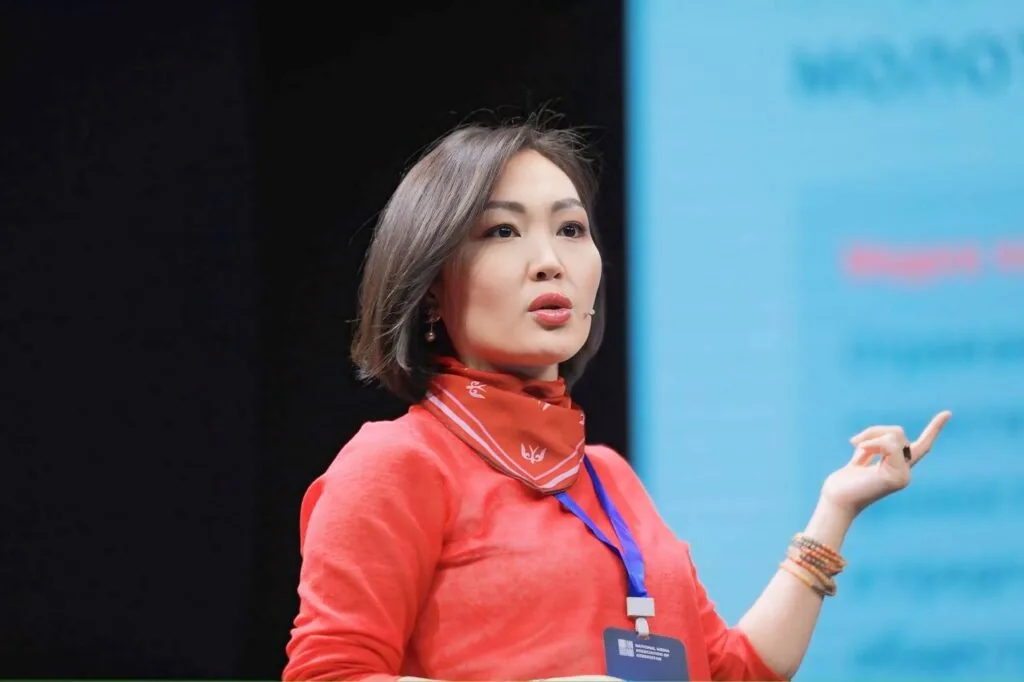
In 2017, I entered the National School of Public Policy of the Academy of Public Administration under the President of the Republic of Kazakhstan. The second semester was spent at the Maxwell School of Citizenship and Public Affairs, Syracuse University — one of the leading schools, whose graduates include many US politicians. The studies were difficult: I had to quickly adapt to academic requirements without preparatory foundation courses.
About Stereotypes
One could talk endlessly about gender stereotypes. When I encountered such situations, I reacted sharply. I believe they are still present in our society — perhaps in a more veiled form, but they have not disappeared anywhere.
For example, refusing to hire a girl because she is "not married, which means she will get married and go on maternity leave." At the same time, I myself was on maternity leave for only four months and returned to work due to life circumstances.
But I can confidently say: I was lucky to have "human" managers who valued persistence, confidence in one's position, responsibility, and a thirst for updates, innovations, and changes.
Obstacles for Women in IT
One of the most subtle but persistent problems is that women in IT have to constantly "prove" their competence. Where men's professionalism is often taken for granted, women have to explain once again why they deserve to be at the decision-making table.
This is manifested not in direct refusals, but in nuances: distrust of technical solutions, doubts about leadership qualities, uneven distribution of project responsibilities.
I have also encountered emotional duality — the expectation that a woman will be both soft and tough, persistent, but "within acceptable limits." Surviving such contradictions helps inner strength, self-belief, awareness of one's value, and support from the environment.
Another difficulty is the balance between work and family, especially for women raising children alone. This requires not only high self-organization but also letting go of perfectionism. I have learned to be "good enough" — not perfect. Setting boundaries while remaining open to new opportunities. This approach allows for professional growth and maintaining inner resilience.
Recommendations for Those Just Starting Their Path
- Do not be afraid to start with ignorance. Entering any profession, especially IT, is often accompanied by the feeling of "I am not ready" or "I do not have enough knowledge." This is normal. The main thing is to maintain curiosity and a willingness to learn.
- Find your professional community. Loneliness in a profession is exhausting. Belonging to a community inspires, helps you grow, and opens doors that are difficult to open alone.
- Maintain inner resilience and do not be afraid to be yourself. Do not adapt to templates dictated by society or the industry. Women have a unique ability to combine strategic thinking with empathy, innovation with practicality, rationality with humanism. This is not weakness, but strength.
Remember: being a professional is not only about knowledge and experience, but also about how you interact with the world, how you take care of yourself, and how you help others grow.

Aisha Orymbayeva, city — Almaty, founder of Element programming school, Instagram
About Me
I am the founder of the Element programming school, which has been helping people master IT professions for eight years. We started in 2017 as a children's programming school for kids from eight years old. Today, we work with adults as well, teaching in-demand directions: frontend development, backend development, product and project management. Our graduates enter the market as ready-made specialists, and we additionally help them with employment in IT companies in Kazakhstan.
How I entered the IT profession
My path began with the idea of teaching children programming. At that time, I was studying in the fourth year of the "Computing Technology and Software" faculty at Suleyman Demirel University. In parallel, I was already trying to conduct classes for children, and this became the starting point.
In 2022, the Element network grew to 12 schools across Kazakhstan. But with the onset of the pandemic, we completely switched to an online format. This transition was successful: since then, we have trained more than 5,000 students across the country.
I studied in the IT sphere, before that — at the Nazarbayev Intellectual School. Even then, I saw the prospects for the rapid growth of the IT sphere in Kazakhstan, so the choice of specialty was obvious.
Later, I decided to link my career with education. The experience of studying first in a regular school, and then at the Nazarbayev School showed that children's IT education lags far behind the needs of the times. Unfortunately, many teachers were not ready for rapid changes in an industry that develops and updates literally every year.
Therefore, I decided to start with a children's programming school to occupy this niche and help a new generation adapt to the digital future from an early age.

About Stereotypes
At the beginning of my career, I encountered the opinion that this specialty is more suitable for men. Such comments were frequent then. Now I hardly see them — there are more and more women in IT who show excellent results. Among my acquaintances, there are many girls who have achieved career heights in the industry. I have not encountered anything more serious or radical.
Obstacles for Women in IT
Most often, women encounter the opinion that men have a more developed logical part of the brain, and that IT is more suitable for men, since most of them are introverts, and this profession is supposedly more for them. Most often, I heard exactly this. But there are also women with a good logical mindset who are perfectly versed in and understand IT.
In my work, I always tried to add more creativity and creativity — whether in design or interactive solutions. I wanted to bring something interesting, and in my opinion, this turned out successfully.
Recommendations for Those Just Starting Their Path
My main advice to those who want to develop in IT — take on any projects that are given at the beginning. Each project gives valuable experience. With experience, you begin to see more, understand tasks better, and you start to be trusted with more large-scale projects. Therefore, do not be afraid to start with small tasks. In a year or two, you will already see that the scale of your projects has significantly increased.
The Tech on Telegram Follow The Tech on Telegram
Keep up with the latest technology and startup news.
Related reading







More from this author

News
zypl.ai begins operations in Japan and focuses on next-generation risk models
Mansur Ismagulov

News
Elon Musk's net worth has exceeded $700 billion for the first time
Mansur Ismagulov

Article Interviews
"Central Asian countries should build a joint ecosystem," — Bekhzod Ismoilov on the development of AI in the region
Mansur Ismagulov

Article Interviews
Bloom's Taxonomy and Engineering Levels: A Practical Growth Model
Mansur Ismagulov

Article Useful
How the IT industry in Azerbaijan developed in 2025: key events
Mansur Ismagulov

News
Tajikistan has become a new member of the regional innovation alliance Central Asian Innovation Hubs.
Mansur Ismagulov