WomenInTech. Stories of women who are changing IT, cybersecurity, and MedTech

Two experts from Kazakhstan and Uzbekistan shared their experiences in building careers in IT, cybersecurity, and biotechnology. In the interview, they discussed launching startups and scientific projects, developing within international universities and communities, and overcoming professional stereotypes, building careers through networking, mentorship, and continuous learning.
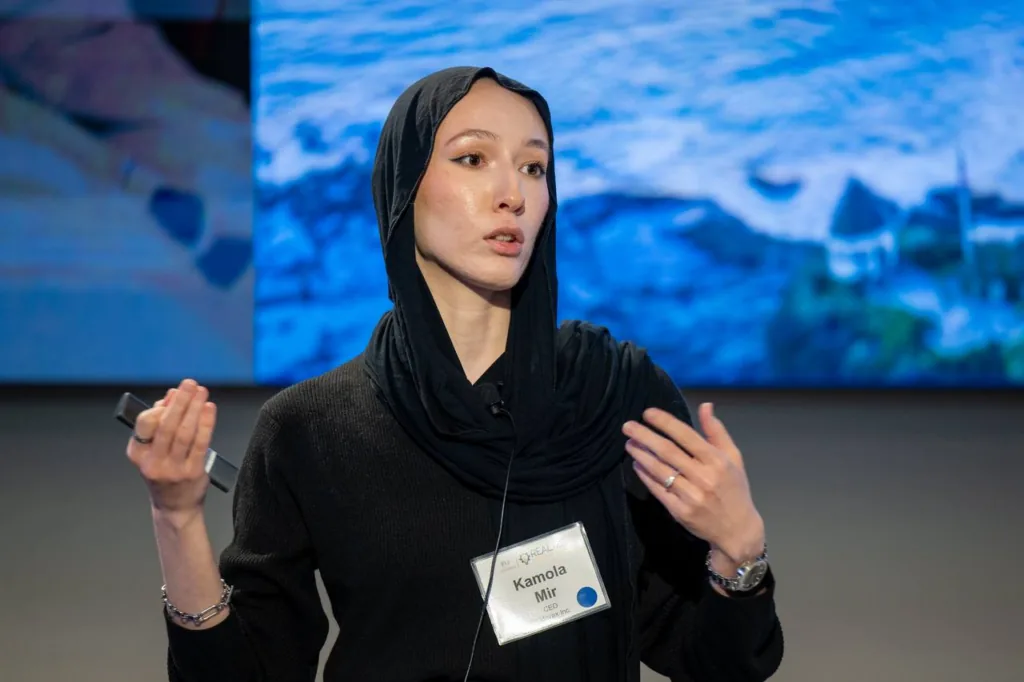
Kamola Mir, City — California, CEO, LinkedIn
About Me
I am a biotechnologist and an expert in maternal health. Currently, I am the CEO and founder of Lidavex Inc. Together with my co-founder Simon Linwood, we established a MedTech company developing medical devices that assist in the childbirth process — for analyzing labor progress and predictive diagnostics.
We are also developing AI algorithms. Essentially, we are creating the world’s first cervical library, which forms the AI infrastructure for FemTech companies. These solutions can potentially be applied in areas such as cervical oncology, fertility, menopause, and other aspects of women’s health.
How I Entered the IT Profession
I started my career at a medical college. Before that, in school, I participated in various projects, mainly in the field of children’s education — we organized volunteer schools. In college, I studied to become a nurse in Tashkent at Borovsky College, where we underwent clinical practices and other medical disciplines. In parallel, I participated in UN projects and student initiatives. Later, I moved due to biotechnology, which led me into the MedTech sector, as biology and biotechnology require programming in R and biostatistics — this is where my acquaintance with coding began.
My interest in MedTech arose after my experience of motherhood. After the birth of my son, I encountered problems that remain unsolved in many countries to this day. At that time, I developed my own device, patented it with the help of professors, and that is how my project began. My professor became my first investor.
The project launched in 2024, following my childbirth experience and my desire to solve a problem faced by women worldwide. The idea came unexpectedly — after a robot vacuum cleaner broke down, I had the thought to use LIDAR technology, which is used in iPhones and cars, for medical diagnostics.
After studying the market, I realized that no similar solutions existed, and together with my professor, we secured a patent in just two weeks. Later, Stanford supported the development of the project in the field of MedTech and women’s health.
It was there that I met my co-founder, who joined the project because he wanted safe childbirth conditions for his daughters in the future. Today, our team consists of 12 specialists from four countries, and our advisors include doctors, engineers, and scientists from Australia, the United Kingdom, and other countries. Currently, we are developing international collaborations and preparing the device for market release.
On Stereotypes
In MedTech, there is often a stereotypical image of a CEO — a man with extensive experience, usually older. Therefore, young specialists and women sometimes find it harder to be perceived as “investable.” I was told directly: “You are not investable,” because investors already impose expectations based on appearance, age, or religious indicators. Even if you are a professional, the first impression is often formed through these filters.
I worked with this through communication. I used the position of a learner: “I need help, can you mentor me?” This worked because people, especially senior leaders, often want to share their experience and feel their significance as mentors. This makes it easier to build connections and receive support.
At the same time, I built my personal brand through my visibility. At conferences, I am often the only woman in a hijab, which automatically makes me more memorable. It is important that people rarely remember technical details — usually, an image, story, or emotion remains. Over time, this became part of my personal brand, which I began to use consciously.
And in the end, it works: you start being recognized even in everyday situations. This enhances personal visibility and helps in professional networking.
Barriers for Women in IT
It is important to turn your characteristics and even obstacles into strengths. If you perceive difficulties only as problems, they will remain so. But before an emotional reaction, any situation is simply a task that can be solved.
The same applies to gender discrimination. This is also more of a task that can be solved. Yes, discrimination still exists, but I prefer to turn it into an advantage or a tool. Why not use what distinguishes you or even limits you to your benefit?
For example, if women in IT are not taken seriously only because of their gender, this becomes a kind of filter: it immediately becomes clear which teams and people are not right for you. Phrases like “we are looking for IT guys, not IT girls” are already a signal of a toxic environment.
This approach saves time and resources: there is no need to spend months on interviews and work only to later encounter disrespect. This works as an early filter that helps you quickly understand where you definitely should not be.

Recommendations for Those Just Starting Their Path
- Networking — this is the only thing that works. It has always been this way, not only in our countries but everywhere. You need to know people who know people, because that is how advancement most often happens.
As the joke goes: who has more chances for a promotion in IT — the one who works the hardest, who completes the most tasks, or the “cool” person? Most often, it is the one who is easier to interact with, because networking and “vibe” play a big role. - Do not be afraid to ask for help, but it is important to formulate the request correctly. Not in the format of “I lack money” or “my visa is running out,” but in the format: “Here are my skills, here is my experience, do you have any recommendations or contacts where this can be applied?” That is, it is important not to ask from a position of need, but to show your strengths and look for a match.
Because pity does not get you far. Maybe they will help once, but the interaction will not continue further, because this creates an imbalance in communication. - Use your strengths and keep an eye on trends. Not only in terms of external or fashionable trends, but in the context of the industry. For example, the current trend is AI, so it is important to enter it in time and use this window of opportunity. In 2019, there was a trend for UN conferences — then we used this as a platform for strong networking and contacts.
Such windows of opportunity open and close, and it is important to know how to enter them in time to get the maximum experience, resources, and connections. People you cross paths with in such environments often remain in the industry and continue to influence it further, so this networking only strengthens over time and works in the long term.
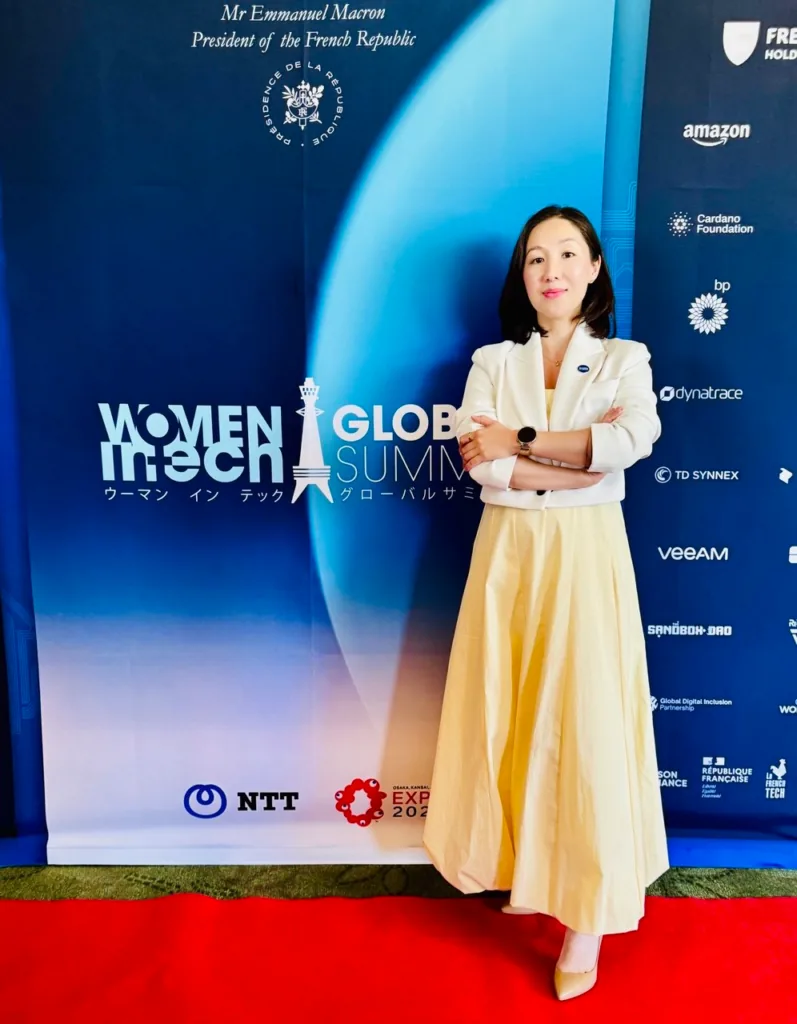
Dinara Kozhamzharova, City — Almaty, Senior Lecturer at Satbayev University, Senior Member, Women in Science Leader at Women in Tech Kazakhstan, Board Member at Women in Cybersecurity Kazakhstan, Board Member and Certification Director at ISACA Astana Chapter, LinkedIn

About Me
I am a Senior Lecturer at the Department of Information Systems at Satbayev University, Institute of Automation and Information Technology. My activities cover not only teaching but also participation in professional communities related to technology, science, and cybersecurity.
I am a member of communities such as Women in Tech, Women in Cybersecurity, and ISACA. In Women in Tech, I oversee the Women in Cyber and Women in Science directions, as I am actively engaged in scientific activities and research in the field of cybersecurity. In Women in Cybersecurity, I also participate in community work and board-level directions.
Additionally, in the ISACA chapter, I am the Certification Director and a member of the board team. The organization is engaged in the development of professional certification in cybersecurity and IT audit, including international certifications such as CISA and others. In addition, I am a member of the IEEE organization. Such professional communities provide great opportunities for development: access to scientific publications, participation in international conferences, exchange of experience, and expansion of professional networks.
In my opinion, the strength of such communities is that they truly open doors. For example, in Women in Tech and Women in Cybersecurity, we regularly share vacancies, programs, and opportunities for girls and women in the tech sector, thanks to which access to such opportunities becomes faster and easier.
How I Entered the IT Profession
My education is fully related to Computer Science: I completed my bachelor’s, master’s, and doctoral studies at Satbayev University, where I now also teach.
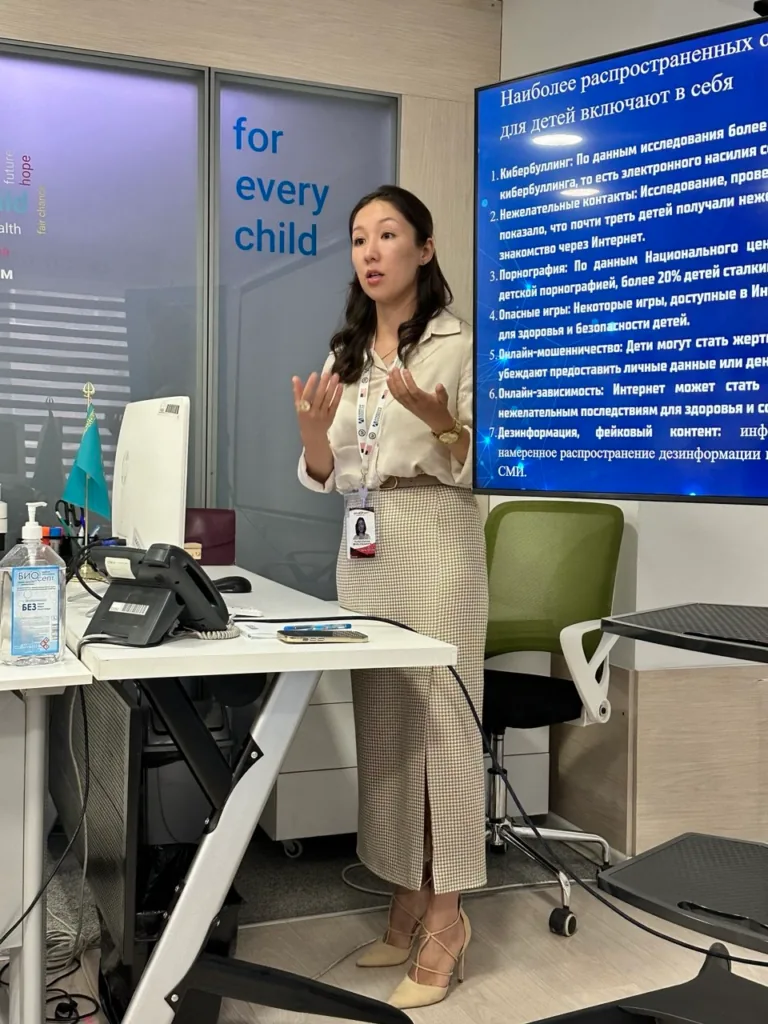
I started my career even during my studies. After graduating with a bachelor’s degree in 2009, I began teaching at Satbayev University, starting with the position of tutor and then lecturer. Later, I moved to the International University of Information Technologies, where I worked for about nine years and grew from a senior lecturer to leadership positions. Among other things, I headed the UNICEF laboratory — one of 13 in the world and the only one in the CIS at that time.
Together with UNICEF, we implemented projects on digital literacy and cybersecurity for children, parents, and teachers, including Digital Literacy and Online Safety for Children, Parents and Teachers.
Later, I served as the acting head of the Department of Information Systems, and in 2024, I returned to Satbayev University as the Deputy Director of the Institute of Automation and Information Technology. Then I decided to focus on science and returned to teaching.
My entire career developed in parallel with education and research. I completed international internships in Warsaw, Suwon University, and Purdue University, and under the Bolashak program — at the University of California, Los Angeles, in the field of Advanced Cyber Security in 2018-2019.
On Stereotypes
There are still few women in cybersecurity: if you look at global statistics, women make up about 25% of specialists in the cybersecurity field, and even fewer in AI. Therefore, cybersecurity is still often perceived as a “male profession.” Although in practice, this has long ceased to be true.
We have good examples of women who have achieved great success in this field. For example, Sultana Mashirova is one of the strongest Kazakhstani specialists in OT/ICS security. There is also the Women in Cybersecurity community, which supports women in this industry and helps develop the professional community.
In the past, men in the industry often treated women in cybersecurity quite skeptically, although the situation is gradually changing now. Similar stereotypes existed for a long time in science as well: it was believed that scientific activity was primarily a male domain. Although, if you look at history, many important discoveries were made by women, but often their achievements were attributed to men.
Now the trend is gradually changing. More and more people understand that women successfully demonstrate themselves in science, cybersecurity, and AI, and professional qualities are becoming more important than gender stereotypes.
Barriers for Women in IT
The main obstacles are related to stereotypes that a woman cannot combine multiple roles simultaneously: being a mother, building a career, running a company, and developing professionally. There are still significantly fewer women in CEO and C-level positions, and one of the reasons is the belief that a woman will go on maternity leave and will not be able to combine family and work.
In reality, this is possible. Yes, sometimes focus is lost, but with the support of those around you, everything is real. Support from other women is especially important. For example, in the Women in Tech community, participants constantly support each other, and such an environment really helps to move forward. When others believe in you, it is easier to believe in yourself.
It is also important to keep learning. The path does not end after university or doctoral studies. In the tech industry, everything changes quickly: new technologies, tools, and approaches appear. If you do not develop constantly, you can quickly start falling behind the industry.
Role models play a big role — women who have already gone through this path. For example, Sultana Bashenova, who had to work “in the field” in cybersecurity and face stereotypes, but she continued and became a strong example for others. Among role models, Asem Ulaganova is also noted.
When you see such women, motivation to move forward appears, and you understand that reaching such heights is possible. The main thing is to believe in yourself, keep working, learning, and not be afraid of stereotypes.
Recommendations for Those Just Starting Their Path
The career path is not always simple. I teach and often ask students: “Did you choose this major yourself, or was it your parents’ decision?” Many answer that they chose it themselves, but there are also those who realize they would like to engage in another field. And there is nothing wrong with that. Today, you no longer have to stay in a profession that does not bring pleasure for your whole life. If a person realizes that this is not their path, they can change the field and look for what is truly interesting.
Therefore, it is important to build a career around interest and internal motivation. Work should bring pleasure and a desire to develop. And even if something did not work out the first time, you can always start over and build a new path.
In the scientific and technological environment, mentors play a big role. In such fields as AI, multi-agent systems, or cybersecurity, it is the scientific supervisor or mentor who helps set the direction of development. After that, the person independently delves deeper into the topic and forms their own expertise.
It is also important to participate in conferences and professional events. In cybersecurity, for example, there is Capture the Flag — competitions where hard skills are tested. On platforms like Women in Tech and Women’s Tech Hub, you can follow events, participate in webinars, and find mentors.
We also have a buddy system format: if you are preparing for certification, you can team up and prepare together. I am currently preparing for CISSP — a cybersecurity certification, and joint preparation helps maintain motivation. Through such communities, you can find vacancies and mentorship.
It is important to maintain curiosity — without it, it is difficult to develop in the tech field. And, of course, you need to invest in professional certifications.
Professional connections are most often formed through communities. For example, when a university needs a speaker, it is enough to write to the professional community — and the right experts are quickly found. Students are also inspired by such opportunities: they participate in volunteering at conferences, gain experience in event organization, and learn through practice.
The main thing is to never stop learning. In any field, constant development remains the foundation of professional growth. And if a person really invests in themselves and works, the result will definitely come.
The Tech on Telegram Follow The Tech on Telegram
Keep up with the latest technology and startup news.
Related reading






More from this author

Article Useful
How to protect your accounts from hacking: 8 settings you should check today
The Tech

Article Useful
500 Global: How the Accelerator Works and Who Can Receive Investments
The Tech

Article Interviews
Game Development in Central Asia: Arkady Moldavski on Developing Reverb and the Growth of the Industry
The Tech

Article Useful
Google, Tesla, BlackRock, and the IMF: Where to Apply for an Internship in Fall 2026
The Tech

News IT
Tesla unveiled the flying electric car Roadster
The Tech

News IT
Intero Biosystems startup won the Startup Battlefield at TechCrunch Disrupt 2026
The Tech