In Astana, the national strategy for artificial intelligence and the digital economy was discussed.
Author - Mansur Ismagulov
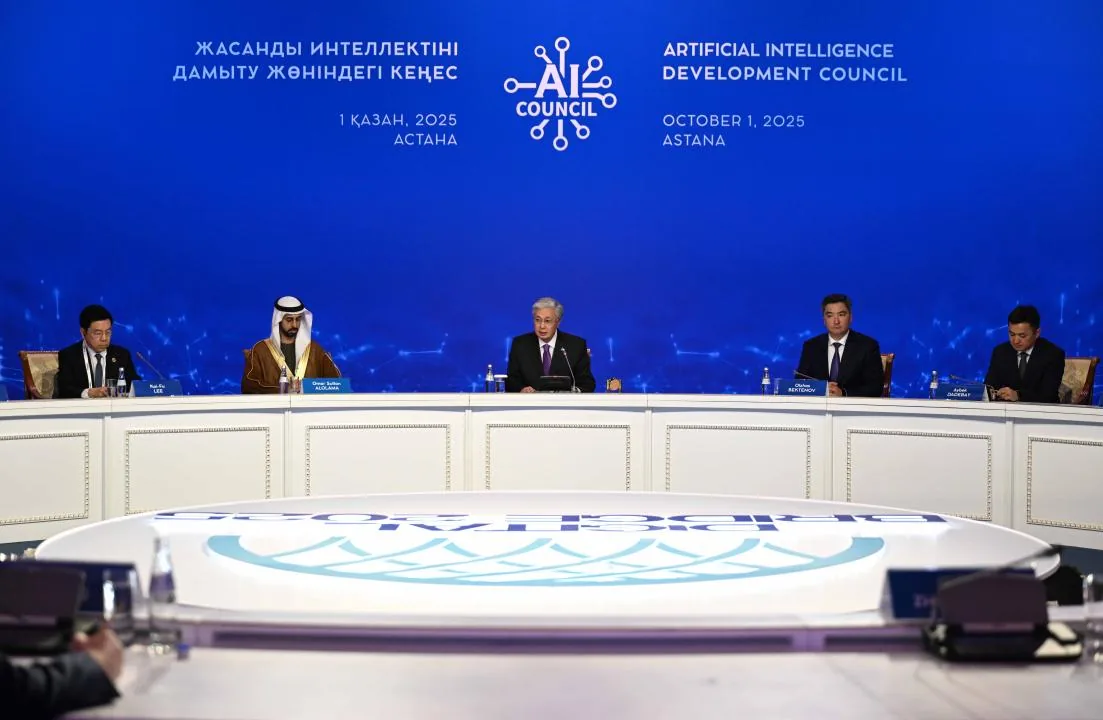
The first meeting of the Council for the Development of Artificial Intelligence under the President of the Republic of Kazakhstan took place in the capital. The event was attended by leading international experts and leaders in the field of artificial intelligence, as well as representatives of government agencies, business, science, and the educational community.
The event was dedicated to the topic “Artificial Intelligence in Education: Opportunities and Challenges.” Participants discussed the institutional environment for AI implementation, infrastructure development, and workforce training for the digital economy, and presented their recommendations.
President Kassym-Jomart Tokayev noted the particular importance of this event. Without the development of artificial intelligence, it is impossible to compete globally. Digital systems and AI have today become a crucial condition for national sovereignty and a driving force for economic growth.
The President also emphasized that humanity is living in an era of profound transformations, where AI exerts a defining influence on the economy, public administration, science, and education. The use of this technology directly affects competitiveness and sovereignty. Artificial intelligence will become the driving force of transformation. Our goal is not merely leadership in the region or the world. The main task is to transform Kazakhstan into a progressive, civilized state. Many countries have already recognized artificial intelligence as a strategic resource of the 21st century, directing significant investments into its development. China is implementing an AI+ plan, and the United States has a strategy for global leadership in this field. Kazakhstan must not lag behind these trends. This is precisely why we have created the Ministry of Artificial Intelligence and Digital Development, which will coordinate and comprehensively implement AI technologies.
A key event of the meeting was the speeches by world-renowned AI experts. Omar Al Olama, Minister of State for Artificial Intelligence of the UAE, spoke about the AI ecosystem and his country’s experience in developing human capital. He emphasized that Kazakhstan and the UAE share a common future in technological development.
Kai-Fu Lee, one of the most renowned futurists and investors in the field of AI, founder of Sinovation Ventures and 01.ai, addressed the topic of sovereign AI and the practical implementation of national models in his speech. He noted Kazakhstan’s boldness in appointing young specialists to key positions in the technology sector.
Richard Stirling, CEO of Oxford Insights, delivered a report on the role of education and human capital in international rankings of countries’ readiness to apply AI. He shared research results showing that students proficient in AI tools learn faster and better absorb material. Kazakhstan, with its strong mathematical school, can achieve impressive results.
Other recommendations were also presented by:
— Olaf Groth, Professor at the Haas School of Business, futurist, and expert in geoeconomics and technology
— John Hopcroft, Turing Award laureate, Professor at Cornell University
— Pradip Khosla, Rector of the University of California, San Diego
— Alexander Khanin, founder of Polynome Group, a company developing solutions in the field of AI and biometrics
— Ebtesam Al Mazrouei, head of the UN’s global initiative AI for Good. She spoke on the topic “National Language Models and Their Role in Education and Science.”
The moderator of the meeting was the Vice Prime Minister — Minister of AI of Kazakhstan, Zhaslan Madiev.
Zhaslan Madiev noted that the national AI ecosystem is developing in three directions: institutional environment, infrastructure, and human capital.
The Mazhilis of the Parliament approved the draft Law on Artificial Intelligence. It establishes the legal and ethical foundations for the responsible use of AI and ensures the widespread application of technologies across all spheres of society and the economy. We are preparing a national strategy that will define Kazakhstan’s transformation into a digital state.
Kazakhstan is actively developing technological infrastructure. In July, the national supercomputing center alem.cloud was launched — the largest in Central Asia. An important milestone was the creation of the region’s first national language model, KazLLM. Together with international partners, Sherkala and AlemLLM were also developed.
This year, the National Artificial Intelligence Platform began operations, providing access to data, computing resources, and language models, enabling the creation of AI agents without programming skills.
Astana Hub plays a central role in Kazakhstan’s innovation ecosystem. Today, it unites 1,700 participants and already has offices in the United States, Saudi Arabia, the United Kingdom, Dubai, and Shanghai. On October 2, the International Artificial Intelligence Center alem.ai will be presented in Astana, with the goal of bringing together experts, startups, and government agencies to develop national AI solutions.
The President emphasized that the experts’ recommendations will be reviewed and used in further work. He also proposed dedicating the next meeting of the Council to the topic “AI — the Engine of the Digital Economy.”
Source: gov.kz
The Tech on Telegram Follow The Tech on Telegram
Keep up with the latest technology and startup news.
Related reading






More from this author

News
zypl.ai begins operations in Japan and focuses on next-generation risk models
Mansur Ismagulov

News
Elon Musk's net worth has exceeded $700 billion for the first time
Mansur Ismagulov

Article Interviews
"Central Asian countries should build a joint ecosystem," — Bekhzod Ismoilov on the development of AI in the region
Mansur Ismagulov

Article Interviews
Bloom's Taxonomy and Engineering Levels: A Practical Growth Model
Mansur Ismagulov

Article Useful
How the IT industry in Azerbaijan developed in 2025: key events
Mansur Ismagulov

News
Tajikistan has become a new member of the regional innovation alliance Central Asian Innovation Hubs.
Mansur Ismagulov