How did Yandex Neuro Scale Kazakhstan go?
Author - Mansur Ismagulov
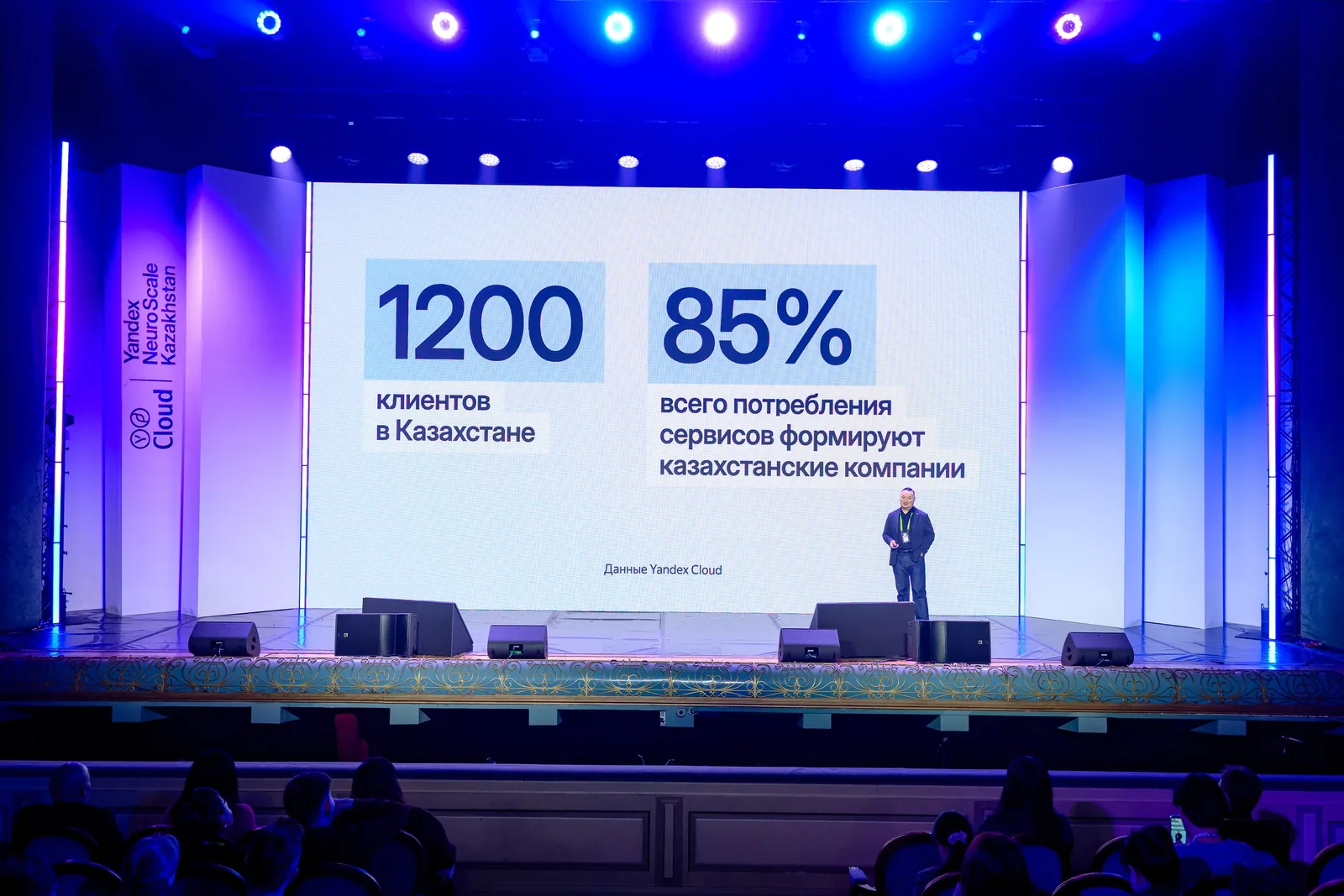
On November 5, the flagship Yandex Cloud conference, Yandex Neuro Scale Kazakhstan, took place in Almaty. This year, the company focused on neural network technologies and their integration into business processes. Experts shared real-world AI implementation cases and presented updates to key Yandex Cloud services.
The conference was opened by Timur Shalekenov, Head of Yandex Qazaqstan; Arystanbek Joldasbekov, General Director of Yandex Cloud in Kazakhstan and Central Asia; and Alexander Chernikov, Operations Director of Yandex Cloud. In their speeches, they noted that AI is becoming not just part of the company's product strategy, but a key element of all cloud services.
Arystanbek Joldasbekov, Director of the Yandex Cloud Public Cloud Platform
We have come a long way from infrastructure to an ecosystem. Today, our mission is to help businesses create "digital employees" and integrate AI into key processes safely, quickly, and efficiently.
Since the launch of the local availability zone, the data center in Karaganda, the consumption of Yandex Cloud services in Kazakhstan has increased 15-fold, and almost fourfold since the beginning of 2025. Currently, about 40 services are localized.
The conference's technical reports were divided into three tracks: Infra & DevTools, Data, and ML & AI. In the Infra & DevTools track, new capabilities of Yandex Object Storage and routing in Kubernetes® were announced. In the Data track, the development strategy for the data platform, event-driven architecture, updates to PostgreSQL, and the Yandex DataLens BI tool were discussed.
In the ML & AI track, which supports the main theme of the conference, Neuro, several updates to key AI services were presented.
Among the announcements were new capabilities of Yandex AI Studio, a platform for developing AI applications. It includes generative neural networks for text and visual generation, speech synthesis and recognition technologies, an environment for training, and other ML tools. Added to these is the Realtime API technology, which allows creating voice agents that respond with virtually no delay.
The development of agentic solutions is part of Yandex Cloud's strategy. In her speech, Elena Belobrova, Head of the ML Services Development Department, explained how to launch an AI agent in a few steps, how it differs from an assistant, and how to turn a website's search bar into a full-fledged AI assistant using the Yandex Search API.
Elena Belobrova also announced major updates to services related to speech synthesis and recognition. Within Yandex SpeechKit, the company created a unified API that allows converting the recognition result into the desired format simultaneously with recognition. The user simply needs to specify what needs to be done with the text: shorten it, check for errors, bring it to a specific structure, etc. The system works with both Kazakh and Russian languages, can translate material from the original language to the desired one, or keep two languages in the text.
Another new feature within SpeechKit is the technology for creating voices in speech synthesis: several hours of a speaker's speech in Russian are recorded, and from this, a voice synthesis in Kazakh is created. That is, the speaker may not know how to speak Kazakh, but can obtain a synthesis in this language with good pronunciation.
In the updated version of the communication analytics service Yandex SpeechSense, an assistant appeared that allows drawing conclusions from Russian-language dialogues in Kazakh and vice versa, attaching your own knowledge base or script to analyze the correspondence of manager dialogues to the script and receive recommendations for improvement, as well as asking absolutely any prompt and receiving the result immediately, without creating reports and long settings.
Elena Belobrova, Head of the ML Services Development Department
We focus on the needs of Kazakhstani businesses, ensuring support for the Kazakh language and seamless transition between Kazakh and Russian.
The conference gathered more than 400 offline guests, and almost 1000 participants joined the online broadcast. The recording is available on the website: kz.scale.yandex.cloud.
The Tech on Telegram Follow The Tech on Telegram
Keep up with the latest technology and startup news.
Related reading






More from this author

News
zypl.ai begins operations in Japan and focuses on next-generation risk models
Mansur Ismagulov

News
Elon Musk's net worth has exceeded $700 billion for the first time
Mansur Ismagulov

Article Interviews
"Central Asian countries should build a joint ecosystem," — Bekhzod Ismoilov on the development of AI in the region
Mansur Ismagulov

Article Interviews
Bloom's Taxonomy and Engineering Levels: A Practical Growth Model
Mansur Ismagulov

Article Useful
How the IT industry in Azerbaijan developed in 2025: key events
Mansur Ismagulov

News
Tajikistan has become a new member of the regional innovation alliance Central Asian Innovation Hubs.
Mansur Ismagulov