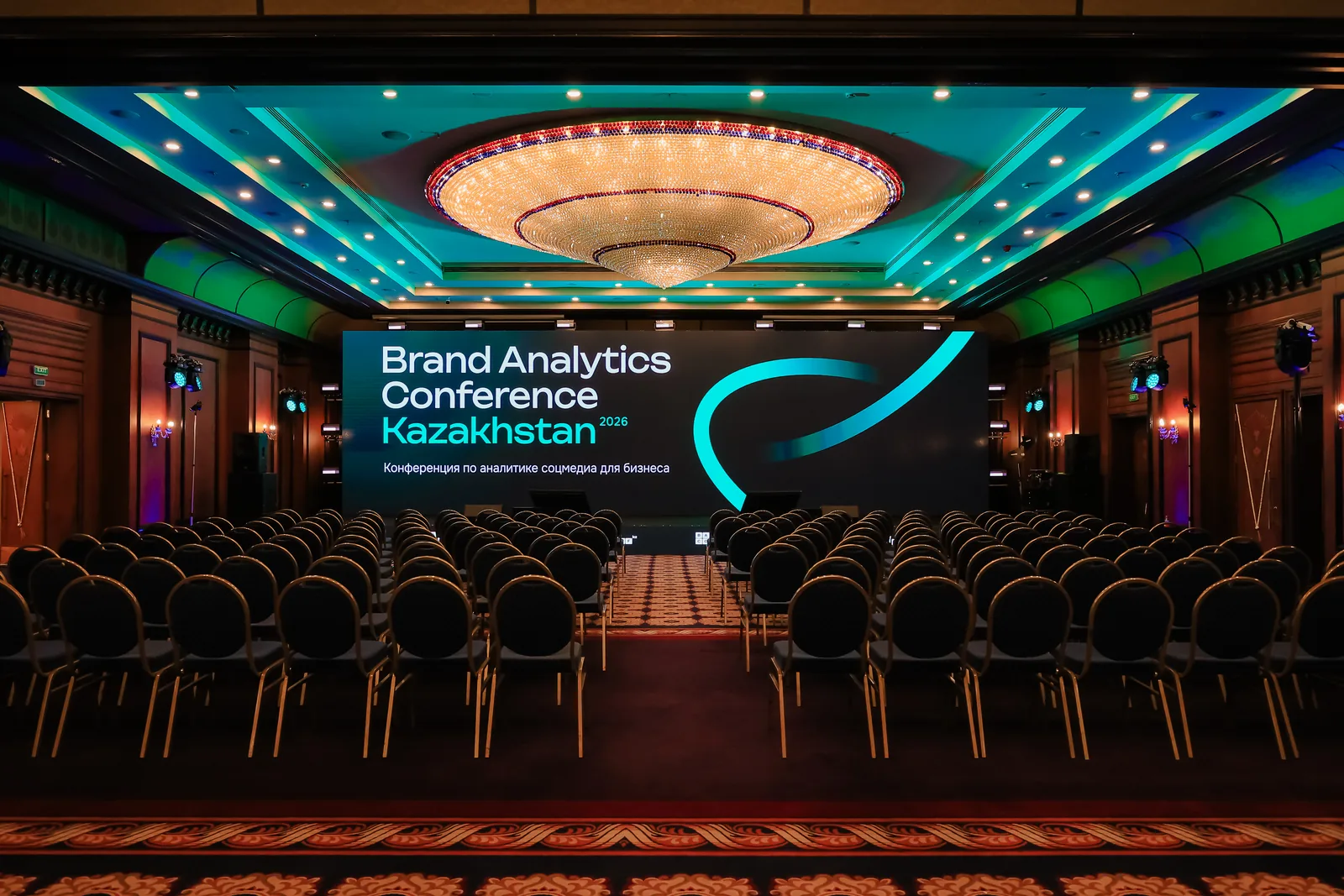
The Brand Analytics Conference Kazakhstan 2026 took place in Almaty.
The Tech AI
Get the key points in seconds - a short summary from The Tech AI.
On September 16, the Brand Analytics Conference took place in Almaty, bringing together more than 200 participants. Experts presented data from a study of social networks in Kazakhstan for the summer of 2026 and a report on the culture of canceling brands. New AI tools of the Brand Analytics system were announced, including support for the Kazakh language in BrandGPT and "Smart Boost," as well as cases of analytics application by large companies.
On September 16, the Brand Analytics Conference Kazakhstan took place in Almaty — a conference for marketers, PR specialists, business owners, and agencies dedicated to social media analytics. Experts discussed the practical application of analytics to solve current business challenges.
The conference was attended by more than two hundred marketers and PR specialists from major Kazakhstani and international brands, as well as media representatives.
Social Network Research
The business program opened with a research block. Brand Analytics presented data from the study “Social Networks in Kazakhstan: Figures and Trends, Summer 2026.” Vasily Chyorny from Brand Analytics reported that the leading social platforms by the number of active authors per month and by the volume of content they created in August 2026 were Instagram — 4.75 million authors and 43.88 million posts — and Threads — 1.23 million authors and 13.52 million posts. Meanwhile, the highest share of posts in Kazakh was on Facebook — 41.4%, Threads — 19%, and Instagram — 18.8%.
The most “female” social networks were Odnoklassniki — 73.9% women, Instagram — 68%, and Threads — 67.3%. The most “male” platforms were VKontakte, where the share of men is 64.8%, Telegram — 64%, and YouTube — 62.9%.
Natalya Ospanova from Alvin Market Research presented the report “The Culture of Brand Cancellation in Kazakhstan, 2026,” in which she spoke about the new reality of reputational crises. She shared data: 78% of Kazakhstani respondents had heard about situations where people began to speak negatively about a brand, company, service, store, or public figure and refused to use them due to a scandal, and 21% personally participated in the boycott or cancellation of a particular brand.
Together with Anna Shelepova from Impact PR, they analyzed situations that lead to brand cancellation and proposed scenarios for handling them.
Experts emphasized that building risk management, including the use of monitoring and analytics, is becoming one of the top priorities for PR specialists. The classic approach with the “red folder” is not disappearing but is being rethought.
Discussion on Trust and Crisis Communications
The central event of the day was the discussion panel “Strategic Communications and Risk Management for Building the Key Brand Asset — Trust.” Participants discussed the topic of bilingual communications and cultural code as the foundation for building trust-based communications.
Viktor Eliseev from TSARA and Alfiya Bzhekeneva from ATLAS Capital spoke about why attention to cultural context helps build trust, while mistakes in this area can lead to a crisis. According to Viktor Eliseev, there are several “Kazakhstans” within Kazakhstan, and communications must be tailored depending on who you are talking to — different target groups have different triggers and media habits. Alfiya Bzhekeneva emphasized that it is no longer enough to simply translate texts from Russian to Kazakh — it is necessary “not to seem, but to be,” as the audience is highly sensitive to artificiality, especially when it comes to trust in a brand.
They also paid attention to GEO — several participants shared their experience and emphasized that GEO requires a restructuring of media planning, and increasing brand visibility in AI-generated responses strengthens the strategic role of PR and highlights the impact of communications on the sales funnel.
New AI Tools from Brand Analytics
Svetlana Verklova from Brand Analytics presented the updated version of the AI assistant within the Brand Analytics system — BrandGPT, which now supports Kazakh, Uzbek, and other languages of the Central Asian region, generating great interest among the audience.
An updated version of the AI tool for automatic message tagging and comment analysis, “Smart Boost,” was also presented — it now also supports work with the languages of the Central Asian region.
In addition, guests were told about MCP integration — a unique market connector that allows accessing Brand Analytics from all popular language models and obtaining analytics, up to a ready-made presentation, without logging into the system.
Among the new features, the “Story Development Tree” was demonstrated, helping to track the path of a news item or article in the media landscape, find the original source, and understand who is driving the story.
New capabilities allow for faster analytics with fewer resources — but most importantly, they do not just speed up data analysis, but enable working with meanings, thereby accelerating the decision-making process.
Cases from Brands and Agencies
The business program concluded with a case studies block.
Conference attendees saw detailed breakdowns of business tasks solved using the Brand Analytics monitoring and analytics system:
— “Bank Through the Eyes of the Client: How Audience Research Became the Basis of the Communication Strategy” — Eldana Rayimzhan from Otbası Bank, Natalya Kladova from Sidorin Lab
— “Almaty Education Situation Center — From Monitoring to a Management Decision Platform” — Igor Sarypov from Presslab, Ardak Smagulova from GNMCNTO
— “What Happens to a Brand Beyond Its Own Marketing” — Ayzada Abaskanova from Mbank Kyrgyzstan
— “Anatomy of Insights: How Social Media Analytics Overcame Skepticism” — Amir Rakishev from Bosch, Ekaterina Arkhangelskaya from RQ/AMDG
— “Analysis of the Strategic Positions of a Bank in the Media Landscape” — Mira Khalina from Halyk Bank, Artur Kuzmin from Media System Group
— “Is It Possible to Manage Reputation in Digital?” — Gaukhar Kerimova from Home Credit Bank.
Participants received ready-made recommendations for work, learned how to make decisions based on data rather than intuition using social media analytics.
The conference ended with an active networking session, where participants made new acquaintances and discussed ideas for potential joint projects.
The Tech on Telegram Follow The Tech on Telegram
Keep up with the latest technology and startup news.
Related reading




More from this author

Article Useful
How to protect your accounts from hacking: 8 settings you should check today
The Tech

Article Useful
500 Global: How the Accelerator Works and Who Can Receive Investments
The Tech

Article Interviews
Game Development in Central Asia: Arkady Moldavski on Developing Reverb and the Growth of the Industry
The Tech

Article Useful
Google, Tesla, BlackRock, and the IMF: Where to Apply for an Internship in Fall 2026
The Tech

News IT
Tesla unveiled the flying electric car Roadster
The Tech

News IT
Intero Biosystems startup won the Startup Battlefield at TechCrunch Disrupt 2026
The Tech