Technical Interview: Preparation for Candidates and Guide for Managers
Sergey Bobkov, IT and information security expert
Author - Mansur Ismagulov

The Tech AI
Get the key points in seconds - a short summary from The Tech AI.
Sergey Bobkov, an expert with 20 years of experience in IT, shares recommendations on preparing for technical interviews for candidates and managers. He emphasizes the importance of practicing skills on platforms like HackerRank and LeetCode, as well as developing system design and soft skills. The article discusses modern trends, including the use of automated screening tools and structured interviews for objective evaluation of specialists.
Sergey Bobkov is an expert with over 20 years of experience in IT and information security, having progressed from a system administrator to the head of IT departments in large companies. He specializes in building scalable and fault-tolerant IT infrastructures and is the author of a methodological guide on creating IT systems from scratch. Sergey possesses deep knowledge in system design, team management, and solving complex technical challenges. In this article, Sergey shares his advice on preparing for and conducting technical interviews, offering practical recommendations for both candidates and managers.
A technical interview is an important stage for both the company and the candidate. Both parties evaluate each other: the employer sees how well the candidate fits the tasks and adapts to the work environment, while the candidate understands what it is like to work in that company and with that team.
My IT career spans over 20 years, and during this time, I have gone through many interviews — both as a candidate and as an employer. This process has changed dramatically in recent years. Today, competition in the IT market is intensifying daily, and requirements for candidates are rising. Technical interviews have become more diverse and focused on real-world tasks that candidates will face on the job.
One of the most important aspects of an interview is preparation. I often notice that candidates, despite having excellent skills, underestimate the importance of preparation. A technical interview is an opportunity to demonstrate not only your knowledge but also how you solve problems under time constraints and increased pressure.
As an IT department head, it is important to me not only how a candidate writes code or solves algorithmic problems. I look at how a person explains their approach, how clearly they can structure their thoughts, and how they react to changes in task conditions. In real work conditions, it is crucial not only to find a solution but also to explain it, work in a team, and discuss details.
I recommend approaching interview preparation in the same way as actual work. Study not only what might be needed for coding or algorithms but also practice working under uncertainty, learn to analyze, and propose solutions for complex business problems.
Preparing for a technical interview for candidates
When I first started my career, the interview format was much more straightforward — discussions of skills, a few questions on technology knowledge, and perhaps a couple of tasks. Everything has changed today. Technical interviews have become a multi-layered process involving several different formats.
One such format that has gained widespread popularity is online interviews using coding platforms like HackerRank and LeetCode. I encounter this format more and more often, especially when hiring for entry-level and mid-level positions.
Candidates are asked to solve problems in real-time. My advice is to practice on these platforms. When I personally recruited teams for startups, I always paid attention to this aspect to see how a person thinks during the problem-solving process, not just the final result.
Another important format is questions on system design. If you are applying for a senior position or an architect role, be prepared to design systems that must scale and ensure fault tolerance. Personally, I often encountered candidates who, despite having excellent technical skills, struggled to explain their architectural decisions. The ability to propose a scalable database architecture, consider load balancing, and describe a system so that it remains stable under high loads — this is what makes a candidate successful in such interviews. I recall how, in one company, we spent a long time discussing how to create a system capable of handling millions of users simultaneously. This is not an easy task, and such cases will help you in interviews.
Reality dictates its own conditions. I increasingly see candidates facing practical tasks related to real business cases. During interviews at R-Vision, I have repeatedly used tasks based on real problems our team faced. This could range from debugging infrastructure issues to optimizing web application speed. Such tasks allow for a deeper immersion into the company's realities, and here it is important how the candidate handles real-life tasks.
Equally important is the assessment of Soft Skills. Over the years, I have seen how a lack of communication skills can negatively impact the interview result. In one of my teams, there was an engineer who was a brilliant specialist, but his inability to clearly explain his ideas and work in a team led to numerous misunderstandings.
When I conduct interviews, I always ask questions that help assess the candidate's Soft Skills. For example, I ask them to describe previous projects and explain how they resolved conflicts within the team. It is important to see how the candidate interacts with colleagues and how they explain their decisions. Often, it is not enough to simply find a solution; you must also convey it to other team members so that it is accepted.
If we talk about examples, I often ask: "Tell me about a situation where you faced a conflict in the team. How did you resolve it?" or "How do you explain technical decisions to people who are not deeply immersed in technical details?" These questions help me understand how a person thinks, interacts with colleagues, and whether they can be part of an effective team.
Thus, preparing for a technical interview is not only about working on Hard Skills but also about the ability to communicate, explain, and make decisions within a team.

Preparing to conduct interviews for managers
In recent years, there has been a number of important changes in approaches to conducting technical interviews, and 2023 was no exception. The main trend is the use of automated solutions for initial candidate screening. Systems such as CoderPad and TechMeetups help managers and HR departments significantly reduce the time spent on initial candidate evaluation. They provide platforms where candidates can take tests on programming languages, algorithms, and technical concepts in real-time. When I hired employees for my teams, such solutions proved extremely useful. This not only saves time but also allows for a more objective assessment of candidates' abilities. For example, the CoderPad system allows you to observe the code-writing process in real-time, which helps see not only the final result but also the entire thought process of the candidate and their approach to solving problems.
In addition to automated solutions for candidate screening, another key trend of 2023 is the active use of data analysis for decision-making in the recruitment process. Platforms like CoderPad provide metrics on task completion time, number of errors, and code quality. This helps, especially in the early stages, when you need to select the best candidates from a large pool. Personally, this approach allows me to focus on key aspects of the interview instead of spending time on routine checks of basic knowledge. Thanks to preliminary data on test results, I can ask more complex questions related to real problems the company faces.
Below I provide a table that will help you easily navigate the tools for conducting technical interviews and choose suitable solutions for your goals.

Structured interviews are one of the most effective ways to standardize the hiring process and avoid subjectivity. Over the years, I have convinced myself that a clear structure allows not only to evaluate candidates faster but also to do so more objectively. It is important to ask the same questions to all candidates to enable comparison of their answers based on uniform criteria.
Advice for candidates and interviewers
For candidates
1. Preparation for questions on algorithms and data structures
When it comes to algorithms and data structures, many candidates make the mistake of thinking they know the "basics." However, even experienced developers sometimes forget that interviewers may ask questions that concern not only theory but also the practical application of algorithms.
It is especially useful to solve problems under time constraints to get used to limited deadlines. Another important point is understanding the execution time and complexity of algorithms. Questions like "What is the complexity of this algorithm?" are quite common, and they should not be underestimated.
2. Practice solving system design problems
One of the best trainings is to independently design scalable systems for various scenarios. Start with something simple: how would you design a web application with a million users? Which databases would you choose? How would you ensure security and fault tolerance? Immersing yourself in such tasks in your free time helps not only to prepare for interviews but also to develop strategic thinking. Work through several such cases and try to explain your solution out loud — this is useful when you are in an interview setting.
3. Improving Soft Skills
Practice talking about complex things in simple language. Try explaining to a friend or colleague how a data structure works or why you chose a certain architecture. This will help you handle interviewer questions related to team interaction more easily and improve your teamwork skills.
For managers
1. Improving the interview process: focus on communication and clarity of tasks
I always believe that a good interview process starts with a clear understanding of what exactly we want to assess in the candidate. Often, technical assignments are too vague or require too much guessing. My advice is to clearly formulate tasks and scenarios so that candidates understand what is expected of them. This helps candidates focus on key points and demonstrate their strengths.
2. Creating a favorable atmosphere
For many candidates, an interview is stressful. Do not turn the interview into an exam. I always start with a simple conversation to relieve tension. For example, you can ask the candidate to talk about their last project or work experience. This not only allows you to learn more about the candidate but also helps them relax and get into a productive conversation. As soon as a person feels comfortable, they demonstrate their abilities better.
A technical interview is always more than just a knowledge check. It is an opportunity for both parties — the candidate and the employer — to understand how they can work together, how the candidate handles challenges, how adaptable they are, and how they interact with the team.
In my methodological guide "Building an IT Infrastructure from Scratch: From Planning to Implementation," I dedicated a significant part to the interview process, both technical and Soft Skills assessment. I share methods that help conduct interviews effectively, as well as recommendations on how candidates can prepare for difficult interviews. I strongly recommend everyone who is thinking about building strong teams or preparing for new career challenges to read it.
Author: Sergey Bobkov
The Tech on Telegram Follow The Tech on Telegram
Keep up with the latest technology and startup news.
Related reading




More from this author

News
zypl.ai begins operations in Japan and focuses on next-generation risk models
Mansur Ismagulov

News
Elon Musk's net worth has exceeded $700 billion for the first time
Mansur Ismagulov
Article Interviews
"Central Asian countries should build a joint ecosystem," — Bekhzod Ismoilov on the development of AI in the region
Mansur Ismagulov

Article Interviews
Bloom's Taxonomy and Engineering Levels: A Practical Growth Model
Mansur Ismagulov

Article Useful
How the IT industry in Azerbaijan developed in 2025: key events
Mansur Ismagulov
News
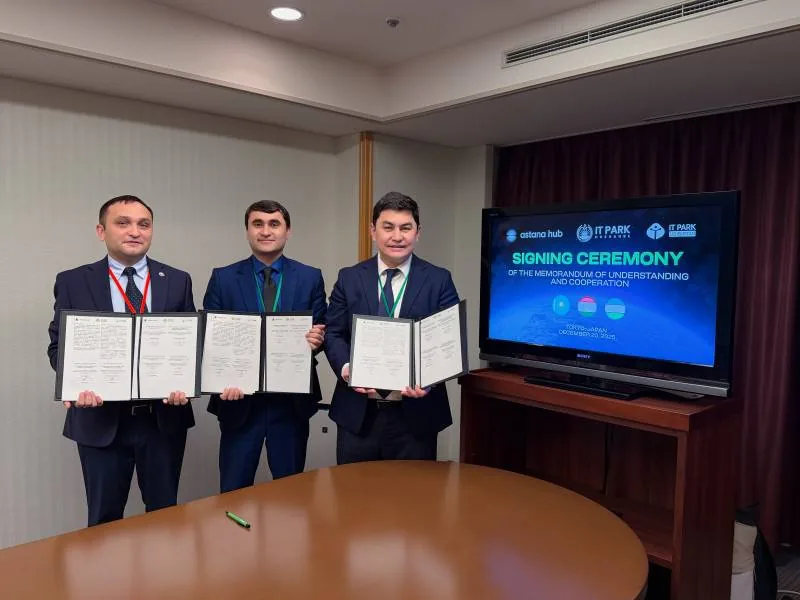
Tajikistan has become a new member of the regional innovation alliance Central Asian Innovation Hubs
Mansur Ismagulov