Tech and sports: how technology helped organize a marathon for 16,000 people
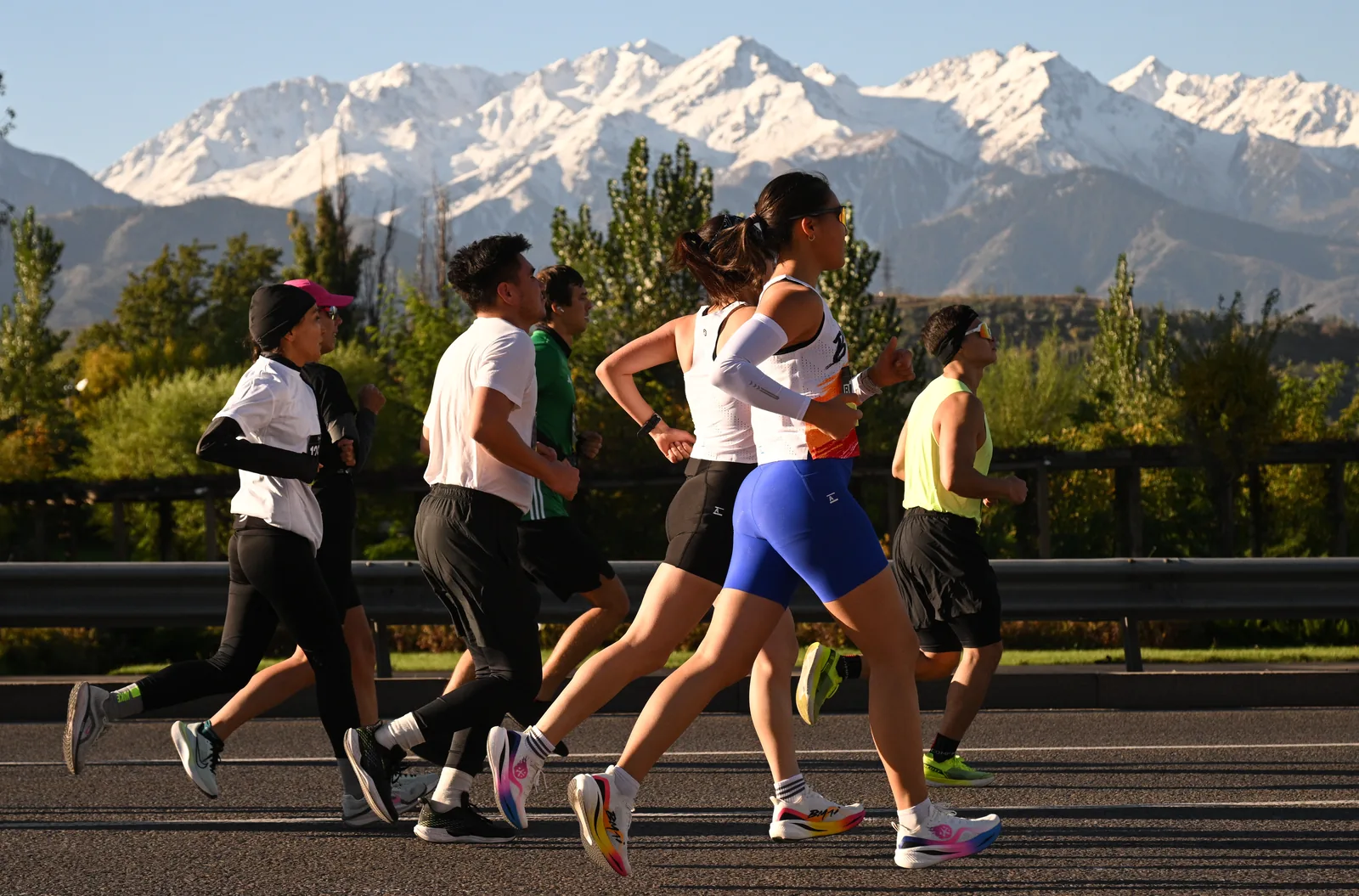
Technologies make life easier and provide confidence — even in sports. How? Read about it using the example of Central Asia's largest startup, Almaty Marathon, in a new article by The Tech.
Author - Mansur Ismagulov
The Tech AI
Get the key points in seconds - a short summary from The Tech AI.
Alibek Abanov, IT Manager of the "Bold to Be First" Foundation, describes the digitalization of the Almaty Marathon: online registration via eGov Mobile, MyLaps timing, and a dashboard with results. On race day, up to 10 specialists from the tech team are on duty; the equipment error margin is 0.02–0.03%. A series of TANs has been launched with synchronization of participant data. Plans include transitioning to a new website engine, an API for data exchange, volunteer registration, and displaying runner movement on a map.
Alibek Abanov, IT Manager at the corporate fund “Boldness to Be First”, Almaty Marathon
In recent years, we have made Almaty Marathon events modern and convenient for participants. A run for a runner consists of four stages: registration, bib pickup, participation, and access to results. Each step is supported by its own technologies.
Runner User Experience
Registration takes place through a simple and clear form on the website. It collects not only basic data but also the participant’s cluster. All data is available in the personal account.
One or two days before the start, participants receive their starter packs at the EXPO. Previously, this required signing a paper health declaration and then standing in line to pick up the pack. We have simplified the process: now the declaration can be signed online via the eGov Mobile app—quickly, conveniently, and directly from your phone.
Our fund is the first and only in Kazakhstan to implement such a feature at races.
On race day, participants can track their results in real time. This has become possible thanks to a newly developed module on the website for uploading and downloading data in online mode from the MyLaps timing system. Special checkpoints—timing points—are installed along the course. The athlete must run through each of them: the time at these points is recorded and automatically transmitted to the system. This allows us to track whether the participant has crossed all control sections, where exactly they slowed down, stopped, or, for example, shortened the distance. All data is sent to the participant’s personal file and is available online.
After finishing, the participant’s data automatically enters a file, which, after verification by timekeepers and the IT team, is automatically imported to the website via a secure UDP channel. Next, the information is sent to the site, where a special algorithm processes it and generates statistics. Just one minute after finishing, the participant can view their results and summary data on the dashboard.
The website displays: average finish time, distribution of participants by distance, gender, and age. A map is also available showing the countries and cities from which runners came. A separate section is dedicated to running clubs—how many participants they represented and which of them achieved the best result.
Convenient Statistics and Dashboard
When a large-scale project can be presented in numbers, it is always interesting. That is why we created the dashboard—a digital panel that reflects key event metrics in real time.
The dashboard helps the team, partners, and stakeholders quickly assess the scale and effectiveness of the event. It allows for the use of accurate data, viewing dynamics, and drawing conclusions—such as how engagement changes, who is running and how, and where processes can be improved.
Technically, it operates based on an algorithm developed by our specialists: the system reads a file with participant data. However, difficulties may arise during the event—it is important to ensure that the participant actually finished at the specified time. Some drop out of the race, while others run slower than last time. Sometimes the chip fails to register—these are rare cases, accounting for about 0.02–0.03% of the total number, which can be considered acceptable equipment error.
Therefore, before uploading data, files are cross-checked, finish video recordings are reviewed, and the time board synchronized with the system is verified. This ensures that every finishing participant receives an accurate result, and the dashboard reflects the true picture of the race.
Almaty Marathon Technical Team
On regular days, two to three people work in the technical department. On race day, the team expands to 10 specialists. These are employees who install equipment at the points and monitor its operation, a senior specialist coordinating the team’s actions on the course, a start operator recording the start, and a specialist receiving data from the dashboard. Additionally, developers are responsible for uploading files to the website and verifying the correctness of automatic parsing.
On race day, I perform the role of chief timekeeper: I work with the timing system, control the correctness of output files, check participant results and their marks on the course. After final verification, I hand over the files for awards and act as the secretary of the chief judge.
Since our courses are certified, we can also prepare official documents for participants wishing to apply for a sports category, such as Master of Sports or Candidate for Master of Sports.

Plans for Implementing New Technologies
This year, the TAN series started. It includes two of our races—Almaty Marathon and Turkistan Marathon—as well as Baku Marathon in Azerbaijan, Bishkek Snow Leopard Run in Kyrgyzstan, and Samarkand Marathon in Uzbekistan. Now you can run through historic Turkic cities and receive a unique TAN series finisher medal.
Our team is developing the series website. A unique participant passport—ID, issued upon registration on the TAN site—is already ready. On the Almaty Marathon and Turkistan Marathon websites, the registration form includes a field for this ID. Using it, we synchronize data: if a series participant runs our races, this information will be displayed in their personal account. At the moment, we plan to implement an API for data exchange between the Almaty Marathon website and TAN.
Also at the Almaty Marathon level, we are preparing to transition to a new website engine, which will be more productive, with extended capabilities and more flexible solutions for our tasks. We plan to implement functions for re-registration and changing the distance—participants will be able to do this themselves through their personal account. We also plan to launch separate registration for volunteers. Currently, more than a thousand volunteers work with us, and it is time to create a full-fledged database with a separate registration form accessible to supervisors.
Plans include developing a mobile application to simplify and speed up service operations on mobile devices. The new website engine will allow data exchange of significantly higher quality, which will also increase the comfort of using Almaty Marathon services.
Another idea we have been working on for a long time is displaying the participant on a map. The implementation turned out to be more complex than we anticipated, but it is definitely necessary and will be in demand. In the results section, participants will be able to not only see their race data but also track their movement along the course or share this information with loved ones and fans.
Technologies allow participants to feel confident at all stages, from registration to receiving results. Register for the Almaty Marathon on September 28 and the Turkistan Marathon on October 26 and check it out for yourself.
The Tech on Telegram Follow The Tech on Telegram
Keep up with the latest technology and startup news.
Related reading







More from this author

News
zypl.ai begins operations in Japan and focuses on next-generation risk models
Mansur Ismagulov

News
Elon Musk's net worth has exceeded $700 billion for the first time
Mansur Ismagulov

Article Interviews
"Central Asian countries should build a joint ecosystem," — Bekhzod Ismoilov on the development of AI in the region
Mansur Ismagulov

Article Interviews
Bloom's Taxonomy and Engineering Levels: A Practical Growth Model
Mansur Ismagulov

Article Useful
How the IT industry in Azerbaijan developed in 2025: key events
Mansur Ismagulov

News
Tajikistan has become a new member of the regional innovation alliance Central Asian Innovation Hubs.
Mansur Ismagulov