Tastamat is a startup that helps companies deliver orders to customers.
We met with Alisher Kogabaev, the founder and CEO of the startup Tastamat. Alisher shared the story of its founding, its uniqueness, and the project's future plans.
Author - Mansur Ismagulov

The Tech AI
Get the key points in seconds - a short summary from The Tech AI.
Tastamat is an infrastructure project founded on December 5, 2017, providing parcel pickup services through lockers. The ecosystem includes 450 terminals in 10 cities and a mobile app; over 400,000 parcels have been delivered in five years. The company collaborates with more than 40 partners, including IHerb and Aliexpress, and the cost of one terminal has been reduced to $600.
How We Started
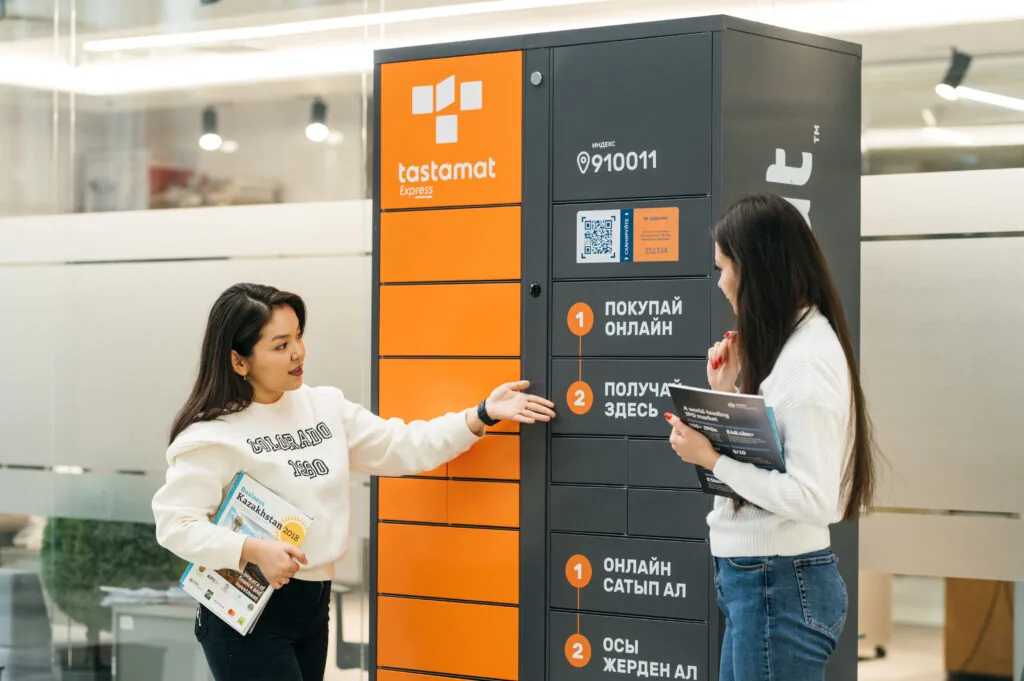
Tastamat is an infrastructure project consisting of modern parcel lockers, serving as a lifeline for KazPost and other logistics companies. Today, the Tastamat ecosystem comprises 450 terminals in 10 cities and a mobile application. Our partners include logistics companies and online stores not only in Kazakhstan but also international companies such as IHerb, BoxBerry, and many others.
The company was founded on December 5, 2017. Thanks to Tastamat, people can receive their orders and parcels at a convenient time and place. There is no longer a need to coordinate delivery times with couriers, travel to the post office, wait at pickup points, or change one’s plans. Our customers are no longer held hostage by the logistics system.
The name Tastamat is derived from the combination of two words: "postamat" (parcel locker) and the Kazakh word "tasta," which translates to "leave" or "put down."
A distinctive feature of Tastamat is that, thanks to the application, logistics companies can offer more comfortable prices to users.
Target Audience
The target audience of our project consists of people who shop online. This includes women, men, teenagers, and older generations.
The pool of Tastamat partners is extensive: ranging from the Chinese marketplace Aliexpress to Pandora jewelry, the Satu marketplace, and many others. Currently, we have more than 40 partner stores and logistics companies.
Over five years of operation, we have delivered more than 400,000 parcels.
Tastamat solves the "last mile" problem. "Last mile" refers to the interaction between the courier and the recipient for order delivery. This is the weak link in e-commerce logistics. Customers are often asked to stay home and wait for the courier. Among all steps in the logistics chain, this action accounts for 53% of delivery costs.
The Idea Behind the Product
In 2017, I worked at JSC KazPost and, together with mutual acquaintances and colleagues in Astana, began studying the local and international markets and the experience of those who were already involved in parcel lockers or had experience in this field.
At that time, there was only one company in Kazakhstan offering similar solutions: KazPost, which was implementing this project. At that time, 150 parcel lockers had been installed in the country. We realized that the future lay in e-commerce, but the infrastructure was underdeveloped. When we analyzed the cost of the parcel lockers purchased by KazPost, we found that each locker cost KazPost $10,000. We considered this expensive and decided to make them cheaper.
Thus, the first terminal cost us $1,000, marking our first major victory—we managed to reduce the cost from $10,000 to $1,000. We continued to improve the design: removing unnecessary components and replacing materials. Now, our terminals cost no more than $600 each, including delivery and customs duties.
About the Team

At the start, we were four or five people: some were strong in sales, others in attracting investments, some excelled at negotiations, while others developed digital products. We coded ourselves and assembled the first prototype.
The average age of an employee at Tastamat is 25 years. We employ young IT and PR specialists, project managers, marketers, and financiers who have professional backgrounds in their respective fields and have worked in the largest national and international companies. There are also employees who joined us as interns while still students. All of them have since defended their theses and continue to work with us, bringing value to both the company and society.
Challenges
One of the difficulties was software development. Our priority was simplicity of use for end users and potential partners when integrating our systems.
The second challenge was attracting investments. We needed to find people who believed in this project and would invest in our startup.
The third challenge was assembling a team capable of high-quality and efficient project implementation, which we successfully overcame.
However, the biggest challenge came in March 2020, during the pandemic. In startups, there is a concept called the "Valley of Death." The pandemic became our turning point away from the "Valley of Death." It was our first exam, which we passed with distinction. However, we are still returning to the performance levels we had before the pandemic.
Achievements
In 2018, we completed an acceleration program at Astana Hub, and the following year, we entered the Top 100 startups in Asia. We also presented our project at the Echelon Asia Summit 2019 technology exhibition held in Singapore.
The venture capital fund BeInTech invested $1,500,000 in our project.
Additionally, we attended a postal industry exhibition in Hamburg, where we observed all major global players in the logistics market.
In 2021, Tastamat received the title of "Best Enterprise of Kazakhstan."
We doubled the number of partners. According to annual figures, the monthly user growth rate from 2021 to 2022 was approximately 40%.
In 2022, we collaborated with the official TikTok office and received a grant of $5,000 to promote our brand on their social network. Currently, Tastamat has over 16,000 followers on TikTok.
We also pursued scaling: by 2022, we had 200 terminals in Kazakhstan, and by the first quarter of 2023, we had manufactured an additional 250 terminals, which are now ready for installation.
Plans for 2023
We plan to scale up to 1,000 terminals, installing and launching them. In numerical terms, we aim to deliver more than 800,000 parcels, doubling our current volume.
In 2022, we experienced our first expansion by entering the Kyrgyz market, where we installed and launched two terminals: in Bishkek and Osh. Our plans include further development, entering neighboring countries' markets, scaling both in the near and far abroad, developing the project, and creating competition with major players who have similar businesses in other countries. We also aim to become a unicorn.
The Tech on Telegram Follow The Tech on Telegram
Keep up with the latest technology and startup news.
Related reading







More from this author

News
zypl.ai begins operations in Japan and focuses on next-generation risk models
Mansur Ismagulov

News
Elon Musk's net worth has exceeded $700 billion for the first time
Mansur Ismagulov

Article Interviews
"Central Asian countries should build a joint ecosystem," — Bekhzod Ismoilov on the development of AI in the region
Mansur Ismagulov

Article Interviews
Bloom's Taxonomy and Engineering Levels: A Practical Growth Model
Mansur Ismagulov

Article Useful
How the IT industry in Azerbaijan developed in 2025: key events
Mansur Ismagulov

News
Tajikistan has become a new member of the regional innovation alliance Central Asian Innovation Hubs.
Mansur Ismagulov