Surfaice — a startup that is implementing AI on construction sites in the US
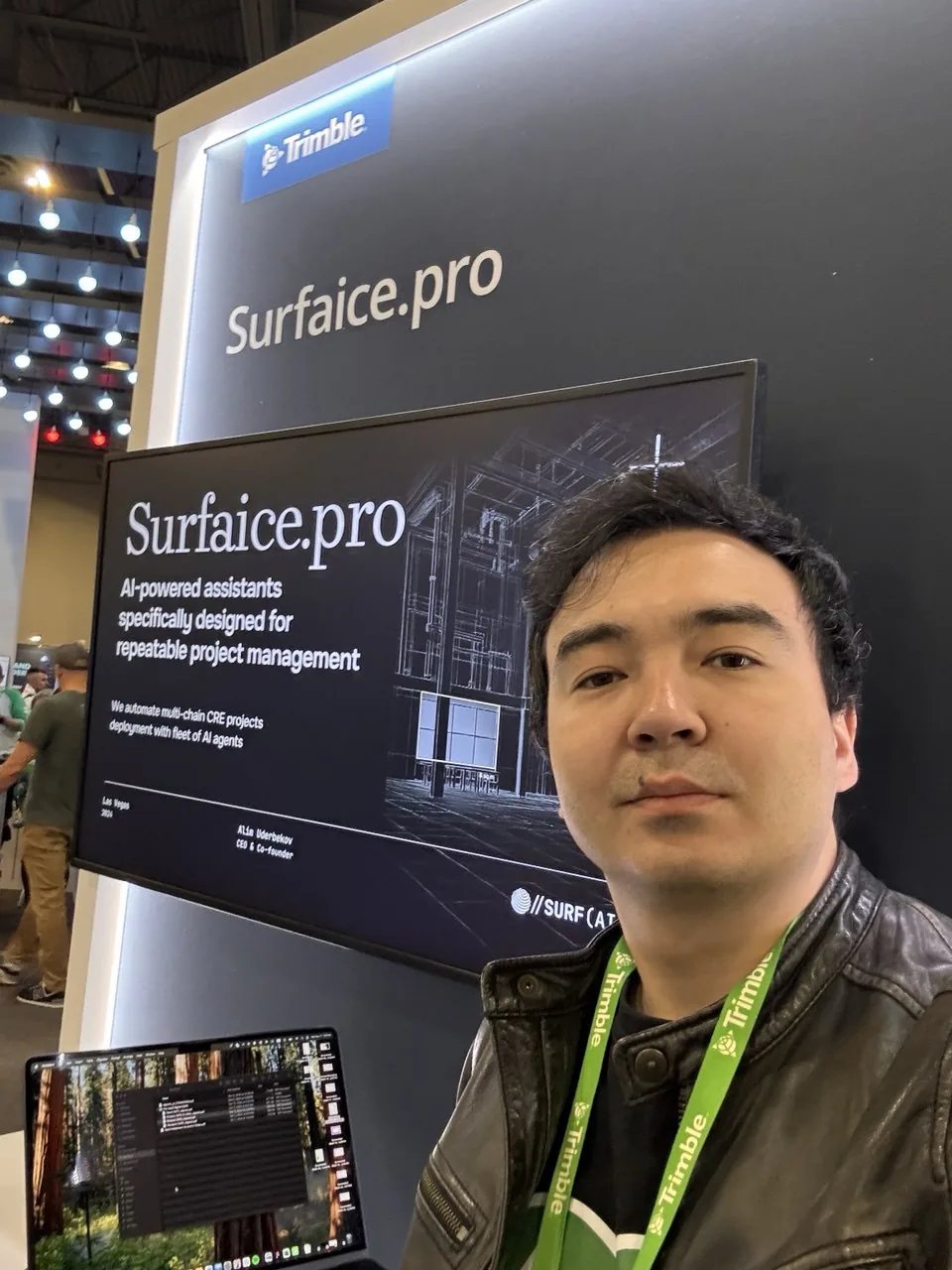
The Tech team interviewed the US-based startup Surfaice — winner of Road to TechCrunch 2025, which is integrating AI into construction projects and preparing to scale in San Francisco.
Alim Uderbekov, location — Palo Alto, CEO of Surfaice, LinkedIn
About Me
I have always considered myself an entrepreneur, and my strength lies in product thinking. I graduated from Bauman Moscow State Technical University with a degree in "Space Complex Management." There, I realized the main thing: an engineer is someone who creates solutions that change the world. For example, a built bridge is not just concrete and metal, but thousands of years of time that people save by moving faster. This is the essence of engineering — creating value on a societal scale.
To me, an entrepreneur is like an artist, except their "paintings" are new technologies and products. My interest in construction comes from my family: my father, a mathematician by training, opened a construction company in the 90s, and from childhood I saw how houses and projects were created. I literally persuaded my parents to buy me my first computer for calculating estimates. I think this shaped my view of the industry.
Construction is not the easiest sector, and implementing innovations there is especially difficult. Even teams from Berkeley and Stanford, who raised $25 million for an AI solution for analyzing blueprints, returned almost all the money after six months, stating: "Builders don't need innovations." But precisely because of this, I believe there is a huge opportunity here — to transform an industry that shapes our world but remains conservative and technologically backward.
The Team
This is not my first startup; I have built companies before. I cannot say that I have developed a clear playbook for myself, but generally, the industry dictates its own rules.
When building a startup, the first thing you need to do is build a pitch, a story. But the story is always built around a problem. So, I started by simply arriving in the US and looking for a problem. I looked for it this way: I imagined that I wanted to build, say, a four-unit house in America, and started figuring out how it all works, what the entire process looks like.
Immersing myself in this, I realized that the process is extremely inefficient: you spend a lot of resources and time. For example, a house in the US takes two years to build. Of that, actual on-site work lasts at most a year, while the remaining 12 months are waiting: while you get permits, gather documents, find contractors. In reality, nothing happens on the site during that time.
And this is inefficiency. Although it has long been proven: in China, 30-story buildings are built in 24 hours. So, we know how to build fast. The question is — why isn't this done everywhere? The answer: because the process is expensive, cumbersome, and inefficient.
That is where the idea came from — why not delegate the management of construction site data to artificial intelligence? A system that can work with data could manage the construction itself. If we imagine the future, it is obvious: in 5-10 years, AI will manage all types of construction in the world. Just as it is now impossible to imagine construction without blueprints, soon it will be impossible to imagine construction without AI managing everything.
That is how we started digging in this direction. I began communicating more deeply with builders and realized another thing. Since AI is an advanced technology, it is important to find those who need it. And most builders, as it turned out, are not interested in this.
Take a simple example: apartment renovation. If a builder makes a mistake somewhere or finds a problem, he almost always shifts this onto the client. Additional permits are needed, the tiles do not fit, there are extra costs — in the end, the customer pays. The builder acts as an intermediary who formally represents your interests, but in reality, benefits from inefficiency. The less transparent the construction, the more opportunities he has to take a part of the budget.
Then I asked myself: who is the most efficient builder in the market? And I realized — it is McDonald's and Starbucks. They are interested in building quickly, cheaply, and uniformly. They clearly understand exactly what they want to build.
Here is a simple example: if I say "imagine a 12-story residential complex," you will have one image, I will have another, and they will match by 20%. But if I say "imagine a McDonald's by the road," then our images will match by 80%.
Therefore, we started focusing on standard projects. If AI manages construction, it is obvious that it will first work with such projects: repetitive, standardized, where creativity is not needed, but precision, meticulousness, and complete adherence to the template are. It is exactly these projects that we began to digitize.
Target Audience
We focus on construction companies that primarily implement standard projects. Today, among our clients are major retail brands in the US opening more than 300 stores annually, as well as restaurant chains that consistently launch new locations. In America, we are also running pilots with other large companies. In Kazakhstan, we work with a number of local customers.
Currently, we have seven clients — that is not many, but this pace is chosen consciously. Our goal is not to "quickly make a small solution for everyone," but to deeply integrate an AI agent into construction processes and build a vertical model.
The main users within companies are construction directors, owners, and management. It is they who receive the key benefit from efficient construction organization, and the product is built around their needs.
A separate direction relates to projects as such. One of the most standard and socially significant projects in the world is school construction. We raised this issue at a meeting with the president, noting that for Kazakhstan, this is a strategically important task. Today, schools are overcrowded: there are 50-60 students per class with a norm of 20, teachers are overloaded, and infrastructure is worn out.
We believe this creates long-term risks for the country. Therefore, our initiative is to use AI for accelerated and more efficient school construction. In this logic, the state becomes an important client for us — in the form of akimats, who manage such projects.
Incubation Programs
We are residents of Silk Road Innovation Hub and Astana Hub, thanks to their teams for the support. Thanks to the hub, I made it into the top 20 entrepreneurs of Kazakhstan, we went to Draper University, where we underwent acceleration and the Hero Training Program. In addition, we participated in Antler in Austin, USA.
So, we are really going through this entrepreneurial journey and moving forward. My feeling is that this is all very useful. Accelerators help you get to the right people and clients faster, make intros, give you understanding, and ease soft landing. But the most important thing is your belief that you are creating value.
If you have talent and you are driven by what you do, you will still break through and find a way out of any situation. Of course, the environment helps, but if talent wants to develop, it goes itself to where it can grow.
Therefore, I believe that an accelerator is an important tool, especially at the beginning of the path. But I want to say to those who are currently in entrepreneurship: if you are not in an accelerator, do not worry. This does not mean that you are not developing or achieving nothing. Just as you can learn mathematics without going to school, in business, you can move forward in different ways.
Difficulties
I would say this: the hardest thing is to be an entrepreneur.
I once received an important lesson. Everyone has a goal — to build something big, to achieve success. Everyone wants to drive a "Ferrari," live in Miami, have big houses. But it is obvious that not everyone who actually achieves this has goals. So, the mere presence of a goal does not guarantee a result.
No matter what coaches and public figures say, I am convinced: a goal does not determine achievement. Therefore, it is important for an entrepreneur to understand — success is not outside, success is inside. Everything depends only on you.
An entrepreneur is a person who ends each day with the understanding: "I am happy because of what I did today." For me, such a driver became, for example, a call from a client who said: "Guys, I use your product every day, it is fantastic, we are delighted." This truly fills you with energy.
The second thing is learning. You need to learn constantly. The hardest thing is to overcome yourself. If you have not attracted investment, the reason is not a bad investor, not the market, not the country. The reason is that you did not do something, did not refine it, did not think it through.
And honesty is important here. The ability to admit: "I am not good enough yet, I need to work more." This is that very state of stay hungry, stay foolish. Sincerity with oneself is the most difficult part of the path. And this applies not only to business, but also to the formation of personality in general.
My advice to founders is this. It is important to be a valuable person — a person who brings value. Not the one who is known the most, but the one who gives the most benefit.
Often young entrepreneurs ask questions: "How to build a unicorn? How to launch a startup? What metrics to show?". But this is the wrong focus. The real question should sound like this: "What should I do today to be closer to success tomorrow? To create a startup that will be useful to people, bring joy, and at the same time make me happy?".
Every day you should honestly ask yourself: did I do today what I should have done to get closer to this state? It is from here that growth begins.
The answer is simple: today you need to bring more value than yesterday: a doctor — to perform more operations and better than before, a teacher — to teach more children and inspire them, a builder — to complete tasks faster and with higher quality, helping people and companies.
If step by step the value increases, sooner or later a moment comes when people start wanting to work with you on their own. And the market seems to push you to scale.
A simple example: if a manicurist is good, more and more clients will come to her. Over time, she will open one salon, then the second, the third. Her final product remains the same — satisfied clients who leave happy.
Achievements
We are still alive, and this, in my opinion, is the most important achievement for a startup. If we talk about the path, then yes — we attracted investment in the US, including from one of the leading construction tech funds. I have a strong partner in America — she built the 7-Eleven chain, managed a budget of $1.5 billion, was a senior director, and managed up to 350 stores a year and 1,200 renovations.
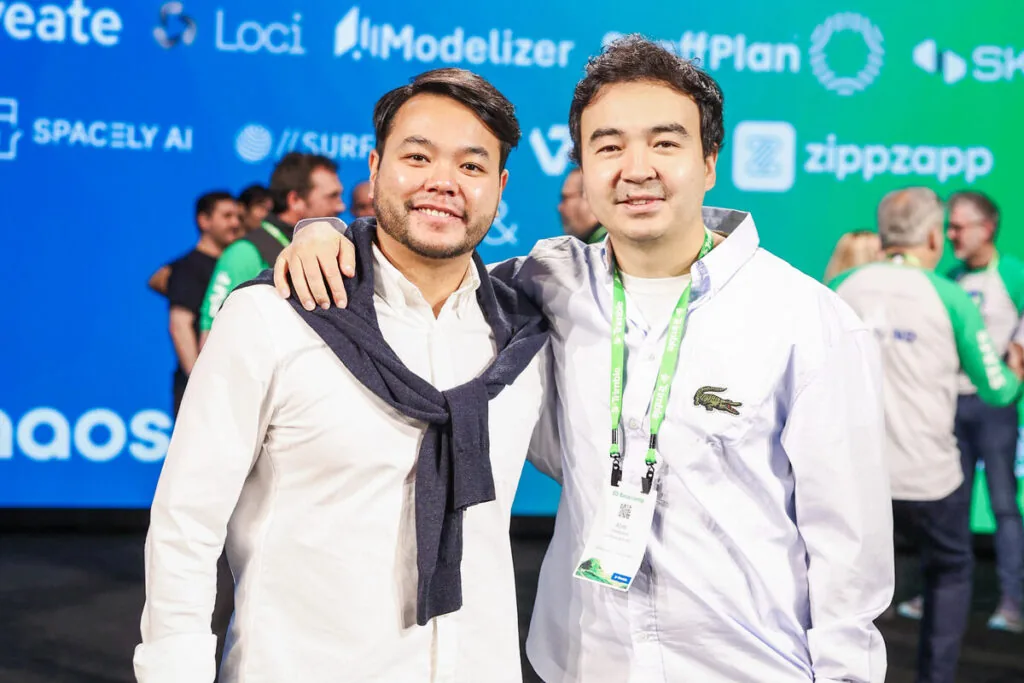
I have an excellent team. The best CTO of Kazakhstan and Central Asia for 2023 joined us, very talented guys are working here. In this regard, we have something to be proud of. I am proud of my team, our results, and I am glad to be in the moment in which I find myself.
But at the same time, I always remind myself: all this is just a stage. The startup exists today, but tomorrow it may not exist. It is important to simply keep moving. Therefore, I do not want this to sound like "successful success." For me, the philosophy is closer: a samurai has no goal — a samurai has a path. It is the path that is more valuable than the individual peaks that have already been overcome.
Plans
Our plan is to continue to live and move forward. In short, our main goal right now is to show that with the help of artificial intelligence, a construction project can be built completely.
We want to reach a point where an engineer can simply say: "Assistant, build me a McDonald's restaurant in San Francisco," — and the agent independently launches the process. It would find a location, send an inspector for measurements, collect data, calculate the budget, prepare preliminary drawings and a work schedule, select a team, prepare tender documentation, and find contractors. The entire chain — under AI control.
Our mission is to create the first precedent in the world where artificial intelligence is capable of managing a project entirely. Just as engineers once invented technologies that saved humanity thousands of years, we want to show that in construction, it is also possible to reach a fundamentally new level of efficiency. This is our goal, passion, and drive.
And, of course, I want to thank those who support us on this path. These are Astana Hub, Most Ventures, Big Sky Capital, Sturgeon Capital, as well as clients from Kazakhstan who became our first partners. Special thanks to Astana Hub for sending us to Draper University. This is important to me, and I am sincerely grateful to everyone who believes in us and helps us move forward.
The Tech on Telegram Follow The Tech on Telegram
Keep up with the latest technology and startup news.
Related reading






More from this author

Article Useful
How to protect your accounts from hacking: 8 settings you should check today
The Tech

Article Useful
500 Global: How the Accelerator Works and Who Can Receive Investments
The Tech

Article Interviews
Game Development in Central Asia: Arkady Moldavski on Developing Reverb and the Growth of the Industry
The Tech

Article Useful
Google, Tesla, BlackRock, and the IMF: Where to Apply for an Internship in Fall 2026
The Tech

News IT
Tesla unveiled the flying electric car Roadster
The Tech

News IT
Intero Biosystems startup won the Startup Battlefield at TechCrunch Disrupt 2026
The Tech