Stanford University professor on the secrets of creating startups and innovations through questions
Paul Kim, Associate Dean at Stanford University, explained how artificial intelligence helps create startups and why everything starts with the right questions.
Author - Mansur Ismagulov
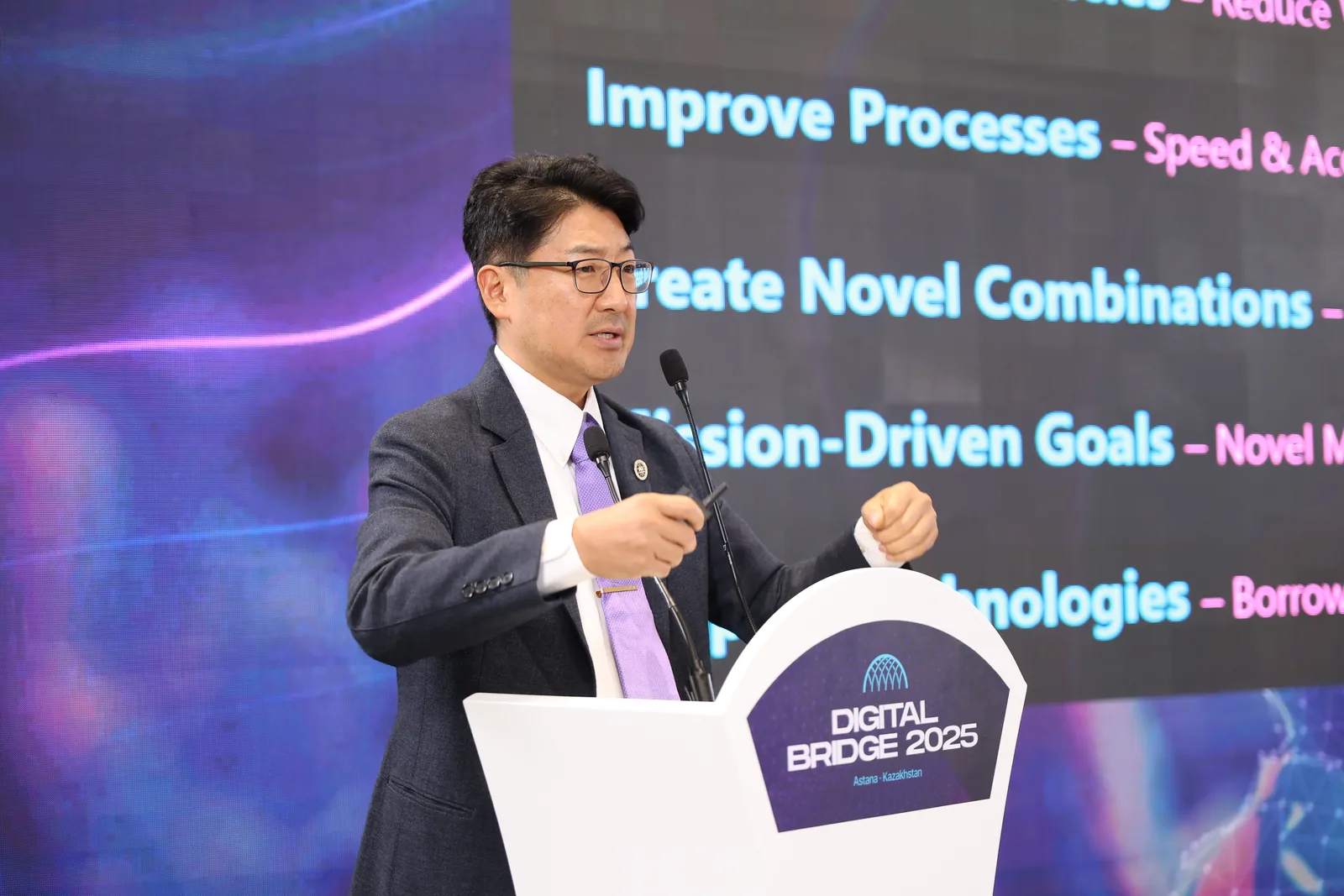
Paul Kim, Associate Dean and Chief Technology Officer, Stanford Graduate School of Education
The AI Era and the Power of Questions
I see tremendous energy and enthusiasm around AI—and it is inspiring. The main point I want to convey is that we need to learn how to ask good questions. This is a key skill in the age of AI.
I am an advisor to RoboMentors, RoboScapital, and Uni—EdTech startups. Previously, I founded several organizations, worked at the World Bank, and have been teaching at Stanford University for 25 years.
When you see a photo of me playing with a small robot dog, what comes to mind? What questions arise? This dog is smart: you can talk to it, it can teach children English, act as a security guard, or provide emotional support. Then the question arises—do we want a real dog or such a one? What will happen if such dogs become commonplace and are constantly by our side? They listen, remember, and interact. Imagine how this will change society. I am confident that within a year, a similar dog can be bought for less than a phone.
This is a new phenomenon, and it is important to ask questions about it. I have worked in the field of education for many years, and the AI market here is growing incredibly fast.
Here is an example: a boy named Leo, a fifth-grade student, shows me on the screen how cosine similarity works. He is playing with artificial intelligence. Even third-graders can already use AI. Leo asked a question: “Can an AI-based solution be created to help African regions escape poverty?” An unusual question for a child, but AI helps him realize his idea. He uses the Replicant tool, which turns a question into code: it generates an interface, checks the program’s functionality, and creates the structure. All that is needed from a person is to come up with a good question.
As a result, Leo developed a system of swarm drones that explore the land, find water, minerals, and fertile soils. They fly, return to recharge, and continue their work. And all this was done by a fifth-grade student.
If a child is capable of this, you can achieve much more. We live in an incredible time: imagination becomes creation. If you can imagine it, you can create it. AI will help bring the idea to life, but creative thinking remains the fuel for innovation.
Learning Through Questions
Google once created a system called Dory—named after the fish from the cartoon “Finding Nemo” who constantly forgets everything. The idea was to encourage employees to ask questions. Eric Schmidt, former CEO of Google, said: “We run the company not on answers, but on questions. Answers are always there. The important thing is to ask the right questions.”
This also applies to education. In the age of AI, it is important to be able to ask fundamental questions—the ones that no one asked before. It is precisely such questions that drive learning and innovation forward.
I developed the SMILE project—Stanford Mobile Inquiry-based Learning Environment. Its goal is to help people come up with creative questions. Perhaps we were not taught to ask questions creatively in school, but the system helps improve questions step by step.
I conducted research in different countries. In Kuala Lumpur, for example, competitions on creating questions using AI took place on a large screen in a shopping mall. I managed to collect more than 30,000 examples, and the results showed that AI indeed helps people become more creative. Creative questions are the fuel for innovation.
On the smile.stanford.edu website, you can create groups, discussions, and assignments. AI evaluates questions, suggests how to improve them, and makes the formulations deeper and more inventive. If you don’t want to configure anything yourself—AI will do it for you: it will create a group, select a topic like “rapid prototyping” or “startup evaluation,” and you will be able to discuss ideas with others. Everything has become simpler than it was ten years ago, but much smarter.
Take your phone, register—and start with questions. Come up with those that will help you understand how you can develop a country, business, or education in the era of artificial intelligence.
From Ideas to Innovations
How to create innovations? It all starts with a question. What comes to mind when you see something new? For example, that very robot dog. How can you use its potential? How can you reduce inefficiency, minimize waste, increase accuracy? Or what can be combined to create an innovation? For example, a medical drone delivering medicine, or a system that uses AI to search for new drug compounds.
You can look at things through a “temporal lens.” In a few years, robot dogs will become commonplace. Companies will appear that sell accessories, training programs, and services for robots. If this happens in two or three years—what products will be needed then? These are questions that should be answered now.
Another approach is the “stakeholder lens.” If robots interact well with children, they can help the elderly, teachers, or medical staff. By changing the perspective, you can find new directions for development.
I know companies that already use AI for agriculture—analyzing plant conditions and forecasting yields. They should think about the future: satellite monitoring, new industries, predictive models. Or the company Smart Mining—they deal with predictive equipment maintenance. Today they are small, but in a few years they will be able to enter international markets and use satellite data.
So you need to think—two to three years ahead. By designing solutions for the future, you create real innovations.
Key Takeaways
AI is not the goal. It is a tool that helps you achieve your goals. Using AI for the sake of AI itself is a mistake.
You need to look for opportunities in different industries, forecast the future, and prepare in advance.
The Tech on Telegram Follow The Tech on Telegram
Keep up with the latest technology and startup news.
Related reading







More from this author

News
zypl.ai begins operations in Japan and focuses on next-generation risk models
Mansur Ismagulov

News
Elon Musk's net worth has exceeded $700 billion for the first time
Mansur Ismagulov

Article Interviews
"Central Asian countries should build a joint ecosystem," — Bekhzod Ismoilov on the development of AI in the region
Mansur Ismagulov

Article Interviews
Bloom's Taxonomy and Engineering Levels: A Practical Growth Model
Mansur Ismagulov

Article Useful
How the IT industry in Azerbaijan developed in 2025: key events
Mansur Ismagulov

News
Tajikistan has become a new member of the regional innovation alliance Central Asian Innovation Hubs.
Mansur Ismagulov