"Practical experience helps to understand how life works," — Alla Klimenko, CEO of MadDevs, on starting a career in IT
In an interview, Alla Klymenko talked about her journey in IT, the initial challenges she faced, and gave advice to beginners.
Author - Mansur Ismagulov

The Tech AI
Get the key points in seconds - a short summary from The Tech AI.
Alla Klimenko, CEO of MadDevs and Enji.ai in Bishkek, began her career at WorksForWeb after her fourth year of university, where she worked for five years. Her mentor was Vadim Glebov, and challenging moments included stress tests from co-founder Sergey Kokotya. She advises students to start working as early as possible to gain practical experience, as a diploma without practical experience is less valuable.
Alla Klimenko, city — Bishkek, CEO of MadDevs and Enji.ai
About Me
I have a higher technical education. I studied at the Software Engineering faculty at Ala-Too University. I have always been drawn to technology, and I entered the IT field even in school, participating in programming olympiads. Even then, it was clear that this was my path. My family also supported me: my father told me from childhood that IT is the future. I grew up with this thought, and so it happened.
I am the CEO and co-founder of MadDevs and Enji.ai. Enji.ai is a product of MadDevs. I handle the operational and financial management of the company.
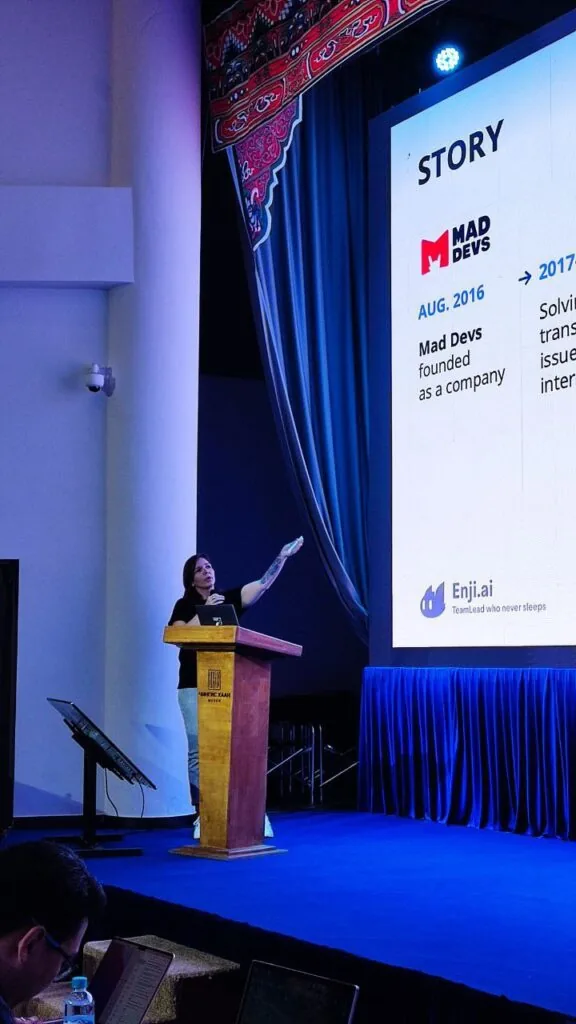
About My First Job in IT
In my fourth year of university, I realized that writing code was not for me, although I was able to do it. At the same time, I wanted to gain practical experience, as the university provided a foundation that had little to do with real life. Teachers gave beautiful theory, and practitioners from companies told us something from books, trying to connect it with their experience, which did not always work out well and did not help students understand what we would face at work.
Therefore, alongside my studies, I submitted two resumes: one for an internship at MegaCom, and the second to a small company called WorksForWeb. I was hired at WorksForWeb immediately after the first interview. I started as a junior assistant to a senior programmer. MegaCom continued to invite me for interviews every two to three weeks without giving a definite answer. So, at some point, I simply did not go to another interview.
At WorksForWeb, it became clear within the first two months how everything we tried to explain at university is connected to real life. I was lucky in this regard — my mentor at the company was Vadim Glebov, who loved telling young people how everything works and how it should work correctly. After a while, I even started explaining to my classmates what we tried to convey at university and how it actually works.
I worked at this small company for five years. I rose to manage the customization department. At first, it was simply gathering requirements from clients and customers and presenting them in a readable format. Then came planning to ensure everything was done on time, and managing expectations. Next was communicating with clients, correspondence, and selling services. It was necessary to gather requirements, calculate costs, and explain why it cost exactly that much. Then I had to check that developers had done everything and test it to ensure it worked correctly.
Over time, there were more projects, and it was necessary to plan work among all parties, manage expectations, objections, and so on.

Challenges
When looking for my first job, the most important thing for me was the opportunity to gain experience. Anywhere, for any money or even for free — the main thing was to start. Students in general need to start working as early as possible, even if the job is not related to their future profession. Practical experience helps understand how life works, commercial relationships, business, and how relationships with clients and customers are built.
The earlier a student starts working, the faster they adapt and accept reality. The base of university knowledge is important, but it has little to do with real life. If you already have work experience, you will be a much more valuable employee than someone who only has a diploma. And even without a diploma, a person with experience is more valuable. I looked for jobs on sites like hh, found two ads, sent my resume, and was invited for an interview.
I did not prepare for the interview at all. I came and said that although I was in my fourth year and knew nothing, I wanted to learn and develop. Since the company was small, decisions were made quickly. It was enough for Vadim to say during the interview, "I want to try working with you," and that was enough to get me hired.
From the challenges, I can recall a peculiar approach to hardening. Once, I had a miscommunication with a client who was dissatisfied with the result. Then the head of the sales department and co-founder of the company, Sergey Kokot, gave me a stress test: we yelled at each other for three hours, I defended the team, and he insisted that we had done everything wrong. It was a difficult but good educational moment.
Another case is related to a lack of experience. I fell into a trap, thinking that if I sat until late in the evening today and completed more tasks, there would be less work tomorrow. It turned out that it does not work that way. New tasks appear every day, and you need to learn to distribute the workload, to be able not only to work but also to rest. In the end, I realized that I needed to systematize and optimize work, and this helped me become more effective.

3 Tips to Help You Find a Job in IT
At the moment, the entry barrier into IT is even lower than it was in my time. The demand for good IT specialists is growing. At the same time, many students come with inflated expectations after courses or with a diploma, considering themselves already valuable specialists. In reality, an employee's value is determined by their skills, experience, and the benefit they bring to the company. The entry barrier may be lower, but this does not mean that you can immediately be considered a specialist. It is just an opportunity to enter the industry more easily.
Work on real tasks and interact with real clients. University foundation is important, but practice is necessary. Start working as early as possible. Learn to manage your own and others' expectations. Understanding that you are a beginner will help you adapt faster and grow. Do not expect outstanding results or a high salary right away. Invest in your development and ability to bring real value.
Young specialists are often impatient — they want immediate results, quick achievements. They want to start managing something and earning a lot of money as soon as possible. This does not happen. Real and truly significant achievements are not quick. They cannot be conjured up like in some game. Learn to work on long-term tasks, motivate yourself for long-term goals, take responsibility for your actions and inactions. It is these skills that help you develop, as well as increase your value as a specialist in any field of activity and help you move up the career ladder.

The Tech on Telegram Follow The Tech on Telegram
Keep up with the latest technology and startup news.
Related reading







More from this author

News
zypl.ai begins operations in Japan and focuses on next-generation risk models
Mansur Ismagulov

News
Elon Musk's net worth has exceeded $700 billion for the first time
Mansur Ismagulov

Article Interviews
"Central Asian countries should build a joint ecosystem," — Bekhzod Ismoilov on the development of AI in the region
Mansur Ismagulov

Article Interviews
Bloom's Taxonomy and Engineering Levels: A Practical Growth Model
Mansur Ismagulov

Article Useful
How the IT industry in Azerbaijan developed in 2025: key events
Mansur Ismagulov

News
Tajikistan has become a new member of the regional innovation alliance Central Asian Innovation Hubs
Mansur Ismagulov