High Technologies Park: How 2024 Went for the IT Hub in Kyrgyzstan
At the end of the year, we summarize the work of IT hubs in Central Asia. Temir Chubak, Deputy Director of the High Technologies Park, detailed the achievements of 2024 and shared plans for the future.
Author - Mansur Ismagulov
The Tech AI
Get the key points in seconds - a short summary from The Tech AI.
In 2024, the High Tech Park launched the Unicorn from KG and Dive into Silicon Valley programs, increasing the number of residents to nearly 500. A law was passed establishing the park's permanent status and the digital nomad status. The strategy up to 2027 aims to achieve a turnover of $1 billion and train 50,000 programmers.
Chubak Temirov, Deputy Director of the High Technologies Park
Year in Review
2024 was a landmark year for startup development. Historically, the High Technologies Park, operating since 2011 as one of the first hubs in Central Asia, focused on supporting outsourcing and staff augmentation companies oriented toward service exports. However, this year we began actively supporting startups by launching two major programs: Unicorn from KG and Dive into Silicon Valley. This became one of the key achievements of the year.
In 2024, we made significant strides in developing startups and IT infrastructure. Although it is still early to draw final conclusions, preliminary results indicate a growth in company turnover and an increase in the number of park residents, which now stands at nearly 500. Most of them are export-oriented.
A key achievement was the signing of the law on the indefinite status of the High Technologies Park regime. This law, which passed three readings in parliament and was signed by the president in November, guarantees stability and long-term support for IT companies by preserving tax benefits. This is an important step, considering that the previous law was limited to a 15-year term and was set to expire in 2026.
Another important achievement involves changes in migration legislation. The term "digital nomad" has been introduced, and the status of a digital nomad is now enshrined in law. This simplifies the process of entry, registration, opening bank accounts, and establishing companies for IT specialists and creative professionals working remotely. Kyrgyzstan aims to be attractive to such specialists, drawing on the successful experience of Estonia with its e-residence program.
These initiatives strengthen the position of the IT sector as a driver of economic growth and enhance the country's investment appeal.

In 2024, the Unicorn from KG program achieved significant success. We entered into a long-term partnership with Draper University, known for its intensive Hero Training program in Silicon Valley. Every year, 120 of the best startups from around the world undergo this intensive five-week acceleration, which includes Survival Week.
During the working visit of the Prime Minister of Kyrgyzstan to Silicon Valley, a memorandum of cooperation was signed with Tim Draper, a well-known investor and head of a family conglomerate that has funded projects such as SpaceX and Tesla. Now, the best startups from Kyrgyzstan participate in this program annually.
Last year, we sent the first cohort of participants, and in 2024, the number of startups increased to six—three for the spring cohort and three for the autumn cohort. Among the program participants, Ulan Abdrazaev stood out with his project AkylAI, the first voice assistant in the Kyrgyz language.
The AkylAI project, renamed CorePod for international promotion, achieved great success: it was featured on Jason Calacanis's podcast. Jason Calacanis is one of Uber's earliest investors. Out of 150 startups, only two were selected for the podcast, including AkylAI.
Over the past year and a half, nine program participants have shown impressive results. One of them, Ilyas Jeentaev with his project ArtSkin, took second place at the final pitch of the Hero Training program. His project focuses on creating prosthetics with sensory feedback, allowing users to feel pressure, warmth, and cold—almost like a real hand.
The second program is Dive into Silicon Valley. We send 10 to 20 startups and entrepreneurs to receive initial feedback on their products and expand their networks.
This year, we sent three cohorts of participants. One of the participants was the MyStory project by Aitemir Mudinov, who underwent acceleration in the StartX program at Stanford University. This is a significant success, as StartX is one of the most prestigious acceleration programs in Silicon Valley, providing startups with unique opportunities for growth and development.
Another important achievement is the Antler Global program, through which the Baby Guide project underwent acceleration. We send a limited number of participants, but they achieve excellent results, strengthening their network in Silicon Valley and scaling their products. This is also a significant contribution to the development of not only startups but the country as a whole.
Regarding achievements in infrastructure and legislation, it is worth noting that the High Technologies Park continues to attract international companies thanks to tax preferences and unique infrastructure.
The Digital Code is another significant project initiated to ensure that the legal system keeps pace with innovation. There are few such initiatives in Central Asia and worldwide, and this code addresses many issues related to the legal support of innovative projects. It includes the updating of numerous bylaws and provides baseline guidelines for investors. It is currently undergoing parliamentary hearings and represents an important step for the development of the country's innovation ecosystem.
Support for Startups and Entrepreneurs
Artificial intelligence continues to be the biggest trend of 2024 and will likely remain a key focus in 2025. Within the Unicorn from KG and Dive into Silicon Valley programs, the emphasis on AI is primary. The strategy is oriented toward global tech and the integration of AI technologies. This is not just a trend but a necessity for startups, and the HTP actively supports this direction.
A bright example is the AI Academy, which was opened with the support of partners. This academy trains specialists in artificial intelligence, creating a foundation for future trainers and developers capable of working with AI prompts and providing solutions for products using AI.
Another important trend is SaaS solutions, which are becoming particularly relevant amid digital transformation affecting an increasing number of companies, from large enterprises to small and medium-sized businesses. In Central Asia, where digital technologies are being actively implemented at the state level, SaaS solutions offer flexibility and business scalability.
Additionally, DeepTech continues to develop in Silicon Valley, meaning technological solutions that require deep knowledge and involvement across various fields.
The main challenge remains the shortage of specialists, which is relevant not only for Central Asia but for the entire world. Despite discussions about IT job cuts due to artificial intelligence, the shortage of qualified specialists persists. As technologies evolve, old professions disappear, but new ones emerge, such as prompt engineering. Highly qualified specialists are in particularly high demand. Young specialists who want to enter the IT field need to improve their qualifications, as there is an oversupply of junior specialists with theoretical knowledge but no practical experience. After overcoming this stage, the path to career growth becomes clearer.
We address the shortage of specialists through various initiatives, such as the AI Academy, which focuses on artificial intelligence, as well as IT academies across the republic. We recently opened another IT academy in the Batken region to train youth in IT.
Another issue is the shortage of specialists in AI and Data Science. The same situation applies to cybersecurity; its development is slow despite active digital transformation in Central Asia. In some countries, such as Kazakhstan and Kyrgyzstan, there are CERTs (Computer Emergency Response Teams) that have already begun developing cybersecurity, but there are still problems with personal data protection.
Future Plans
We have three main goals set for the next five years. Our development strategy was established until 2027, and all our tasks are built around these goals.
- Earn the first billion for the sector. We expect that by the end of this year, the combined revenue of our companies may reach approximately $1 billion. The main task is to grow tenfold, i.e., achieve X10. This is an ambitious goal, but we are confident it is achievable and will make every effort to implement it.
- Raise 50,000 programmers. We are actively cooperating with universities to train 50,000 programmers. This year, the Kyrgyz AI Research Institute was created, within the framework of which the AkylAI project emerged. The team is launching an improved version of AkylAI 2.0 on the local market and entering the US market. Within the program, we will continue to work with universities and IT academies to prepare more specialists.
Additionally, we have a program to support women in IT called Programmer Ayimdar. We collect the best applications from across the republic, and for each direction, more than 1,000 applications are submitted. The third cohort on DevOps recently concluded, and next year we plan to continue supporting girls in learning new directions. The High Technologies Park will fund these programs.
- Raise a Unicorn. Two programs are aimed at supporting startups: Unicorn from KG and Dive into Silicon Valley. Various events in Silicon Valley are also planned.
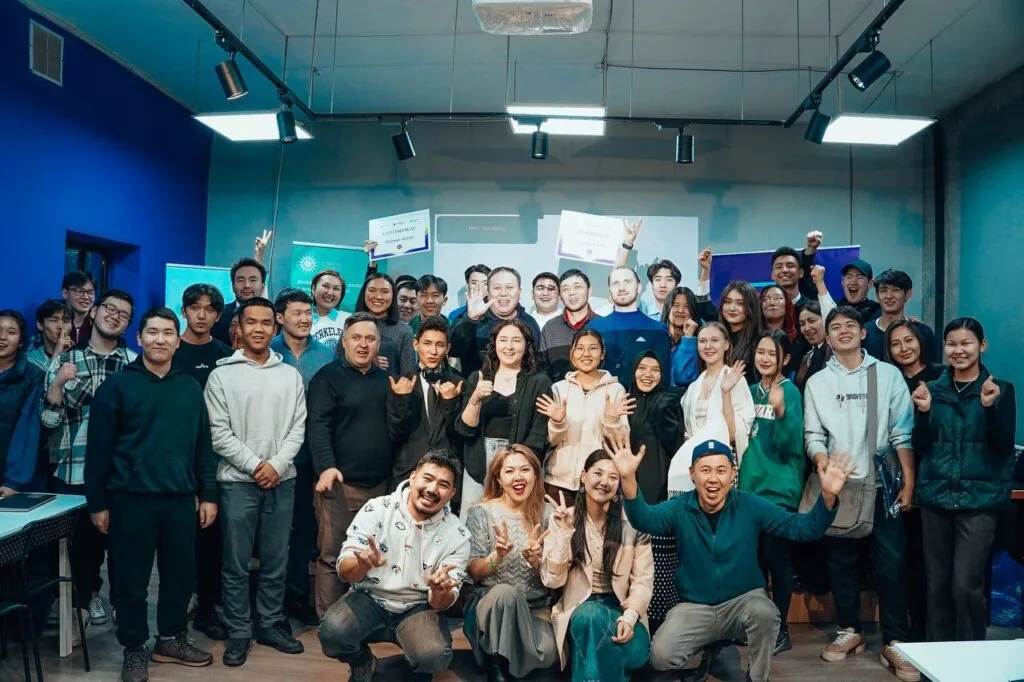
One of the main achievements is the creation of startup houses. Our partner Azamat Akeliev, a graduate of the Unicorn from KG program, opened a network of capsule hotels and co-working spaces in Silicon Valley, solving the problem of expensive and low-quality hotels. Together with the HTP, we created three such startup houses, providing startups from Central Asia with the opportunity to work and live in these locations.
Additionally, we organize pitching sessions for program participants and host various events in Silicon Valley so they can present their projects to investors and partners.
The second program, Cheksiz Programming, is aimed at people with disabilities, enabling them to acquire IT skills and work from home, thereby supporting themselves and their families. We plan to recruit participants and train them in the IT field.
Furthermore, within the 50,000 Programmers program, we will train a wide audience in basic and more advanced digital skills in collaboration with partners. These programs will help increase the number of programmers in Kyrgyzstan.
We also have sub-programs supporting innovative projects, such as AkylAI, through small grants.
For 2025, several major events are planned, including a series of exhibitions. We will start by participating in CES (Consumer Electronics Show) in Las Vegas with more than ten companies on the national stand. These exhibitions will help attract major residents to the High Technologies Park and facilitate the entry of our companies into foreign markets, especially the US.
Additionally, we plan to participate in GDC (Game Developer Conference), Jitex Global in Dubai, and a global exhibition in Osaka, Japan, where we will present a national stand. These events are aimed at promoting technologies and products from Kyrgyzstan, as well as raising awareness about the country and its technological capabilities, including artificial intelligence.
This is part of our broader plan to increase the global recognition of Kyrgyzstan as a center of technological innovation and attract major companies.
For me, the most inspiring aspect of working with the IT community and startups is watching ideas turn into successful projects. It is the process of how startups develop, achieve success, scale their projects, and attain significant results. This is the most pleasant, motivating, and inspiring part of the work.
Working with young entrepreneurs is highly inspiring. Seeing their burning eyes and enthusiasm in the desire to create something new and useful for the community is a huge motivation for further ecosystem development. I believe that Kyrgyzstan can become a significant player on the global IT map, and our task is to support this potential so that the region becomes known worldwide.
In our work with the IT community, we support many initiatives and monitor their progress. From a sustainability perspective, we see a positive trend in Kyrgyzstan: the community is becoming more resilient, leaders are appointed and change, there is continuity and development, and new members appear. We actively participate in their retreats for planning future years, which makes our work particularly important. All of this inspires and motivates us to further develop our ecosystem.
The Tech on Telegram Follow The Tech on Telegram
Keep up with the latest technology and startup news.
Related reading







More from this author

News
zypl.ai begins operations in Japan and focuses on next-generation risk models
Mansur Ismagulov

News
Elon Musk's net worth has exceeded $700 billion for the first time
Mansur Ismagulov

Article Interviews
"Central Asian countries should build a joint ecosystem," — Bekhzod Ismoilov on the development of AI in the region
Mansur Ismagulov

Article Interviews
Bloom's Taxonomy and Engineering Levels: A Practical Growth Model
Mansur Ismagulov

Article Useful
How the IT industry in Azerbaijan developed in 2025: key events
Mansur Ismagulov

News
Tajikistan has become a new member of the regional innovation alliance Central Asian Innovation Hubs.
Mansur Ismagulov