From Electronics Engineer to CEO: Talent Umetaliyev on Starting a Career in IT
In an interview with The Tech, Talant Umetaliyev shared insights on how newcomers can land their first job in IT. He highlighted key areas for starting a career and explained why it's important to be able to work with artificial intelligence.
Author - Mansur Ismagulov

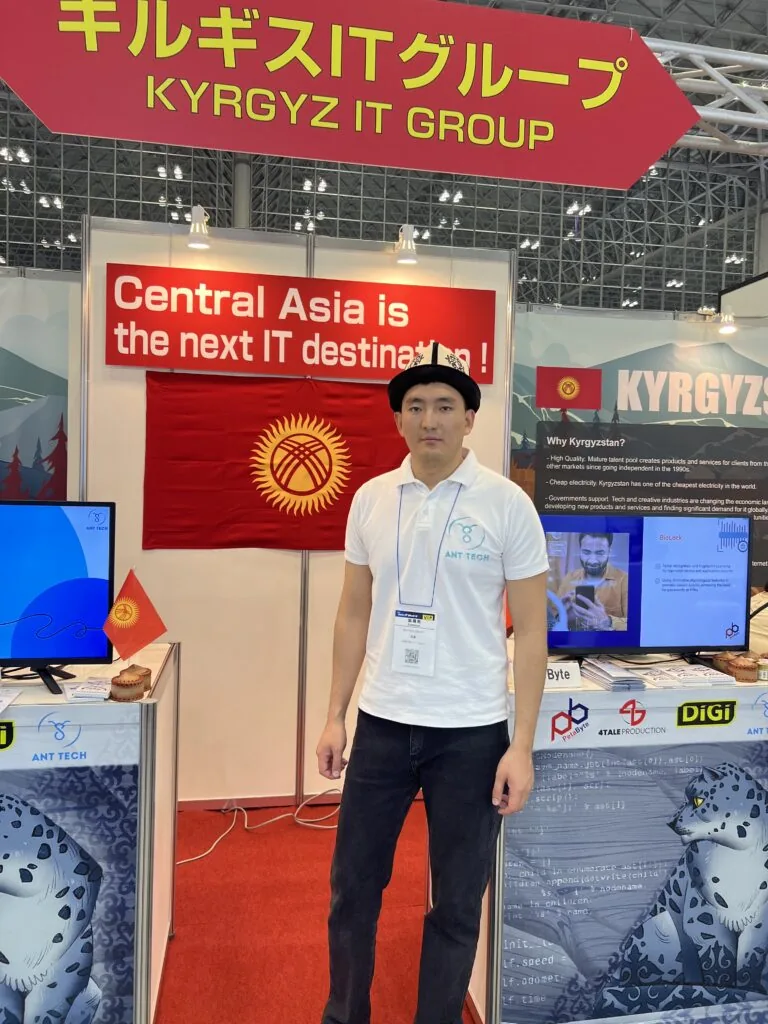
Talant Umetaliev, city — Kansas City, CEO and co-founder of Ant Tech, LinkedIn, Instagram
About Me
I have a higher education degree in "Electronics and Nanoelectronics" — I graduated from Ala-Too University in Bishkek with a bachelor's degree. After completing my bachelor's studies, I was admitted to several foreign master's programs in software engineering on a tuition-free basis: in Hungary through the Stipendium Hungaricum program, as well as in Italy and Poland. In the end, I chose a university in Poland because I had acquaintances there who could help with adaptation. However, during my studies, I fully realized that practical experience and industry development were more important to me than an academic career, so I decided not to finish my master's degree and focused on professional growth in IT.
Currently, I live in the USA, co-founded and lead Ant Tech — the first specialized DevOps company in Kyrgyzstan, which I am developing in the American market.
In my fourth year of undergraduate studies, I started working in my field as an electronics technician. I was involved in the development, repair, and installation of industrial electronic systems at factories and plants. This was work closer to hardware. In addition to hardware, I also handled process automation: writing scripts for controllers and configuring production line management systems. Programming and working with code were already part of my practice, albeit within the framework of industrial automation.
One incident particularly influenced my career path. In winter, we were called to a factory in the Special Economic Zone of Bishkek, where production had stopped due to a breakdown of a major piece of equipment. It was cold, the factory was not heated, and we spent a long time searching for the cause of the failure. Standing among frozen equipment, I first sharply thought about the future — about which direction I really wanted to develop in. It was then that I realized I wanted to switch to the software field, where there are more opportunities for growth and creativity.
About My First IT Job
I started my software career during my master's studies, at the age of 23. I was looking for an internship and found one at A1QA — one of the leading outsourcing companies for software testing, with a strong training and mentoring system.
First, I completed a short course on manual and automated testing. After successfully completing it, I was included in a project as a junior QA engineer. My tasks included writing test cases, conducting manual testing, and working with bug-tracking systems.
However, soon I realized that I wanted to dive deeper into the technical and engineering aspects of processes. I was increasingly attracted to working with Cloud. It was then that I began studying DevOps and soon switched to this direction, where I have been developing ever since.
After university, I had various options — job offers, the opportunity to continue my master's degree. But from an early age, I knew that it was important for me not only to move forward myself but also to help others grow along with me.
Even during my student years, I was actively involved in volunteering. In my second year, I worked in a boarding school for orphaned children and children without parental care. I was not just a mentor but also an educator: I organized leisure activities, helped with studies, and supported them during difficult times. Later, I taught at a private school where my students became prize winners at international olympiads. This experience formed my internal compass — to help, create opportunities, and be a guide for those who are just starting their path.

When myrambek Raimzhanov and I decided to found Ant Tech, we already had a clear motivation. Kyrgyzstan was then experiencing a serious outflow of young specialists — many were leaving to work as migrants in Russia or on construction sites abroad. We wanted to change the situation: to give young people an alternative, to show that it is possible to work for global markets from Kyrgyzstan while staying close to family and homeland.
Friends helped us — DevOps engineers from the USA. They became our mentors: they helped with training, building the technical base, and taking the first steps. Thus, Ant Tech was born — the first DevOps-as-a-Service company in Kyrgyzstan, combining training, practice, and international outsourcing.
From the very beginning, our goal was not just to employ young people, but to build a system for the export of intellectual labor, so that Kyrgyzstani citizens could be part of the global technological economy — on equal terms.
About Difficulties
If previously companies willingly hired junior specialists and gradually trained them internally, the situation is now changing. More and more tasks are being automated, and largely — thanks to AI. At the moment, many responsibilities that were previously performed by junior specialists can be handed over to tools based on large language models. This means that the role of a junior specialist is gradually blurring — and this is exactly where the market is hitting now.
Andrey Karpathy, former AI Director at Tesla, notes: if the fundamentals of programming remained unchanged for decades, then with the appearance of LLMs everything has changed. According to him, "natural language is becoming the new programming language." This reflects the essence of what is happening: code, tests, documentation — all of this can now be generated by AI using simple prompts in human language.
Under these conditions, employers are increasingly choosing middle+ level specialists — those who can deliver results immediately. Companies no longer want to invest in training beginners from scratch.
There is also a second problem: instability of requirements. The rapid integration of AI makes technologies and tools quickly obsolete, and specialists are expected to constantly adapt. What was relevant two years ago may have no value today.

3 Tips to Help You Find a Job in IT
- Beginners need to choose a specialization as early as possible that will be in demand in the next 5-10 years.
Currently, this is artificial intelligence, machine learning, MLOps, data engineering, prompt engineering, and everything related to the implementation of AI in business processes. - They should learn not just "how to write code," but how to solve problems using AI.
The future belongs to people who know how to "work with AI," rather than just compete with it. - You need to improve communication skills, initiative, and product thinking.
Even when entering the profession, it is important to be able to present yourself, understand why a particular code is being written, and be ready for constant changes.
The Tech on Telegram Follow The Tech on Telegram
Keep up with the latest technology and startup news.
Related reading







More from this author

News
zypl.ai begins operations in Japan and focuses on next-generation risk models
Mansur Ismagulov

News
Elon Musk's net worth has exceeded $700 billion for the first time
Mansur Ismagulov

Article Interviews
"Central Asian countries should build a joint ecosystem," — Bekhzod Ismoilov on the development of AI in the region
Mansur Ismagulov

Article Interviews
Bloom's Taxonomy and Engineering Levels: A Practical Growth Model
Mansur Ismagulov

Article Useful
How the IT industry in Azerbaijan developed in 2025: key events
Mansur Ismagulov

News
Tajikistan has become a new member of the regional innovation alliance Central Asian Innovation Hubs.
Mansur Ismagulov