New Gigabyte RTX 5060 Graphics Card: Quiet, Powerful, but with Caveats
We take a detailed look at the new RTX 5060 Gaming OC 8G from Gigabyte — a graphics card that promises energy efficiency, silence, and comfortable Full HD gaming. We found out where it performs at its best and where compromises are noticeable.
Author - Mansur Ismagulov
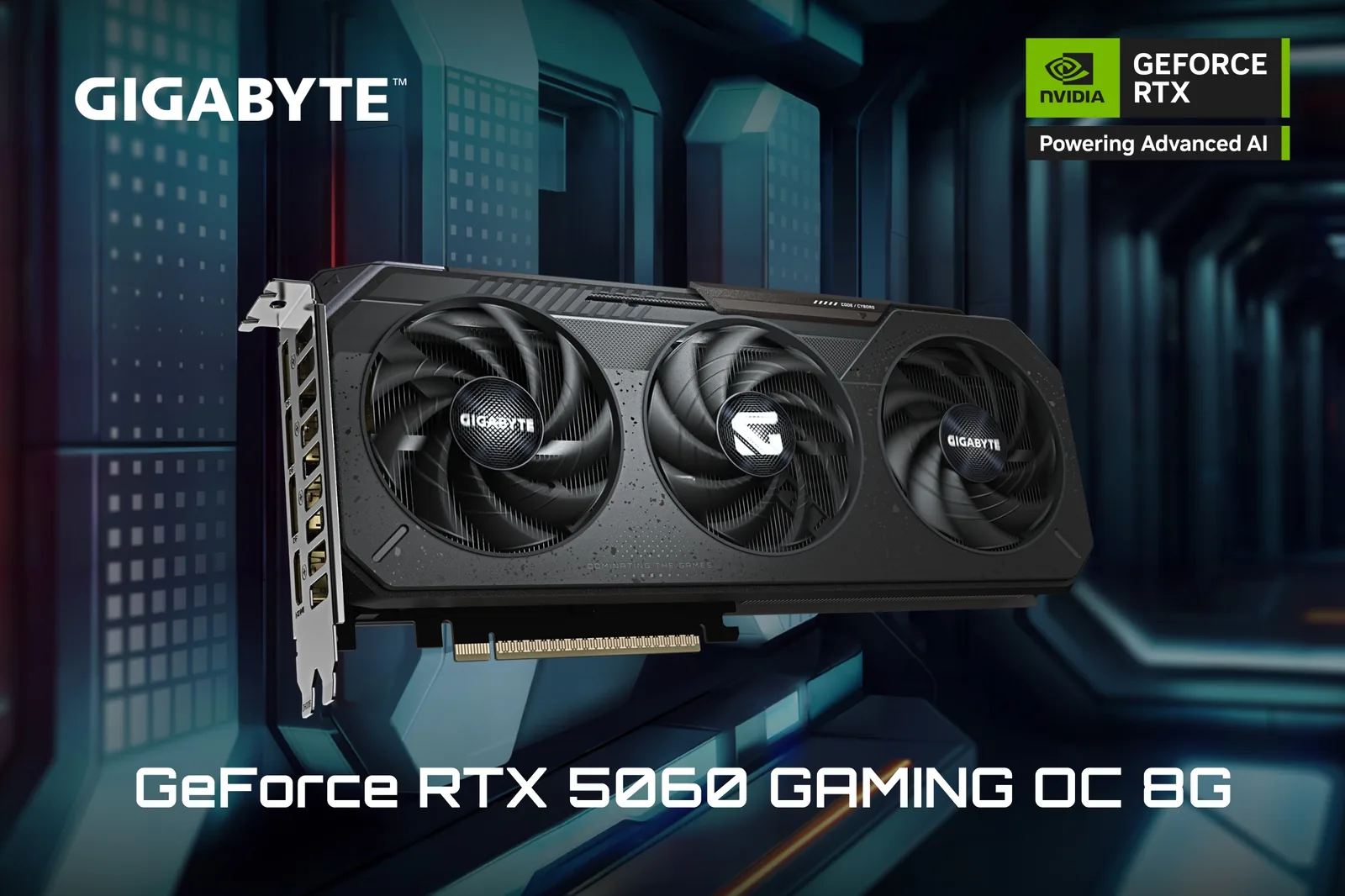
With the release of the RTX 50 series, NVIDIA continues to advance the Blackwell architecture, focusing on energy efficiency, DLSS 4, and Multi-Frame Generation technology.
The GeForce RTX 5060 occupies the "goldilocks" niche — a card designed for comfortable Full HD gaming with modern features and minimal power consumption.
The Gigabyte version — RTX 5060 Gaming OC 8G — features a mild factory overclock, efficient WINDFORCE 3X cooling, and an emphasis on quiet, stable operation.
Technical Specifications
| Parameter | Value |
| Graphics Processor | GB206-250, Blackwell architecture |
| CUDA Cores | 3840 |
| Boost Clock | up to 2595 MHz |
| Video Memory | 8 GB GDDR7 |
| Memory Bus | 128-bit |
| Bandwidth | 448 GB/s |
| Interface | PCIe 5.0 x8 |
| Power Consumption | ~145 W |
| Power Connector | 1 × 8-pin |
| Cooling | WINDFORCE 3X |
| BIOS Modes | Performance / Silent |
| Recommended PSU | 550 W or higher |
Design and Cooling
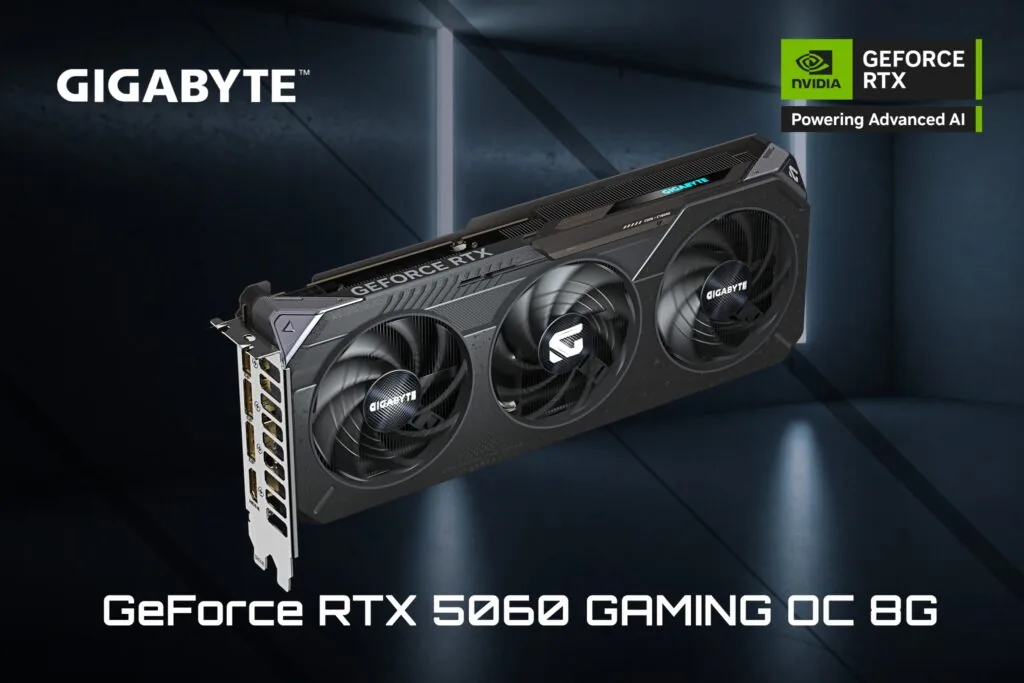
Gigabyte traditionally emphasizes reliability. Here, you get a robust PCB, a metal backplate, and a massive heatsink with eight heat pipes.
The three 90-mm fans rotate in opposite directions, reducing turbulence and noise.
Two BIOS modes are supported:
1. Performance — slightly higher clock speeds and more aggressive cooling.
2. Silent — prioritizes quietness, with minimal reduction in clock speeds.
Even under load, the core temperature does not exceed 64-66 °C, and the noise level remains within 24 dBA. At idle, the fans stop completely.
Power Subsystem
A seven-phase power design is used: five phases for the GPU and two for the video memory. It relies on reliable DrMOS modules and a dedicated memory power controller.
This solution ensures stability, low heat generation, and headroom for overclocking — while keeping the card quiet even under stress.
Gaming Performance
At 1080p, the RTX 5060 Gaming OC 8G demonstrates confident performance — 100-120 FPS in most modern games at high settings.
DLSS 4 and Multi-Frame Generation significantly improve smoothness and responsiveness, especially in fast-paced games.
At 1440p, the card remains playable, but 8 GB of VRAM becomes a limitation — in demanding titles, you may need to lower texture quality or switch to DLSS "Performance" modes.
Ray Tracing works, but requires compromises — without DLSS, FPS drops to 40–55 frames.
On older systems with PCIe 3.0, performance loss of up to 10% is possible due to the limited x8 interface.
Temperatures and Noise
The WINDFORCE cooling system is pleasantly impressive. Even under load, the fans do not run at maximum speed — the core temperature rarely rises above 65 °C, and the noise level in Silent mode is just 21 dBA.
For gamers sensitive to noise, this offers an excellent balance between quietness and efficiency.
Advantages
— excellent performance at 1080p
— energy efficiency and low power consumption
— effective and quiet cooling
— factory overclock
— support for DLSS 4 and Frame Generation
— high-quality build and components.
Disadvantages
— only 8 GB VRAM — a limitation for future games
— Ray Tracing reduces FPS
— PCIe x8 may reduce performance on older systems
— MFG is not useful in all games.
Conclusion
The RTX 5060 Gaming OC 8G is a reliable and balanced video card for Full HD gaming. It combines modern technologies, low power consumption, and excellent cooling.
However, the main compromise is the memory capacity. Already now, 8 GB may be insufficient for projects with heavy textures or active Ray Tracing.
Additionally, Multi-Frame Generation does not always save the day: if the base FPS is low, DLSS 4 provides less benefit, and responsiveness becomes slightly less precise.
Gigabyte GeForce RTX 5060 Gaming OC 8G is an excellent choice for those who play at Full HD and value quietness, stability, and modern technologies.
It is energy-efficient, quiet, and well-thought-out, but it is not suitable for those planning to play at 1440p or expecting long-term future-proofing.
If you are looking for a video card for 1080p with DLSS 4 and low TDP — this is an excellent solution. If you need "memory headroom" — consider the RTX 5070 or RX 7800 XT.
The Tech on Telegram Follow The Tech on Telegram
Keep up with the latest technology and startup news.
Related reading






More from this author

News
zypl.ai begins operations in Japan and focuses on next-generation risk models
Mansur Ismagulov

News
Elon Musk's net worth has exceeded $700 billion for the first time
Mansur Ismagulov

Article Interviews
"Central Asian countries should build a joint ecosystem," — Bekhzod Ismoilov on the development of AI in the region
Mansur Ismagulov

Article Interviews
Bloom's Taxonomy and Engineering Levels: A Practical Growth Model
Mansur Ismagulov

Article Useful
How the IT industry in Azerbaijan developed in 2025: key events
Mansur Ismagulov

News
Tajikistan has become a new member of the regional innovation alliance Central Asian Innovation Hubs.
Mansur Ismagulov