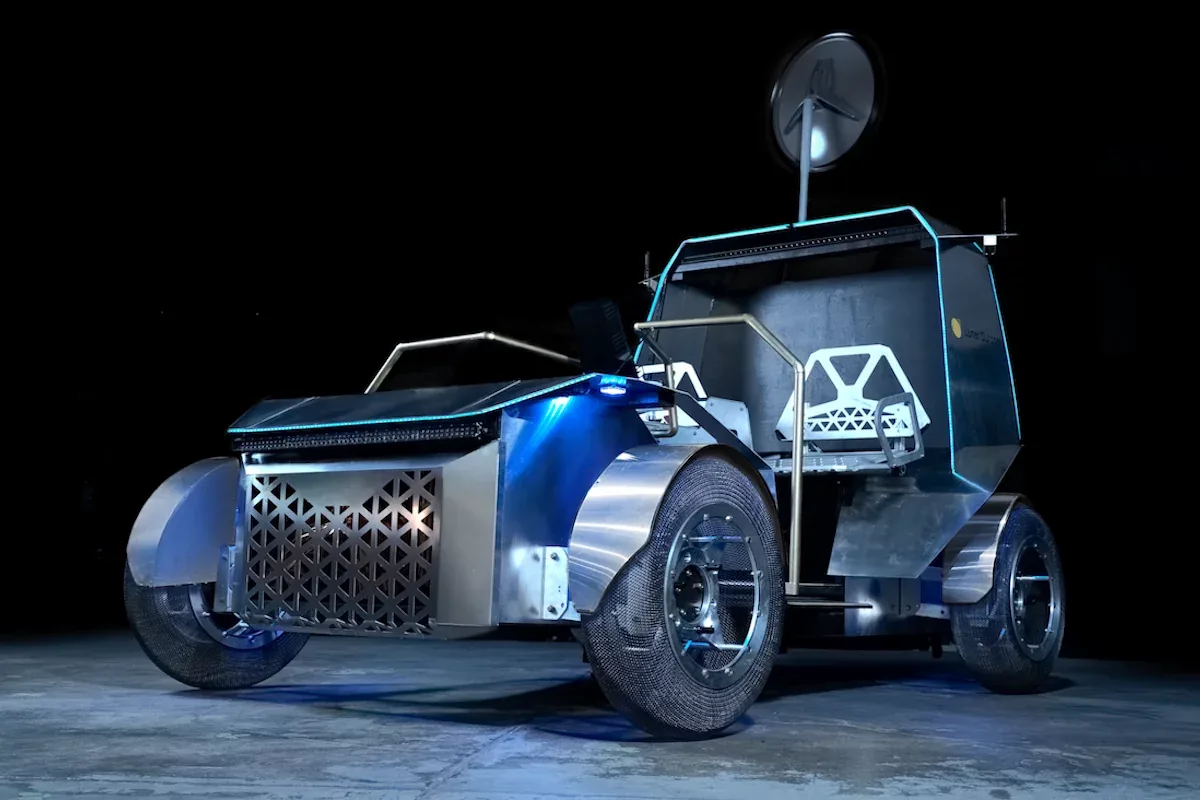
NASA continues preparations to establish a permanent settlement in the lunar south pole region, and for this task, the agency has unveiled a new lunar rover.
The U.S. NASA aims to build a permanent settlement in the lunar south pole region. The base is expected to cover hundreds of square miles, making mobility a key factor for the project's implementation. This week, the agency introduced Pegasus, one of two rovers that will be deployed directly on the surface of Earth's moon.
The Pegasus rover from Lunar Outpost will be able to traverse the lunar surface in three modes: autonomously, under astronaut control, or via commands from Earth. Pegasus will significantly expand the range and duration of human activity on the lunar surface compared to the Apollo program. This will be facilitated by an advanced thermal regulation system designed to handle sharp temperature fluctuations on the Moon.
Last month, NASA selected candidates for the High Achievability Mission, under which lunar rovers are being developed. Astrolab received $219 million to create the Crewed Lunar Rover, while Lunar Outpost received $220 million to develop Pegasus.
To accelerate the schedule for crewed missions, both companies must build simplified versions of the rovers, allowing for faster production at lower costs. Pegasus is being developed based on the larger Eagle model. NASA's revision of the initial plan forced Lunar Outpost to work faster to complete the scaled-down version of the rover within the set timeframe.
The team created high-precision digital twins and multiphysics simulations, built two full-scale prototypes of Pegasus, and conducted two rounds of human-in-the-loop testing. This allowed them to meet NASA's new constraints on mass, dimensions, and performance without falling behind schedule.
The result is a rover that significantly surpasses its Apollo-era counterparts. According to Lunar Outpost, the Pegasus and Eagle rovers can operate for at least a year and are capable of covering a distance 100 times greater than that traveled by Apollo lunar rovers, which covered a total of 90.4 kilometers across three missions.
A key requirement from NASA is resilience to harsh conditions on the lunar surface, including movement across ice-covered areas and fully shadowed regions of craters. The lunar program targets the south pole due to the abundance of ice in this part of the moon, which is crucial for developing water extraction technologies. Temperatures in permanently shadowed crater regions can drop to minus 245 degrees Celsius, while on sunlit surfaces, they can reach 120 degrees. Therefore, Pegasus's thermal regulation system will function autonomously even when the rover is being piloted by an astronaut.
NASA requires Lunar Outpost to deliver a fully flight-ready Pegasus for the Moon by November 2027. In the absence of complications, the Blue Moon Mark 1 lander from Blue Origin will be able to deliver the rover to the lunar surface.
The Pegasus project demonstrates how NASA is building a technological foundation for long-term human presence on the Moon, integrating digital modeling, new materials, and autonomous systems into a unified platform for future missions.
Source: New Atlas
The Tech on Telegram Follow The Tech on Telegram
Keep up with the latest technology and startup news.
Related reading




More from this author

Article Useful
How to protect your accounts from hacking: 8 settings you should check today
The Tech

Article Useful
500 Global: How the Accelerator Works and Who Can Receive Investments
The Tech

Article Interviews
Game Development in Central Asia: Arkady Moldavski on Developing Reverb and the Growth of the Industry
The Tech

Article Useful
Google, Tesla, BlackRock, and the IMF: Where to Apply for an Internship in Fall 2026
The Tech

News IT
Tesla unveiled the flying electric car Roadster
The Tech

News IT
Intero Biosystems startup won the Startup Battlefield at TechCrunch Disrupt 2026
The Tech