"My biggest mistake was poor communication," — Darkhonbek Mamataliev on the beginning of his IT career
Former Uber developer Darkhonbek Mamat Aliyev shared insights into his first job in IT and how it shaped his career path.
Author - Mansur Ismagulov

The Tech AI
Get the key points in seconds - a short summary from The Tech AI.
Dakhonbek Mamat Aliyev, a senior iOS developer at TikTok in San Francisco, founded CodeCraft in 2015. He worked at Super Dispatch, EPAM, and Uber, overcoming imposter syndrome. Mamat Aliyev recommends that students stand out through real projects, be proactive in their job search, and engage with professional communities.
Darhonbek Mamat Aliyev, city — San Francisco, Senior iOS Developer, TikTok, @darhonbek
I graduated from the Inha University branch in Tashkent with a degree in Computer Engineering.
Since childhood, I was fascinated by computers because my father worked at a computer college, and I always had access to them. I started with simple tasks: creating documents, postcards, helping my mom with Excel, and preparing tests for school. I did these tasks better than my peers, so people often turned to me for help. I was also into games, trying to hack and modify them. In the ninth grade, I began programming when we studied HTML in computer science classes. I created my first web page. My father noticed my interest and told my cousin, a Linux system administrator.
In college, I started participating in computer science olympiads, but initially, I had no results. In my hometown of Angren, few people understood programming, so I went to Tashkent, found courses, and started learning. When I returned home, I resumed participating in olympiads and began achieving success. Later, I participated in competitions organized by Moscow State University and in the All-Russian School Programming Olympiad (VKOSHP).
I took fourth place in Uzbekistan in a computer science olympiad. The top three places were awarded a scholarship for university studies. Not receiving the scholarship, I decided to enroll at Inha University. It was expensive, but this choice changed my life.
In 2015, Farhod Musaev and I founded CodeCraft — the first startup in Uzbekistan where children learned to program. We broke the stereotype that programming is only for adults and started teaching children. They created games and animations using Scratch, which is similar to real programming. Over two years, I taught more than 500 children. This helped pay for my education, but over time I realized I had reached my limit in teaching and decided to transition to professional development.
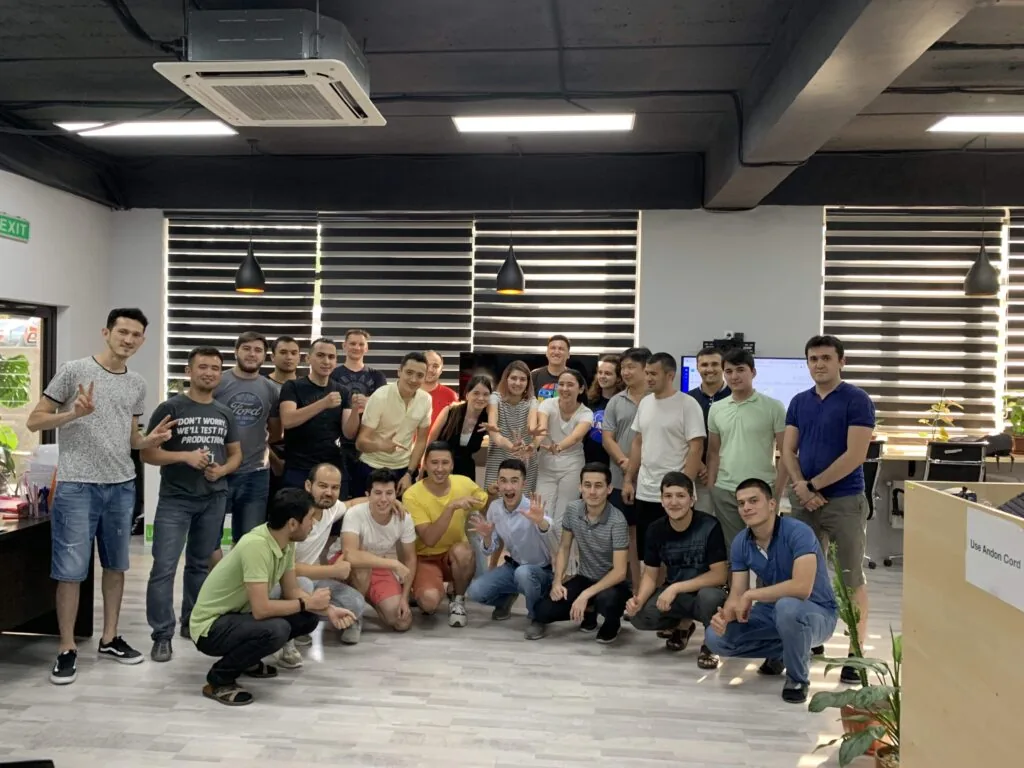
About my first IT job
First, I interned at Super Dispatch, an American startup founded by Bek Abdullaev, about whom I learned from my brother. He arranged a meeting for me with the CTO, Farhod Chinberdiev. In an informal conversation, he asked me: "What have you done? Tell me about your coolest project." At that time, I didn't know exactly what I wanted to do — mobile development, desktop apps, games, etc. It was like career counseling and an interview in an informal setting. I told him about my projects, participation in olympiads, and competitions. He listened and said, "You know what? Everything you told me is nonsense. It doesn't work that way in the real world. You didn't impress me."
This was a shock. I considered myself strong among my peers, but here was someone from the industry saying my achievements were trivial. I realized that I had been comparing myself to beginner programmers and decided to aim for professionals. For six months, I studied intensively, setting a goal to win a university scholarship for the top 10 students. In the end, I became number one, won the scholarship, and moved on to more complex projects.
A few months later, I approached the CTO, Farhod Chinberdiev, and offered my candidacy for an internship, even though there were no openings. I chose iOS development. During the interview, the tech lead didn't look at my resume but immediately asked me to show my code. He was interested in real projects, my approach to logic, and application architecture.
Thus, I got an iOS internship in 2017. At that time, I didn't know iOS or Swift, but I had experience in mobile development on Windows Phone and a little Java. I learned during the internship and then got a permanent job.

Challenges
I faced many difficulties in my first three jobs. The first was Super Dispatch. I had imposter syndrome at that time. It's the feeling that you don't meet the level, and your colleagues are stronger and smarter in everything. This feeling haunted me at Super Dispatch, EPAM, and even Uber, although by that time I already had substantial experience.
Imposter syndrome is normal. You need to understand that experienced colleagues have more context, and it's hard for a beginner to master everything instantly. It's a chance to learn and grow.
At my second job, EPAM, I also had imposter syndrome. I was hired as a Senior iOS Developer, although at Super Dispatch I was a junior. I was 22 years old and worried that I would be fired quickly. For the first six months, I felt insecure. However, over time, I realized that level gradations differ between companies. Complex tasks stimulated me to learn, solve problems, and grow. At EPAM, I worked with amazing engineers from Eastern Europe, and my mentor, Igor Tyutyunnik, taught me a lot.
At my third job, Uber, I reached the Big Tech level and again felt imposter syndrome. Seeing how colleagues solved complex tasks, I thought: "They are so cool, and I have nothing to do here." For the first six months, two thoughts haunted me:
1. I will quit because I can't handle it.
2. I will be fired because I can't handle it.
This adaptation period is called onboarding — when you get used to a new company, processes, team, and study the code. At Uber, I made many mistakes, which I later talked about in presentations. At the moment, it seemed unpleasant, but in the end, it helped me understand how to work correctly and avoid risks.
My most serious mistake was poor communication. When I couldn't meet project deadlines, I stayed silent, hoping everything would resolve itself. But problems don't disappear, and if you talk about them in advance, the team will help. I was afraid to hear: "You can't handle it." But colleagues, on the contrary, offered solutions and helped.
At Uber, they didn't baby me. I solved problems myself, found solutions, and negotiated with colleagues. My eyes were opened to the importance of quickly unblocking myself. At Super Dispatch and EPAM, everything was simpler, but at Uber, it was important to be able to quickly seek help if something didn't work out. This distinguishes seniors from juniors and mid-level developers: seniors don't wait for help; they solve problems and move the project forward.

3 tips to help you find a job in IT
Students often ask me: "How do I get a job or internship in IT?" I see how students from top universities like UC Berkeley and Stanford struggle to find jobs. My friend and I discussed what we could do to stand out:
— stand out with projects. The most important thing is to show real achievements. I reviewed more than 200 resumes, most of which were identical: "Took courses, high GPA." Companies are more interested in your projects than grades. Be proactive: create Telegram bots, web services, or useful AI-based tools. The main thing is that the product is needed and actually used. Participation in competitive programming, such as ICPC, also helps: top companies often hire winners of such competitions.
— be proactive. Don't wait for the right moment; apply in advance. Those who managed to get internships stand out with their extreme activity. They apply for 200 vacancies long before the season starts, for example, in September for summer internships. It's a numbers game: the more applications, the higher the chance. They go to job fairs, write to recruiters, find referrers — recommendations that increase the chance of getting an interview. It's important to at least get to a call with a recruiter. Today, this is the hardest part. Successful students actively communicate with others, get recruiter contacts, make cold calls, and write emails to get referrers — recommendations that increase the chance of an interview. They don't wait until the last moment to submit resumes when all positions are already filled. Don't limit yourself to large companies: working at a medium or small company will give you valuable experience of real projects and teamwork.
— use communities and services. There are services that help you get a job or internship. My company 42mentor.com helps talented people get jobs in Big Tech. We already have successful results. We select talented people and prepare them for interviews, but we don't work with interns. For interns, there are similar services.
Communities also help: for example, on Telegram, there are groups like SNS Internships, Interviews School KZ, where people discuss resumes, share experiences, and talk about interviews at companies like Bloomberg, Meta, Yandex. It's important to actively participate in these communities and use their resources. But the result depends on your activity and efforts.
The Tech on Telegram Follow The Tech on Telegram
Keep up with the latest technology and startup news.
Related reading





More from this author

News
zypl.ai begins operations in Japan and focuses on next-generation risk models
Mansur Ismagulov

News
Elon Musk's net worth has exceeded $700 billion for the first time
Mansur Ismagulov
Article Interviews
"Central Asian countries should build a joint ecosystem," — Bekhzod Ismoilov on the development of AI in the region
Mansur Ismagulov
Article Interviews
Bloom's Taxonomy and Engineering Levels: A Practical Growth Model
Mansur Ismagulov

Article Useful
How the IT industry in Azerbaijan developed in 2025: key events
Mansur Ismagulov
News
Tajikistan has become a new member of the regional innovation alliance Central Asian Innovation Hubs
Mansur Ismagulov