Google for Developers coordinator on working at Google and education at a British university
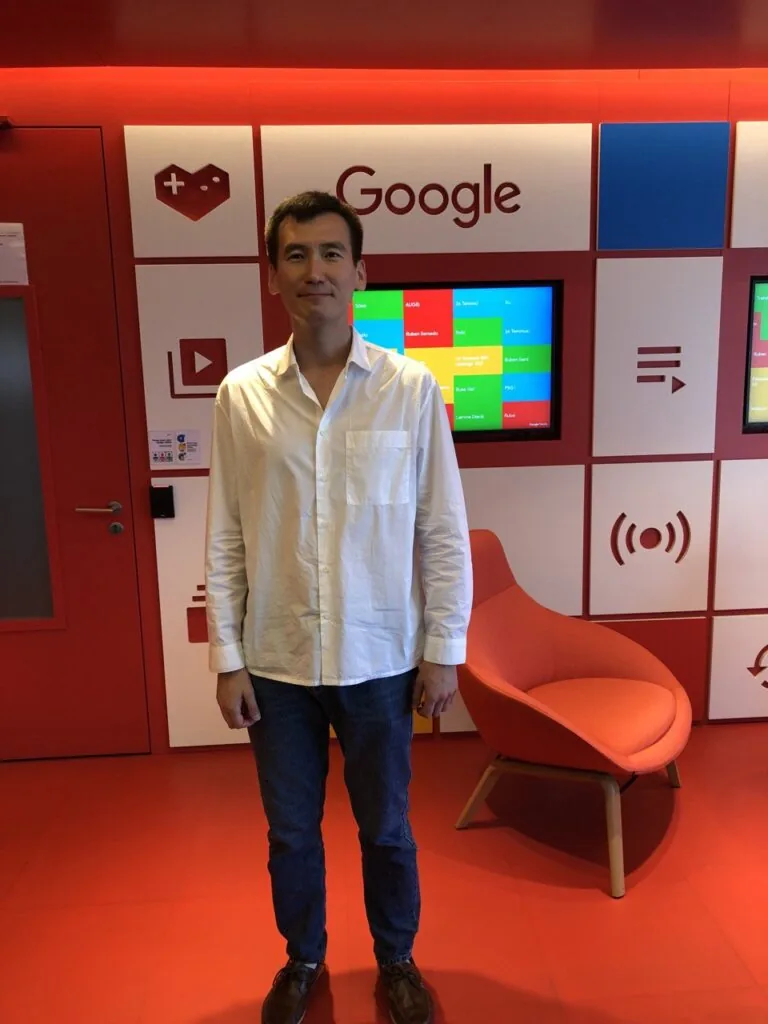
We met with Askar Aytov, Coordinator for Google for Developers and Google for Startups in Central Asia and Mongolia. He shared his experience working at Kazakhstani and international companies, his education abroad, and offered advice for aspiring professionals.
Author - Mansur Ismagulov

The Tech AI
Get the key points in seconds - a short summary from The Tech AI.
Askar Aytov, 37 years old, is the Google for Developers and Google for Startups Coordinator for Central Asia and Mongolia. He works in Almaty and previously worked at Huawei, KPMG, and Forte Bank. He graduated from KazNU, completed a master's degree at the University of Warwick (UK), and is currently finishing his doctoral studies at KazNU. His responsibilities include supporting IT communities, student clubs, and the WomenTechMakers program.
Askar Aytov, 37 years old, city — Almaty, DevRel for Google for Developers and Google for Startups, @askarai_
About Me
I work as a coordinator for Google for Developers and Google for Startups in Central Asia and Mongolia. This involves supporting programs, communities, developers, and startups. We also have student clubs and the WomenTechMakers program, which focuses on advancing women in IT.
On Starting My IT Journey
In my final year of university in 2008, Huawei came to our campus, and after a selection process, they hired me. Then I transitioned into the IT sector and started working at the consulting firm KPMG. Later, I worked at a Kazakhstani commercial bank, Alliance Bank, which is now called Forte Bank. That’s how my journey in IT began. I started in technical roles and later moved into Product Management. Additionally, over a long period, we created the state accelerator and venture fund TechGarden. Later, we established private accelerators.
From 2018 to 2022, with the support of the Bureau for Continuous Development of the Astana International Financial Centre (AIFC), I launched Kazakhstan’s first course for the certification of IT business analysts and product managers, called CenterTOC.
At the same time, as a volunteer, I worked on developing the Google community: first in Almaty, later in Astana. For the last two years, I helped launch the Google for Startups accelerator, after which I was noticed and invited to join the company headquarters.
On Choosing My Specialty
When I was young, IT meant fixing printers and running cables, and it wasn’t well-developed in our region. I went into it because I knew I could definitely find a job in this field. It was more about telecommunications — we were telecommunications engineers. There were few people who wanted to do this, but there were many university spots and open vacancies.
Education
I studied at the Almaty Institute of Energy and Communications, now known as AUES. At that time, we didn’t have bachelor’s degrees; it was called a “specialist” program, and studies lasted five years. Later, I pursued my master’s degree at the University of Warwick in the UK. My major was Information Systems and Management.
Currently, I am completing my doctoral studies at KazNU (Kazakh British Technical University). However, to everyone who wants to work in IT and is looking for a master’s program, I would advise going to the USA. Even British education was difficult to apply in practice, let alone Kazakhstani education. There was a lot of unnecessary content. Although they prepared us for consultant roles, and I went to work in consulting at KPMG after that — I realized I wasn’t ready for that position.
Advice for Young Professionals
Now, large companies in all major cities of Central Asia offer internships that lead to subsequent employment. These internships provide valuable networking opportunities: you can see how others develop, which contributes to your own growth. If you are just starting your career, you should try to get into a large company, as their processes are already well-established. Companies like Google also hire interns every year, but the competition is high, and the chances of getting into their internship program are low. Preparation for their internships is specific: there are preparation methodologies, and we have the Google for Developers Central Asia YouTube channel, where various broadcasts with top specialists are held.
On the Hiring Process at Google
Each department has its own criteria, and I recommend checking their official careers.google.com website, where everything is described in detail. Personally, I took Google courses for Product Management, which require at least basic knowledge of how computers work and basic programming skills taught in school. You need to have strategic thinking and problem-solving skills.
However, unfortunately, applications for the Product Management program are only available if you are physically located in the USA. In my role as a DevRel Coordinator, communication skills, knowledge of regional specifics, the mindset of developers, and experience in organizing communities are valued.
Challenges of Working at Google
Compared to my experience working at Kazakhstani companies, here I have to handle more tasks: what I used to do in three to four days, I now have to do in one day. I have to work more efficiently, but here they respect working hours and value time: no one will disturb you on a non-working day, and emergencies are rare. But because of this, it is important to plan everything in advance, two to three months ahead. The pace is fast, but it is steady. It is important to understand that expectations regarding results are very high, and you can be easily fired if you do not show good results within six months. Personally, I feel some pressure regarding results.
Skills to Develop
You need to understand new technical nuances and monitor the state of the market: what is happening in the community in a broad sense, and be able to maintain contacts with people. Being always available is a difficult skill, when organizers in different cities need support at different times, and you need to provide it. Communication skills, both verbal and written, are very important. Also, English language skills are important: business writing and conversational speech.
The Tech on Telegram Follow The Tech on Telegram
Keep up with the latest technology and startup news.
Related reading







More from this author

News
zypl.ai begins operations in Japan and focuses on next-generation risk models
Mansur Ismagulov

News
Elon Musk's net worth has exceeded $700 billion for the first time
Mansur Ismagulov

Article Interviews
"Central Asian countries should build a joint ecosystem," — Bekhzod Ismoilov on the development of AI in the region
Mansur Ismagulov

Article Interviews
Bloom's Taxonomy and Engineering Levels: A Practical Growth Model
Mansur Ismagulov

Article Useful
How the IT industry in Azerbaijan developed in 2025: key events
Mansur Ismagulov

News
Tajikistan has become a new member of the regional innovation alliance Central Asian Innovation Hubs.
Mansur Ismagulov