How to Become a Data Scientist: The Story of Yerkеbulan Askarbekov
In this article, an AUCA graduate explained how he built his career in Data Science step by step, what challenges he faced, what helped him pass interviews, and why honesty and curiosity turned out to be more important than memorized definitions.
Author - Mansur Ismagulov
The Tech AI
Get the key points in seconds - a short summary from The Tech AI.
Yerkebulan Askarbekov, a Data Scientist from Bishkek, graduated from the American University in Central Asia with a degree in Applied Mathematics and Informatics. His career began with a scientific internship in 2022, followed by a position as a data analyst in retail and an internship in the United States. Currently, he works at MDigital and teaches at the INAI university.
Yerkebulan Askarbekov, City — Bishkek, Data Scientist/ ML engineer, LinkedIn
About Me
I am a Data Scientist with a strong mathematical background and experience in building analytical systems, machine learning, AI, and process automation. I graduated from the American University in Central Asia (AUCA) in Bishkek with a degree in Applied Mathematics and Informatics. I gained admission through a USCAEF scholarship, which fully covered my tuition costs.
I entered IT through my passion for mathematics and programming, which began in school when I enthusiastically studied the basics of software development. At university, I deepened my knowledge of Python and topics related to data analysis and machine learning. Today, I work as a Data Scientist at MDigital, where I participate in creating and integrating ML/AI models. At the same time, I teach a Data Science course at INAI University, training students in the fundamentals of this field.
About My First IT Job
I completed my first professional internship in 2022 at the Research Station of the Russian Academy of Sciences (RAS) in Bishkek, while I was a third-year university student at the age of 22. This was primarily a research-oriented role adjacent to IT, related to Data Science and Data Engineering. I was responsible for migrating scientific calculations from MATLAB—a specialized language for technical computing—to Python. Additionally, I automated data processing and integration by connecting scripts with laboratory equipment used in experiments. This gave me my first experience working in a team, albeit a more research-focused one.
After graduating in 2023, I gained my first commercial experience by joining a local retail company as a Data Analyst. There, I participated in the development and implementation of a Data Warehouse (DWH) system and BI reporting, which allowed the business to better visualize its key performance indicators.
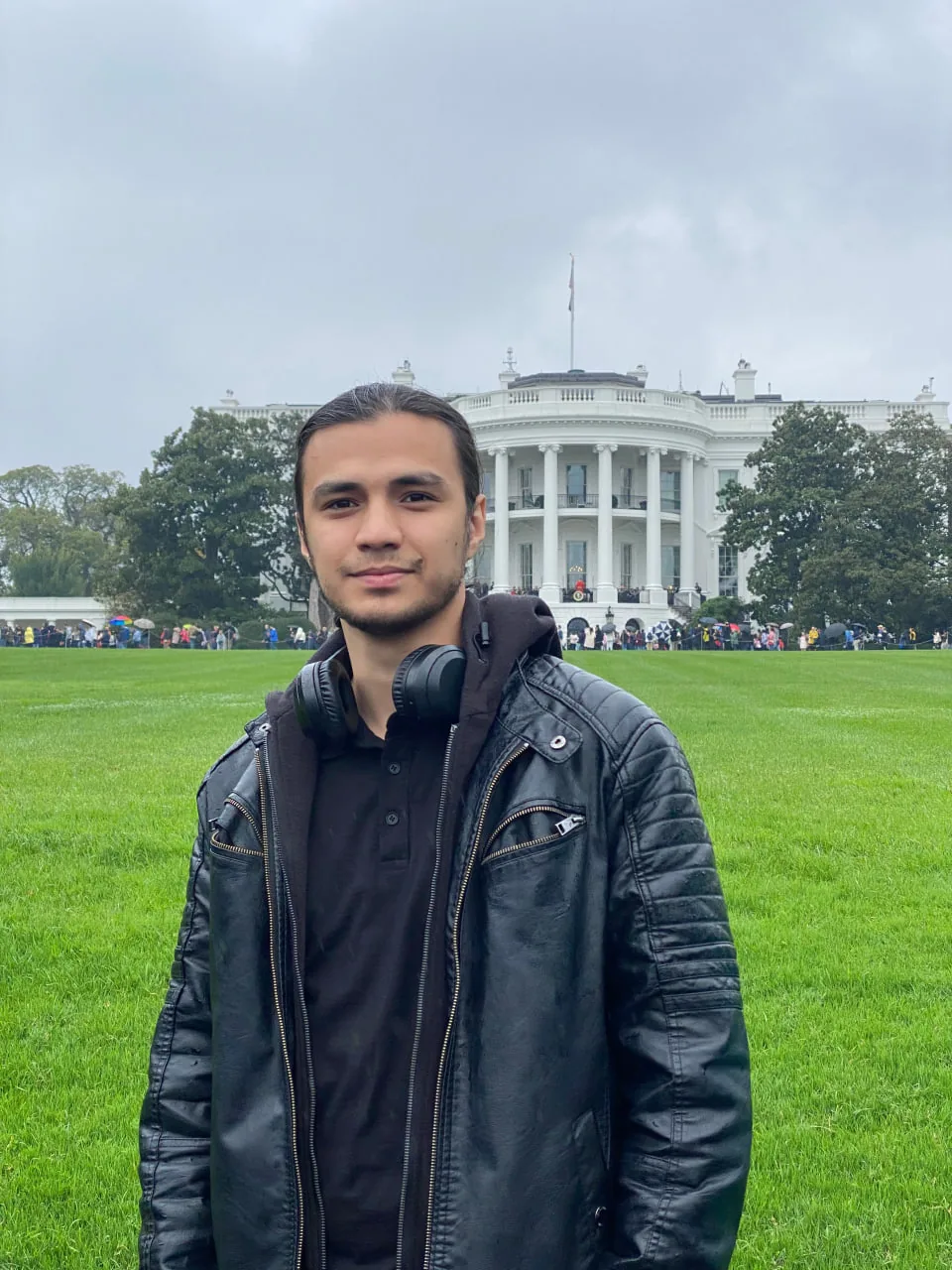
However, in the autumn of the same year, I decided not to stop there and had the opportunity to undertake a professional development internship in the United States, in Washington, D.C. There, I participated in projects related to climate risk analysis, explored the potential applications of ML and AI, and assisted in integrating them into systems for analysts and experts, including tasks that contributed to reports for the World Bank.
To summarize, my initial steps in the profession unfolded as follows: from a scientific environment and automation, through work in retail and business analytics, to participation in international projects assessing risks using data and ML models. This provided me with a solid and diverse start in my career.
I secured the academic internship through a partnership between my university and the research station, so there were no particular issues—it was a natural step within my studies. The internship aimed at professional development, however, was made possible through a grant from the same organizations that once enabled me to study at AUCA. This grant allowed me to complete the program in Washington, which is how I ended up in the US.

Regarding my first commercial experience, everything was quite straightforward—I searched for Entry Level positions related to data so that I wouldn't lose time after graduation and could immediately start developing professionally before my internship in the US—which I then flew to in the autumn. Overall, I can say that all these steps were a logical continuation of my path, allowing me to start applying my knowledge in real work as quickly as possible.
Whether during the international internship or at the local company, the interview process always followed a similar pattern consisting of two stages. The first stage always involves so-called soft skills, where they assess teamwork abilities, ask about general experience, and evaluate skills. I never had problems with such interviews because I always spoke honestly and was happy to share my experience and perspective.
The second stage is more technical, often involving test assignments—either given on the spot or with a deadline for completion. As a specialist, you must always be prepared for this part, but I believe it is not necessary to memorize every concept, syntax, or minor detail. Personally, I strive to remember the essence and logic of concepts rather than just factual knowledge, although, of course, practice is always beneficial, and I periodically try to review things.
Specifically, when it comes to the data field, typical questions almost always concern knowledge of Python—it is already a must-have language for working with data at all stages. They also frequently ask basic programming questions, about databases and their structure. Depending on the project you are interviewing for, you might also encounter more specific questions.
My specialized education in applied mathematics and informatics became a solid foundation for all data-related matters. I would even say that the ability to think like a mathematician and see the logic of processes helps me understand the tasks at work from the inside.
But, of course, one should not forget about personal qualities, especially nowadays when everything is developing dynamically, new technologies and approaches are emerging, and one must constantly keep up. I can confidently say that curiosity has helped me greatly to this day.
I would also separately highlight honesty and openness—they have always been great assets during interviews and job searches. I believe there is no point in wasting either my time or the employer's time, and it is much better to honestly state what you can do, what you want to develop, and where you have little experience. In my opinion, this is only a plus for both me and the company.
About Difficulties
Difficulties were definitely present. Even to secure an internship, knowledge of almost the entire technology stack is often required, especially in our time. I also had cases where interviews ended in failure—somewhere I simply lacked the knowledge or experience for a specific position, and sometimes I just had bad luck with the company itself. After all, it happens that the hiring process at an employer is built in a suboptimal or even completely illogical way.
Overall, I consider this a perfectly normal part of the IT journey, especially at the beginning. Such difficulties help understand which skills need development and teach one to perceive rejections more calmly.
Whenever possible, I always tried to get some feedback because it is important for me to understand exactly where my weak points might be and what can be improved. Honestly, I never tried to dramatize or worry excessively about such moments. I always understood that the situation in IT varies and that the hiring process is sometimes not the most logical or even slightly chaotic, so much depends not only on you.
Therefore, I simply continued to apply for other positions—I did not fixate on one rejection or one company, but simultaneously engaged in self-study to approach each opportunity slightly better prepared. I also tried to study the market itself, looking at current requirements, what is asked in interviews, what approaches and tricks exist, and how best to answer questions, gradually applying all this to myself.
In the end, I believe this is the most correct strategy: not to give up, but rather to use each rejection as an opportunity to review your knowledge again and improve something within yourself. Plus, with time comes more confidence, because you begin to understand that the job application process itself is also experience that helps greatly in the future.
At work, I faced the most typical difficulties that almost everyone encounters—acclimatization. When you join a new place, the atmosphere, foreign processes, and other people are initially unfamiliar, which can even create a sense of discomfort. But I believe this is normal. The main thing is to find common ground with colleagues and build adequate relationships with them. In my case, such things usually faded away very quickly, literally within the first few days or weeks, as soon as I got into the team.
As for technical difficulties, it is simple: if something truly hit a wall due to lack of knowledge or experience, I always calmly asked for help from colleagues who had more competence in that area. In my opinion, this is much better than sitting and trying to figure something out on your own for hours when you can ask and resolve it faster, while also learning something from them. In general, everything that seemed difficult at the beginning was eventually resolved through communication and openness—and this, by the way, is another important conclusion for me.
3 tips for young specialists who want to find a job in IT:
- Develop pet projects and host them on GitHub as a portfolio. This is an excellent practical confirmation of your skills, and even if you do not wish or feel confident showing them to employers, it is still a big plus for yourself. Any experience before real work always helps you integrate into real tasks faster.
- Work on projects with others and build professional connections. This is not only about teamwork, where you can learn a lot from others, but also about networking. Often, it is through connections in the IT community and beyond, especially today when many sectors interact, that new opportunities and interesting job openings arise.
- Do not be afraid to apply and do not be afraid of mistakes. Many wait too long for the "perfect moment" to start looking for a job or applying. In reality, it is better to try and even stumble somewhere than to sit and wait. It is through these attempts that experience comes—both technical and simply human.
The Tech on Telegram Follow The Tech on Telegram
Keep up with the latest technology and startup news.
Related reading







More from this author

News
zypl.ai begins operations in Japan and focuses on next-generation risk models
Mansur Ismagulov

News
Elon Musk's net worth has exceeded $700 billion for the first time
Mansur Ismagulov

Article Interviews
"Central Asian countries should build a joint ecosystem," — Bekhzod Ismoilov on the development of AI in the region
Mansur Ismagulov

Article Interviews
Bloom's Taxonomy and Engineering Levels: A Practical Growth Model
Mansur Ismagulov

Article Useful
How the IT industry in Azerbaijan developed in 2025: key events
Mansur Ismagulov

News
Tajikistan has become a new member of the regional innovation alliance Central Asian Innovation Hubs.
Mansur Ismagulov