How to create digital services that millions of users trust. The experience of Nikolai Natokiev
In an interview with The Tech, Nikolai Natokiev shared his experience working on large-scale digital projects, explained how to transform complex rules and processes into intuitive interfaces, and offered advice to aspiring designers.
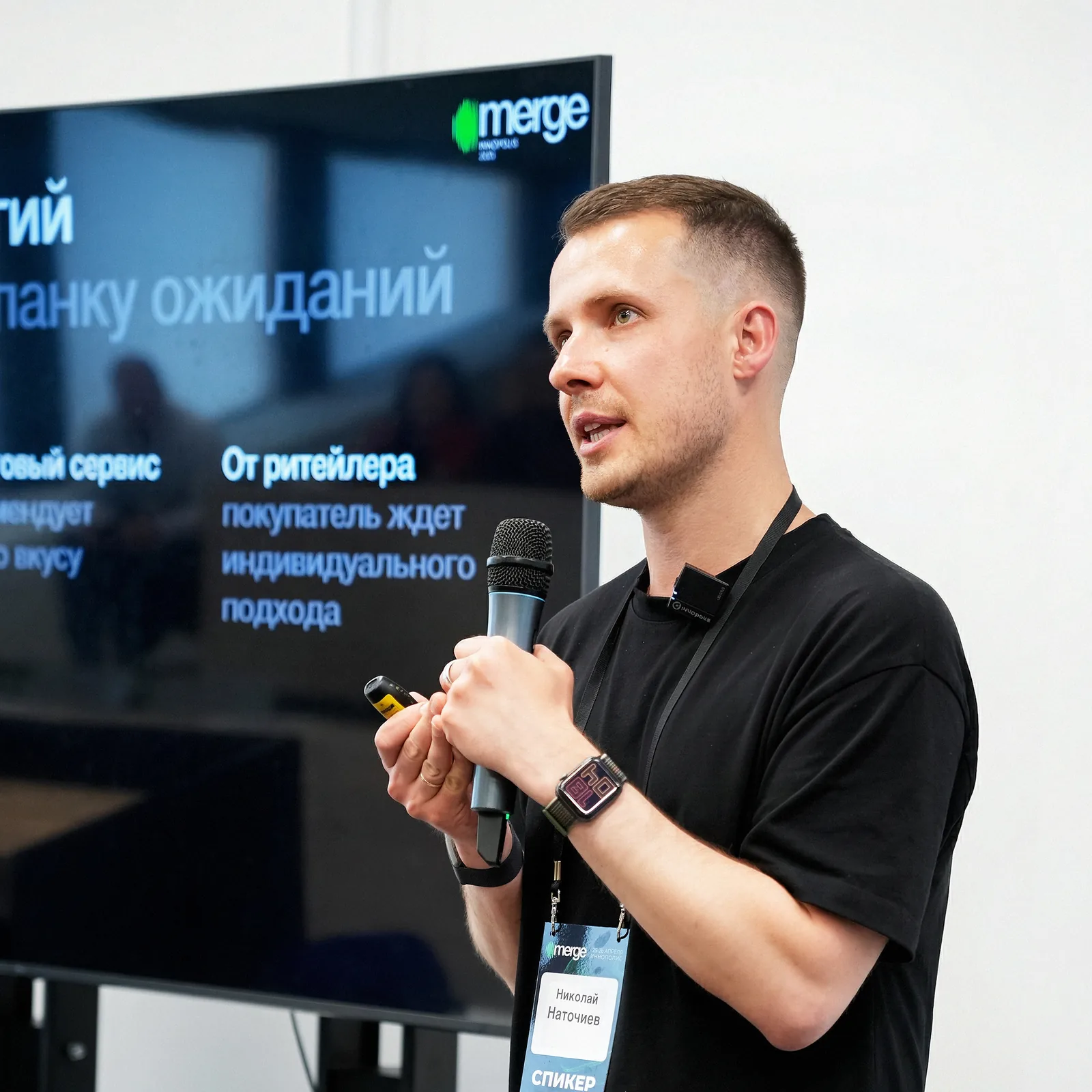
Nikolay Natochiev, city — Almaty, product designer and design director, LinkedIn
About Me
I help digital companies make products clear, transparent, and user-friendly — from idea and concept to research, scenarios, interfaces, design systems, and communications. My specialty is complex B2B/B2G services, where trust, established processes, scalability, and accountability to the user come first.
How I Entered IT
Marketing taught me to think about meaning, audience, and value — but design has always been my primary domain. I have been in design for over 15 years, with 11 of those years in digital: this is my profession and constant interest. With the development of technology and the internet, products became digital, and I realized that I wanted to influence not only “how to tell” but also “what exactly works” inside the service. Therefore, I fully transitioned into IT and product design — where meaning meets reality: user behavior, development constraints, and business goals.
I was most shaped by projects where millions of users’ trust and a high cost of error were at stake: government digital services and national platforms. Participation in initiatives such as “My Tax” and “Honest SIGN” in the Russian Federation solidified three things in me: systematic thinking, accountability, and respect for the user’s context.
Importantly, it was these projects that formed my expert foundation — thanks to it, I began to be invited as an expert to similar initiatives in scale and responsibility in Kazakhstan and other countries.
At the beginning of my career, I faced several key challenges:
- Learn to speak the same language as developers and business — through requirements, priorities, risks, and metrics.
- Stop “drawing screens” and start designing user scenarios and behavior.
- Accept constraints as part of design — and turn them into clear, viable solutions.

Projects and Practical Experience
I was lucky to work on interesting and significant projects where design is an important part of a larger system. When a product is large-scale, legally and technically complex, you mature quickly: you learn to justify solutions, build processes, and think several steps ahead.
I am proud of projects where we managed to turn complex rules and processes into a clear user experience: the national marking system “Honest SIGN” and the line of digital services of the Federal Tax Service — “My Tax,” “My Receipts Online,” “AUSN,” and others.
Importantly, these were projects that were largely created as “first of their kind” — without ready-made global analogs and references, so the responsibility was many times greater: it was necessary not just to “draw interfaces,” but to understand complex logic, visualize it, and make it clear and convenient for millions of users.
In “Honest SIGN,” I went from being the sole interface designer to the Director of the Design Department: I built a team from scratch, established processes, and cross-functional interaction. And in projects for the Federal Tax Service — “My Tax,” “My Receipts Online,” “AUSN,” and others — I led the design development of products from scenarios and prototypes to launch.
My experience is precisely about being equally confident in understanding the product, technologies, and people. I have strong product thinking and intuition: I quickly understand the context, highlight the main points, and turn chaos into a clear plan.
But projects at the start, when nothing exists yet, are especially interesting. I know how to gather vision, package it into a structure, find resources, set up processes, and bring the product to launch. Behind me are agency, corporate, and entrepreneurial experience, managing distributed teams, and working with many startups in different parts of the world.
A turning point for me was a project at “SKB Kontur” — one of the leaders of the Russian SaaS services market for business. There I developed interfaces for a service for managing tax risks, and it was my first experience where I truly understood the role of product design. It was there that I built the foundation — how to do design that lives in the product and brings value to business and users.
About Design and the Industry
Product design for me is creating solutions that work for people. It is a balance between functionality, usability, and aesthetics.
In my opinion, visual trends and “wow effects” are overrated in digital design. Animations that slow down work. Uniqueness for the sake of uniqueness.
At the same time, basic but critically important things are greatly underestimated — speed and responsiveness of the interface. This is that very “invisible design” that the user does not notice directly, but it is precisely what forms the overall impression of the product. Accessibility as the basis of thinking.
The best design is the one that goes unnoticed.
Design is the first signal of whether you can trust the product. True trust is when the product consistently does what it promises.
Trust is built through:
— predictability — the interface behaves as expected, without surprises
— transparency — it is clear what is happening with data and why
— attention to detail — if the product looks careless, a question arises: what else is done wrong in it? Security? Data?
— respect for time — fast work, minimum unnecessary steps.
Today, most companies have already learned to solve basic UX challenges: clarity, consistency, texts, states, and non-standard situations. But large products have a new main risk — overload and information noise. With the growth of superapps, where dozens of services live under one shell, it is easy to “outshout” the user with the interface and different styles. Therefore, the key task is not to overload and maintain integrity: so that sections of marketplaces, banks, and other ecosystems remain consistent.
Simple but stable habits help me with productivity and creativity. I use various time management techniques, trying to adhere to the 80/20 principle: when 20% of efforts give 80% of the result. A few hours of deep focus bring more benefit than days of multitasking. I work best in the morning, so I try to handle important tasks at this time. I constantly improve my strengths and train my visual literacy — I collect references, note working techniques and scenarios. I believe that inspiration is not a coincidence, but the ability to create conditions for work and life. And a separate support is sports. I love running: it is the best way to “air out” my head, recharge, and return to tasks with clarity.
About Trends
Right now, like many others, I am very fascinated by the topic of AI. I am inspired by how AI products, agents, and services are changing professions and digital itself: in my daily work, I actively use assistants — they remove routine and save hours.
But it is even more interesting to observe how interfaces and the approach to their design are changing. More non-linear paths for solving tasks are appearing instead of rigid scenarios, and “interface-less interfaces” — voice, gestures, and other forms of interaction — are gaining popularity. Products are becoming contextual to the user, environment, and moment, and proactive — trying to be one step ahead and suggesting what is needed right now. Designing such services is a separate thrill.
And one more important point: there are more and more AI products, and many of them look similar externally and in terms of experience, so the question of differentiation is critical. I am interested in helping such products express individuality: creating signature techniques, visualizing AI agents, making personalization not only “inside” but also “outside” — in how the product looks, sounds, and feels, including motion and UX. It is for this reason that I created my digital products bureau “Tactic”: to develop my own startups and help other companies turn ideas into products.
In the last few years, I have traveled a lot around the world and seen how the IT landscape is changing in Europe and Asia. Against this background, Kazakhstan for me is one of the leaders in digital products in Central Asia and the EAEU. What I observe here is powerful growth and a desire to be ahead: a strong IT community, many cool specialists and enthusiasts, a huge number of talented people with ideas who launch startups and find investments.
I am inspired by the interest in advanced technologies and the speed at which products are changing and improving in Kazakhstan. At the same time, the state is digitalizing, the design community is growing, and design culture within companies is becoming more noticeable. And what I am leading to: most modern approaches are already present in Kazakhstan in one way or another — now it is important to maintain this pace, strengthen systematic thinking, and continue to move in the same spirit.
Advice for Beginners
Choosing IT in general and design in particular is a real chance to get your dream profession: to do what you like, create products that people use, and be part of a strong, living community. It is important to understand what you are truly interested in, what your strengths are, and what format of work suits you — because in IT there is a huge choice of directions, and it is normal to try, change specializations, supplement skills, and grow in the process.
It is also important to find “your” people. Now it is easier than ever: mentoring, communities, social networks — being in touch with industry leaders and strong practitioners is quite realistic. And the key is to constantly learn and improve skills: through practice, feedback, and expanding horizons — to look for new sides of the profession that you want to develop, and step by step turn interest into mastery.
The Tech on Telegram Follow The Tech on Telegram
Keep up with the latest technology and startup news.
Related reading






More from this author

Article Useful
How to protect your accounts from hacking: 8 settings you should check today
The Tech

Article Useful
500 Global: How the Accelerator Works and Who Can Receive Investments
The Tech

Article Interviews
Game Development in Central Asia: Arkady Moldavski on Developing Reverb and the Growth of the Industry
The Tech

Article Useful
Google, Tesla, BlackRock, and the IMF: Where to Apply for an Internship in Fall 2026
The Tech

News IT
Tesla unveiled the flying electric car Roadster
The Tech

News IT
Intero Biosystems startup won the Startup Battlefield at TechCrunch Disrupt 2026
The Tech