How to Build a Strong Development Team: Insights from Sergek Group CDO Ivan Bozhitov
In an interview, Ivan Bozhitov, Chief Delivery Officer of Sergek Group, talks about the work of the development team and shares his experience in building processes, implementing innovations, and strategies that help the company remain a strong technological organization.
Author - Mansur Ismagulov
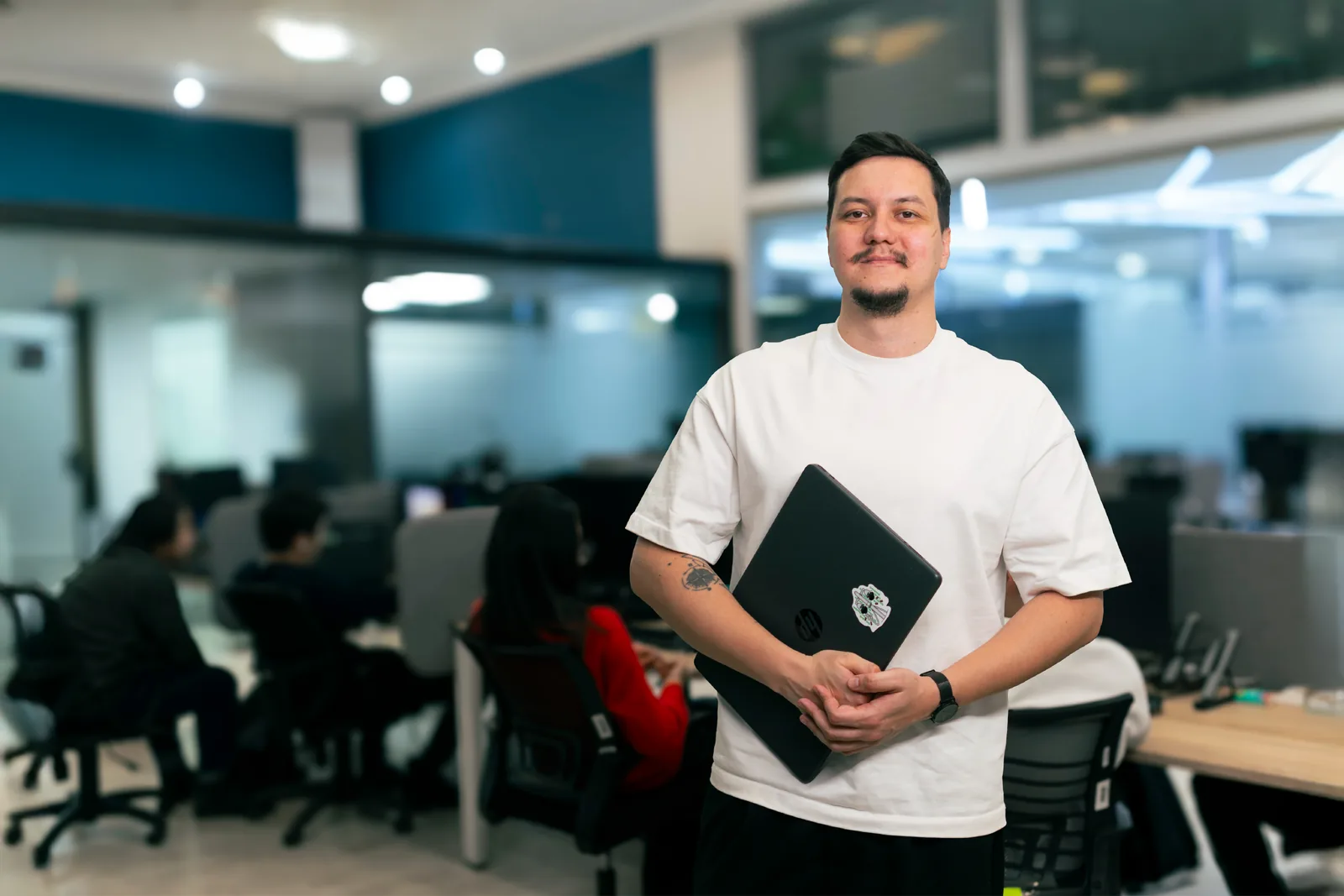
Ivan Bozhitov, City — Astana, CDO Sergek Group, Linkedin
About the Company and Role
Sergek Group has established a functional-matrix organizational structure based on the Spotify model. The technical division is split across two dimensions: the vertical dimension consists of product development teams, each involved in developing a specific product or domain within the company’s portfolio. There are six such teams. The horizontal dimension comprises chapters, which group specialists by functional areas and areas of expertise. These include the DevOps Chapter, Backend Chapter, Frontend Chapter, QA Chapter, System Analysis Chapter, Data Analysis Chapter, CV Chapter, and Transport Analysis Chapter.
As CDO, I am responsible for the development strategy of the development block. For the Delivery Office, the key focus is on processes: it is these processes that transform development into a stable and predictable mechanism for delivering product increments.
Each product team has a technical lead and a delivery manager. While the former oversees architecture and code quality, the latter turns planning and work coordination into a predictable process, enabling the team to consistently deliver value.
Today, Sergek Group focuses on technologies that make products smarter and more user-friendly. Our solutions learn, predict, and assist by leveraging modern data analysis and AI methods. DevOps ensures process stability and predictability, while R&D enables the exploration, optimization, and creation of new hardware and software systems, making data processing faster, more accurate, and more valuable for users. All of this helps us turn technology into tangible value.
About Challenges and Innovations
Our current primary challenge is constantly growing complexity, which manifests at several levels. The first level is data: its volume is increasing, it comes from various sources, in different formats, and in real time. Sergek Group’s task is not just to collect this data, but to quickly interpret, clean, and use it to build accurate and effective models.
Today, our main challenge is constantly growing complexity, which manifests at several levels. First, there is data: its volume is growing, it comes from different sources, in different formats, and typically in real time. The Sergek development team’s task is not only to collect this data but also to quickly interpret, clean, enrich it, and use it to build accurate and robust models.
Next are scenarios. They are becoming increasingly multi-layered: ranging from road and public safety to eco-meteorological sensors, drones, and Big Data. Models and approaches must work stably under any conditions, while improving model accuracy requires continuous team efforts in optimization and implementing new solutions.
The third level is infrastructure. The system must withstand load, maintain stability, and allow for the rapid implementation of new solutions, despite the distributed nature and scale of the systems.
Finally, there are development processes. As the team and number of projects grow, it is crucial to maintain a unified rhythm, high quality, and a culture of continuous improvement. All these levels together create the complexity we face daily, and it is this complexity that sets the tone for our work, driving us to refine technologies, processes, and approaches.
The selection and implementation of new technologies are based on a combination of practical feasibility and experimentation. First, we test new solutions on limited scenarios and data, evaluating their effectiveness and robustness, and checking compatibility with existing infrastructure in safe conditions. Based on these metrics, we decide whether to integrate the technology, make adjustments, or abandon it for the current stage.
When a product hypothesis arises, such as a new scenario in computer vision, we first test it using a ready-made open-source model. Such models are convenient for quick testing but rarely fit directly: they are often created for only loosely related tasks, different types of data, or fundamentally different operating conditions. Using such models helps determine whether it is worth further developing the hypothesis.
If the idea is validated, we create separate functionality to solve the specific task, but already based on our own infrastructure. In other words, we first assess feasibility, and only then form the technological foundation and implement the solution.
If the product hypotheses relate to other areas, such as creating a fundamentally new section in a product, clickable Figma mockups, classic customer development (custdev), and phased implementation of new functionality take center stage. This approach allows for rapid idea validation and minimizes risks when expanding the product.
In the next three to five years, the market will be shaped by several key trends. First, the development of AI and machine learning, especially in stream data processing and computer vision.
Second, the spread of intelligent and autonomous systems in urban infrastructure—the creation of “smart cities” with the integration of various sensors and real-time analytics.
Third, teams are increasingly engaging in R&D. This is no longer a separate laboratory but part of daily work: engineers and product teams test new solutions, turn experiments into improvements, and quickly validate hypotheses. This is particularly important when working with hardware systems and complex infrastructure, where every innovation directly impacts product accuracy and efficiency. This approach helps accumulate expertise and integrate new ideas directly into product solutions.
About the Team and Culture
It is important for us that the team views the system as a whole, not just their specific task. Each engineer considers how changes affect the entire product and the surrounding processes.
We value employees who share knowledge, propose improvements, and continuously learn. To facilitate knowledge exchange, we use principles of the Spotify model.
During hiring, we look for people who understand their contribution to the common goal and are ready to take initiative. It is important that employees can propose ideas, clearly articulate them, and advocate for them, even if it falls outside their immediate area of responsibility.
Assembling a strong team is much harder than building a technology. Finding people who think systematically, work together, and continuously improve processes is far more difficult than implementing a technological solution. We are proud of our team of developers, DevOps engineers, QA specialists, CV and ML experts, analysts, and R&D engineers.
About the Path and Leadership
I entered the profession out of an interest in complex systems and mechanisms in general. Before joining Sergek Group, I worked in project development, and I joined the company as a project manager with a technical background but without experience in product development.
Over time, the company’s directions were divided into delivery, project, and product management. I became a delivery manager, responsible for processes and coordinating one of the development teams.
The path to the CDO position developed naturally: with growing experience and responsibility, the company recognized the value of my skills at a strategic level. I have always strived to improve processes, increase system accuracy and fault tolerance, study complex areas and topics for me, and explore new approaches to developing high-load systems. This allowed me to transition from working in a single team to managing global initiatives across the entire company.
The greatest benefit to me came from my experience working in a development team and immersing myself in the processes of other product teams. When the company decided to implement the Spotify model and extend the delivery management practice to other product teams, I already had the necessary context to take on the position of Head of Delivery and help build the matrix structure as a unified system.
I supported teams, participated in shaping the structure, and strived to see the system as a whole, not just my area of responsibility. A broad perspective, initiative, and understanding of processes across different teams allowed me to first become a manager and then the CDO.
Also, while working in the positions of delivery manager and Head of Delivery, I understood the specifics of the company, its local and global goals. This enabled me to make and propose solutions that helped develop processes, fill gaps, increase efficiency, and simplify work where possible. Perhaps this experience became the foundation for my transition to the CDO position.
Advice for young professionals: do not be afraid of change and responsibility. Take on tasks that seem “beyond your reach.” Mistakes are not scary—in fact, they are inevitable: only those who do nothing make no mistakes. Experience gained from complex tasks is more valuable than that provided by routine. By trying different approaches and finding solutions, we truly grow professionally.
About the Future and Vision
The role of CDO combines several functions: being a technical visionary who understands where technologies and data work are heading, and an architect of change who implements new approaches and improves processes.
But the most important thing for a CDO is to be a manager who unites teams and creates conditions so that new solutions work and deliver results that can be measured by internal metrics.
A strong technology company is not just about products and technologies, but also about a team that thinks systematically, adapts to new challenges, and finds the best solutions together. A strong technology company combines expertise from various fields: from AI and infrastructure to internal processes, and does so with high quality. Behind every technology are people—those who create it and those for whom it is created.
The Tech on Telegram Follow The Tech on Telegram
Keep up with the latest technology and startup news.
Related reading







More from this author

News
zypl.ai begins operations in Japan and focuses on next-generation risk models
Mansur Ismagulov

News
Elon Musk's net worth has exceeded $700 billion for the first time
Mansur Ismagulov

Article Interviews
"Central Asian countries should build a joint ecosystem," — Bekhzod Ismoilov on the development of AI in the region
Mansur Ismagulov

Article Interviews
Bloom's Taxonomy and Engineering Levels: A Practical Growth Model
Mansur Ismagulov

Article Useful
How the IT industry in Azerbaijan developed in 2025: key events
Mansur Ismagulov

News
Tajikistan has become a new member of the regional innovation alliance Central Asian Innovation Hubs.
Mansur Ismagulov