How the "West-East" hyperhighway will strengthen connectivity in regions and international data transit
In Kazakhstan, the construction of the national optical hyperhighway "West-East" continues. It will run from Aktau to the Khorgos border crossing and will become part of an alternative data transmission route between Europe, Central Asia, and China.

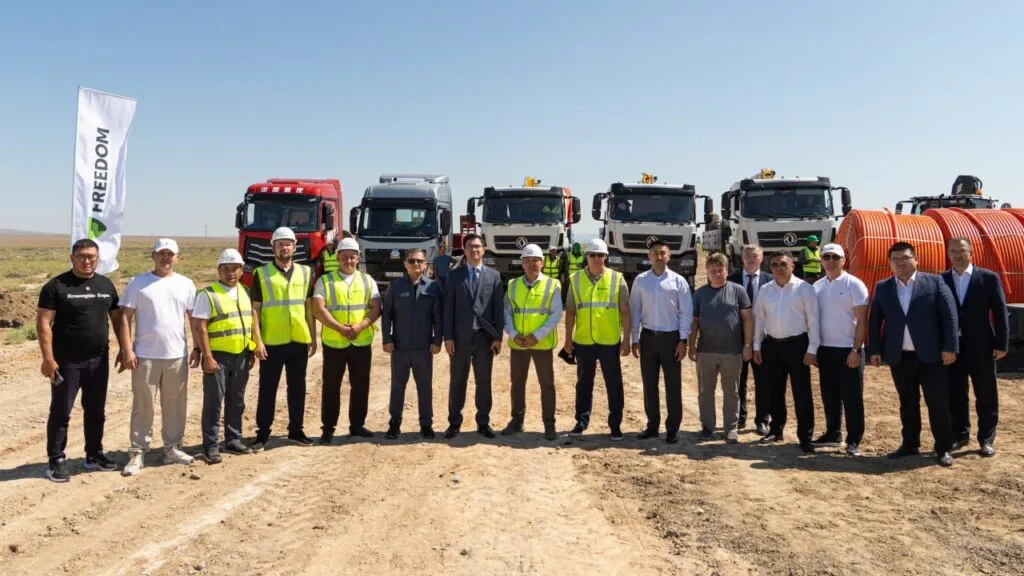
On August 4 and 5, Doszhan Musaliyev, Vice Minister of Artificial Intelligence and Digital Development of the Republic of Kazakhstan, visited the Kyzylorda region, where he reviewed the progress of construction on a section of the mainline. The trip was also dedicated to monitoring communication quality and the development of the region's digital infrastructure.
The project is being implemented under a memorandum between the Ministry of Artificial Intelligence and Digital Development of the Republic of Kazakhstan and Freedom. Freedom Cloud Holding and JSC "ASTEL" are responsible for the project's implementation.
What is being built
The "West-East" project is a main fiber-optic communication line from Aktau, where construction of the Trans-Caspian mainline is being completed, to Khorgos. The total length of the route will be approximately 4,500 km. More than 2,200 km of fiber-optic cable (FOC) has already been laid.
The basic route passes through seven regions of Kazakhstan. Freedom Holding is also considering the possibility of expanding the infrastructure to 13 regions.
Why the mainline is needed
At the direction of the Head of State, Kazakhstan is focusing on developing infrastructure that will serve the country in the long term. The "West-East" hypermainline is part of this approach: Kazakhstan is not just updating domestic communication networks but is establishing a route that can enhance its role in international data exchange.
The mainline will create an alternative traffic transmission channel between Europe, Central Asia, and China. Together with the Trans-Caspian FOC, the project forms a more resilient communication architecture in the region and strengthens Kazakhstan's position as a digital hub of Eurasia.
What this will bring to the regions
At the same time, the ministry is simultaneously addressing practical tasks of regional digitalization: expanding broadband access, modernizing networks, transitioning from 2G and 3G to 4G, eliminating "white spots," and launching public digital services, including Free Wi-Fi in populated areas.
For the Kyzylorda region, the mainline opens up opportunities for organizing high-speed channels with neighboring regions and international operators, as well as for connecting distributed data centers and remote computing resources based on AI.

What technologies will operate based on the hypermainline
The new infrastructure is expected to provide a capacity of at least 12 Tbit/s. This is important for services that require fast exchange of large volumes of data.
Upon completion of the project, Kazakhstan will have a modern optical infrastructure for the development of the digital economy, AI solutions, digital services, and international data transit.
The Tech on Telegram Follow The Tech on Telegram
Keep up with the latest technology and startup news.
Related reading





More from this author

Article Useful
How to protect your accounts from hacking: 8 settings you should check today
The Tech

Article Useful
500 Global: How the Accelerator Works and Who Can Receive Investments
The Tech

Article Interviews
Game Development in Central Asia: Arkady Moldavski on Developing Reverb and the Growth of the Industry
The Tech

Article Useful
Google, Tesla, BlackRock, and the IMF: Where to Apply for an Internship in Fall 2026
The Tech

News IT
Tesla unveiled the flying electric car Roadster
The Tech

News IT
Intero Biosystems startup won the Startup Battlefield at TechCrunch Disrupt 2026
The Tech