How an AI startup from Central Asia can land a major client in the US: demand, figures, and trust
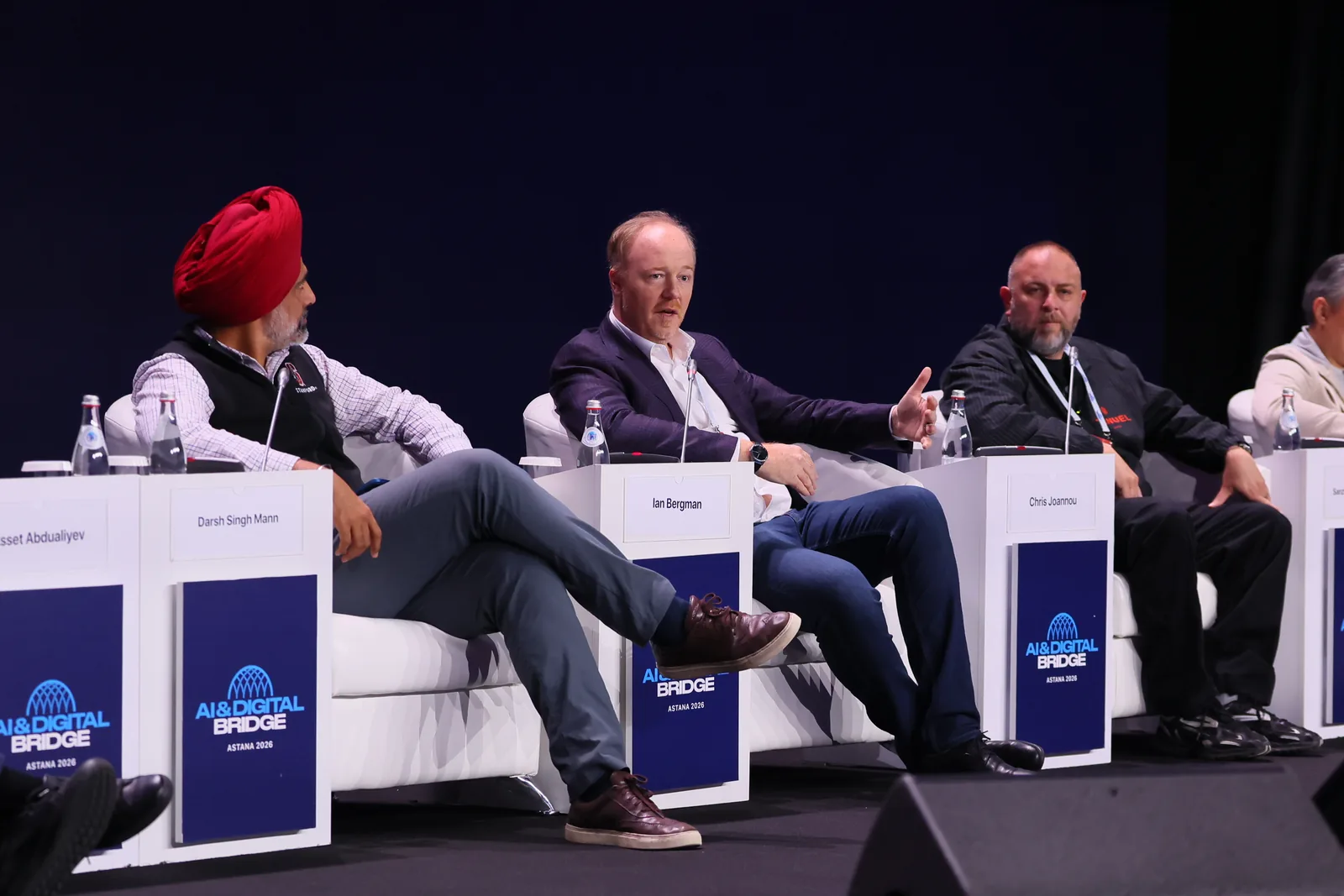
A strong product is no longer enough to secure a major corporate client in the United States. A startup must demonstrate demand, deliver measurable results, reach decision-makers, and earn trust in a new market. This was discussed by the participants of the session "How can AI startups from Central Eurasia move from local validation to global enterprise growth?" at AI & Digital Bridge 2026.
The Tech AI
Get the key points in seconds - a short summary from The Tech AI.
In a discussion featuring Ian Bergman, Chris Ioannou, Darsh Singh Mann, Sanzhar Rakhmetzhanov, and Ivan Belokhvostik, the moderator was Aset Abdualiev. The participants highlighted the importance of speed of action, deep understanding of the industry, and measurable results for startups. Successful entry into the global market requires proof of economic value, security, and trust from customers.
The discussion featured Ian Bergman, CEO of Alchemist Accelerator; Chris Ioannou, Vice President and Director of Draper University; Darsh Singh Mann, Head of Business Development and Global Partnerships at StartX; Sanzhar Rakhmetzhanov, Co-founder of Armeta AI; and Ivan Belokhvostikov, Founder of Cybernet AI. The moderator was Aset Abdualiev, Founder and CEO of Silkroad Innovation Hub.
First the team and the market, then the technology
International accelerators evaluate not just the product itself. Ian Bergman identified speed as one of the key qualities of a founder — the ability to act quickly, test hypotheses, and learn. Darsh Singh Mann added deep industry understanding and the team’s ability to bring ideas to fruition.
For startups from Central Asia, a well-known accelerator can serve as the first source of trust in a new market. Participation in such a program provides access to mentors, investors, and potential customers, as well as helps connect with decision-makers within large companies. However, the accelerator itself does not sell the product on behalf of the founder.
Ian Bergman, CEO of Alchemist Accelerator
An accelerator helps open the door. But from there, you must prove that you understand the problem better than the customer and truly know how to solve it.
An MVP alone is no longer enough
The development of AI has significantly simplified the creation of new products. Therefore, having an MVP on its own no longer constitutes a significant advantage.
According to Bergman, investors and corporate clients increasingly look at real metrics: are there pilots, how quickly do customers appear, and is the startup capable of turning product testing into a commercial contract. This is why the next step after developing the technology is proving its value to the business.
Corporate clients need numbers and trust
Ivan Belokhvostikov noted that for a bank or other regulated company, working with a young startup always involves risk. To move from a pilot to a contract, it is necessary to prove three things: economic impact, solution security, and team reliability.
First, you need to demonstrate value to the business. The company must understand how your solution helps it earn money or save costs. Then comes compliance and data security. And third — a reliable team that can be trusted.
In one of Cybernet AI’s pilots in Mexico, according to Belokhvostikov, the solution showed 20% higher efficiency than the client’s internal team at costs approximately five times lower. Measurable results became the argument for moving to a contract.
In a new market, a startup must be visible
Armeta AI’s experience highlights another condition for international growth — the company’s presence in the professional information space.
Sanzhar Rakhmetzhanov shared that the combination of industry expertise and a strong AI team helped the company enter foreign markets, while participation in Alchemist Accelerator provided access to an international network of investors and partners. At the same time, the startup’s public visibility played an important role.
Sanzhar Rakhmetzhanov, Founder of Armeta
Be visible. We hardly seek clients ourselves — they come to us because we constantly talk about the product and the value we create.
Pitches, industry events, and professional social networks help not only to talk about the product but also to reach potential customers directly. For example, Armeta AI’s introduction to Mitsubishi Power began after the startup won a competition in Houston and evolved into discussions about a pilot project.
What is needed to enter the global market
Discussion participants identified several conditions that help a startup transition from a local product to international corporate sales: a strong team, industry understanding, validated demand, measurable results, customer trust, and access to decision-makers.
Accelerators can shorten the path to investors and corporate clients, but the startup itself must prove the main result — demonstrating the specific problem it solves and the economic value it creates for the client.
The Tech on Telegram Follow The Tech on Telegram
Keep up with the latest technology and startup news.
Related reading




More from this author

Article Useful
How to protect your accounts from hacking: 8 settings you should check today
The Tech

Article Useful
500 Global: How the Accelerator Works and Who Can Receive Investments
The Tech

Article Interviews
Game Development in Central Asia: Arkady Moldavski on Developing Reverb and the Growth of the Industry
The Tech

Article Useful
Google, Tesla, BlackRock, and the IMF: Where to Apply for an Internship in Fall 2026
The Tech

News IT
Tesla unveiled the flying electric car Roadster
The Tech

News IT
Intero Biosystems startup won the Startup Battlefield at TechCrunch Disrupt 2026
The Tech