How a 19-year-old founder from Armenia is building an AI platform for app development
A young founder from Armenia began programming at the age of six and today is developing an AI tools startup for software development that shortens the path from idea to finished application. The product is already being tested by early users and international companies. The project also went through the Plug and Play accelerator, which was an important stage in the development and strategic restructuring of the startup.

Alen Hovhannisyan, Ashtarak, CEO / Co-Founder Bleenk and Robi Labs, LinkedIn
How It All Started
I have been programming since I was six years old. My first experience was a children’s website—a small portal with jokes and stories that I built using a website builder, while studying YouTube tutorials on how to quickly create a site. That was when I first realized that development was genuinely interesting to me.
At 12, I joined a company in my hometown, where I began learning the fundamentals of development in a more systematic format. There, I moved from drag-and-drop solutions to working with code and started understanding how web products work from the inside. This became an important milestone that significantly accelerated my growth.
Later, I worked at this company for a while, but it closed down due to the pandemic. After that, I continued to develop independently: I took online courses, practiced, and solidified my foundation to ensure I didn’t lose my skills.
Two or three years later, I joined another company, then entered university, continuing to balance my studies with my development in IT. Now, I am working on my own startup.

Launching the Startup
We started the startup in 2025. The idea emerged in July, but we temporarily put it on hold, then returned to it in November and continued development.
Initially, it was a small product designed simply to demonstrate how we work. We didn’t do anything particularly complex: we took components from various solutions, mixed them together, added our artificial intelligence, and let users try it out.
At that time, AI builders were actively emerging—OpenAI and other major players were launching their solutions, and it became clear that this was turning into a competitive space, meaning the original idea was no longer entirely in our niche. However, the product continued to run “in the background”—I used it in my work with clients, for example, to fix bugs in production when I couldn’t resolve them manually. That’s when I realized that if it helped me, it could help others too.
In November, we decided to relaunch the project but completely changed the concept. What was previously just a website generator is now a full-production platform that helps create complete applications for various devices—from idea to launch. You can not only build the product but also test it for bugs, check for vulnerabilities, and publish it publicly.
The team mainly consists of my friends. We had known each other for a long time and crossed paths at various events and summits, spending a lot of time together and interacting within the same circle. Gradually, we formed a common chat, and some people from this circle became the core of the team. We later intentionally invited some others.
For example, Mary Grigoryan joined us as a product manager and now handles communications at Bleenk. Also in the team is my co-founder, a classmate whom I persuaded for a long time to join. He always provided strong feedback on the product and possessed strong product thinking, so his involvement became an important part of the team.
Target Audience
We currently have about 32 users testing the early version of the product. The main audience includes indie developers, startup teams, developers, and enterprise teams who work with code, create websites, and build products.
Our startup helps reduce the time between an idea and a ready-to-use application. Instead of setting up infrastructure and switching between different tools, the developer works in a single, unified workspace—one space without switching between applications and pages.
Currently, the first users are actively testing the product—these are programmers who use various platforms and provide us with constant feedback.
Incubation Programs
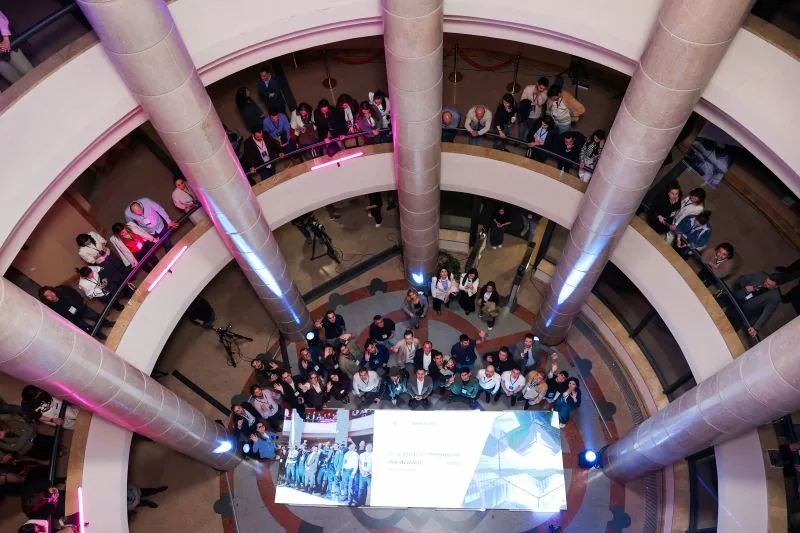
Plug and Play is, perhaps, one of the most important parts of this story for the Bleenk startup. And the most interesting part is how we got in.
I applied there even with my second startup for the second batch, but we were not accepted. I remembered that. When the call for the third batch opened, I applied again—this time without high expectations: if we got in, great; if not, we’d move on. I wasn’t even sure if I had applied before, so I sent the application again “just in case.” Time passed, we were fully occupied with the product, and I almost forgot about the application. Then one evening, while I was just writing code, I received an email: we had been accepted into Plug and Play. Next came the interview and introduction to the accelerator team. I read the email several times and didn’t believe it at first. Then it sank in that we had really made it. There was a note about confidentiality until the official announcement, but I didn’t notice it immediately—and the screenshot had already spread among my friends.
I was very nervous during the selection process. I came to the interview stressed because I had to present the project. However, the accelerator representative helped ease the tension and made the conversation more comfortable. For me, Plug and Play always seemed like a strong global accelerator, and I worried that I wouldn’t meet their level. I even looked at the team’s LinkedIn profiles and thought we were completely mismatched in scale. But in the end, the team turned out to be strong and supportive, and the mentors were truly excellent. I had participated in Startup Summit since I was 12. If it hadn’t been for that, I might never have become a startup founder. It’s a major event in Armenia held at Lake Sevan, where we live in tents for seven days.
I applied several times and initially received rejections—I was told I was “too small.” But eventually, I got in, and it was my first real victory. At that time, I spoke almost no English and understood little of what was happening, but the atmosphere really captivated me.
Later, there was Startup Club, where we learned the basics of startups—how investors, angels, and the entire ecosystem work. This became the foundation before launching our own project.
On Difficulties
As a small startup, the issue of money was always critical—we had almost no budget for full-scale development.
One mentor told us something important: if the product starts to appeal to you personally, you’ve already waited too long. You need to get out to users as early as possible and collect feedback, even if the product is rough. The main thing is to show that there are users who log in, test, and send signals to the market.
We planned the launch for January 26, 2026—simply because the date looked nice. The product went live, media wrote about us, but then it stopped working: we had exhausted our paid limits. The application was unavailable for about two days, and users wrote to support; I even replied from my lessons, explaining the situation.
Later, we were approved for $40,000 in cloud credits through E2B, and we quickly restored the infrastructure. There were other problems too—for example, losing part of the code after a laptop crash, which meant rewriting much of it from scratch. The main advice from this experience is to test hypotheses as quickly as possible and get out to users as early as possible. They provide feedback that is impossible to imagine within the team. The second important point is not to be afraid to launch the product, even if it’s unstable: we were in the market for two days with an imperfect version, but users were still there, and that’s normal for a startup. The worst-case scenario is that the product breaks, and you simply fix it or refund the money—it’s part of the process. A startup is always about uncertainty, and you won’t know the result until you launch.
After Plug and Play, we completely revised our business model. Initially, our prices were too low—we thought it would be easier to attract users that way. But we were explained that a too-cheap product lowers perceived value, and it’s important to shape positioning correctly from the very beginning. This became an important lesson: mentors don’t just support; they force you to change decisions and remove “rose-colored glasses.” This accelerates growth and makes product solutions more mature.
Achievements
We have strong interest from large global companies—those I know personally and that genuinely sound like “wow.” Some of them reached out to us directly with partnership proposals. At first, this was perceived as something unusual, but over time it becomes clear that this is normal practice: large companies do work with small startups, provide access to resources, and help with development. For example, Amazon contacted us several times—directly and through partners. They offered cloud credits and introductions to other companies that could also provide support. We were able to establish cooperation with some of these companies, but not with others.
AI research labs also approached us with proposals for model integration and discounted API access. This became confirmation for us that the product is already noticeable in the ecosystem.
This happened largely because we actively promote the product and openly show what we’re doing—we get noticed, and companies come to us.
Plug and Play opened even more opportunities for us. New acquaintances, managers, investors, and partners appeared, with whom we are now having separate discussions about the startup’s development.
Overall, this shows an important thing: in startups, connections and introductions are crucial. Writing directly to funds or large companies rarely works. But when someone they trust recommends you, it immediately changes the level of perception.
There are many startups in the ecosystem now, and by yourself, you are just one of many. But through the right connections and trust, you become much more visible and “relevant” to investors and partners.
Plans
By the end of the year, we want to scale the product and significantly increase the number of active users. The main goal is to achieve stable monetization so that the product can sustain its own development independently and not rely on credit resources.
We are also considering developing an enterprise direction—creating a solution for large corporations that will be used internally within companies, similar to Google, Amazon, or Sber. Currently, we are studying the market to determine the most appropriate form for this product. For us, it is important that the product becomes sustainable in terms of revenue, as it is complex and requires constant development and support. Most of the system is currently being built within the team, and in fact, I remain the only developer, so the workload is high. If you are interested in investing, we are open to dialogue.
The Tech on Telegram Follow The Tech on Telegram
Keep up with the latest technology and startup news.
Related reading






More from this author

Article Useful
How to protect your accounts from hacking: 8 settings you should check today
The Tech

Article Useful
500 Global: How the Accelerator Works and Who Can Receive Investments
The Tech

Article Interviews
Game Development in Central Asia: Arkady Moldavski on Developing Reverb and the Growth of the Industry
The Tech

Article Useful
Google, Tesla, BlackRock, and the IMF: Where to Apply for an Internship in Fall 2026
The Tech

News IT
Tesla unveiled the flying electric car Roadster
The Tech

News IT
Intero Biosystems startup won the Startup Battlefield at TechCrunch Disrupt 2026
The Tech