Japan Airlines has deployed robots at Tokyo airport: they load luggage and clean the cabin instead of humans
A Japanese airline has launched a pilot project with humanoid robots directly in the airport — and this is not science fiction, but a response to the real problem of labor shortages.
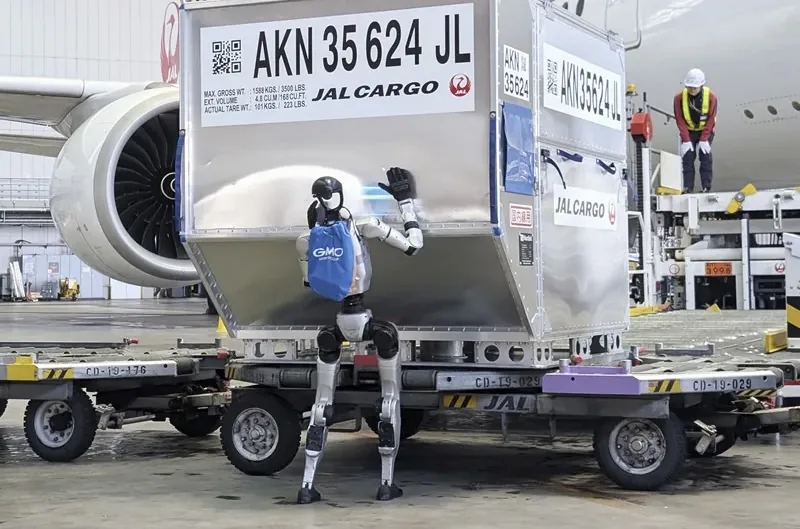
What is a humanoid robot and why this particular form
A humanoid robot is a machine with arms, legs, and a torso that moves roughly like a human. This is not merely a design choice: this form is fundamentally important for operations in an airport.
Robots can adapt to the complex tasks of ground staff—such as handling baggage carts for cargo containers, service stairs, and units for supplying power and conditioned air to aircraft. All this equipment was originally designed for humans, which is why a robot in a human-like form fits into the existing infrastructure without requiring modifications.
What exactly Japan Airlines launched and what it looks like
Japan Airlines has begun testing humanoid robots for ground operations at Tokyo's Haneda Airport amid chronic staff shortages. The airline is collaborating with GMO AI & Robotics: the robots perform tasks such as baggage loading and cabin cleaning—the experiment started in May. This is the first project of its kind in Japan.
The tasks involved in the trials include aircraft towing, loading and unloading baggage and cargo containers, as well as cabin cleaning. At a media demonstration at Haneda, a humanoid robot pushed a cargo container next to a JAL aircraft. The trials will last until 2028: initially, the robots will operate in controlled conditions, and then they will be gradually integrated into the airport's real-world workflows.
What kind of robots are these and how much do they cost
The robots are the G1 models from the Chinese company Unitree. They stand slightly over 130 centimeters tall, weigh about 35 kilograms, and have a maximum speed of 2 m/s. They operate for about two hours on a single charge, and the base version costs around $13,500.
In addition to the Unitree G1, the trials also use the Walker E model from the Shenzhen-based company UBTech. Both manufacturers are Chinese, which is notable in itself for Japan, long considered a global leader in robotics.
Why robots are a measure of necessity, not desire
Behind the impressive technology lies a severe demographic problem. The initiative emerged at a time when Japan's aviation sector is struggling with rising tourist demand against a backdrop of shrinking workforce due to an aging population. Airports are crowded with tourists, but there is no one to work.
Tomohiro Uchida, President of GMO AI & Robotics, framed the problem as follows: "Although airports appear highly automated and standardized, their internal operations still rely heavily on manual labor and suffer from serious staff shortages." According to OECD forecasts, Japan's working-age population will decrease by 31% by 2060 compared to 2023. Against this background, robots are no longer futuristic concepts but practical necessities.
What comes next
Haneda Airport, which handles over 60 million passengers annually, will serve as a testing ground until 2028. The airline aims to improve efficiency and reduce dependence on ground staff.
If the experiment proves successful, the use of robots in airports could become standard practice—improving efficiency, addressing labor shortages, and changing the traditional appearance of the aviation industry.
The Tech on Telegram Follow The Tech on Telegram
Keep up with the latest technology and startup news.
Related reading



More from this author

Article Useful
How to protect your accounts from hacking: 8 settings you should check today
The Tech

Article Useful
500 Global: How the Accelerator Works and Who Can Receive Investments
The Tech

Article Interviews
Game Development in Central Asia: Arkady Moldavski on Developing Reverb and the Growth of the Industry
The Tech

Article Useful
Google, Tesla, BlackRock, and the IMF: Where to Apply for an Internship in Fall 2026
The Tech

News IT
Tesla unveiled the flying electric car Roadster
The Tech

News IT
Intero Biosystems startup won the Startup Battlefield at TechCrunch Disrupt 2026
The Tech