Higher Education in IT: An Overview of the School of Information Technology and Engineering at KBTU
Today, the School of Information Technology and Engineering is the largest school at KBTU, where more than 3,000 students are studying at the bachelor's, master's, and doctoral levels.
Author - Mansur Ismagulov

The Tech AI
Get the key points in seconds - a short summary from The Tech AI.
The School of Information Technology and Engineering has been operating since 2002 and holds ABET accreditation. It offers five undergraduate majors, eight master's programs, and two doctoral programs. The curriculum includes elective courses and the opportunity for students to take courses from other schools. The school continues to develop through GameLab KBTU (2022), Data Science, Computational Neuroscience (2023) laboratories, and the Industrial Committee.
Bachelor’s Programs
Since its establishment in 2002, the School of Information Technology and Engineering has been developing rapidly and offers education in five bachelor’s specialties approved by the Ministry of Education and Science of the Republic of Kazakhstan:
— “Automation and Control”
— “Information Systems”
— “Computer Engineering and Software”
— “IT Management”
— “Robotics and Mechatronics”.
The educational programs have undergone accreditation by the Engineering and Technology Computing Accreditation Commission of the Accreditation Board for Engineering and Technology. This accreditation is recognized as a global leader in academic programs in applied and natural sciences, computer engineering, engineering, and technology. Accreditation guarantees that the programs meet strict international standards and provide high-quality education.
All students, regardless of their chosen specialty, study a strong mathematical foundation along with blocks on programming languages and algorithms.
Starting from the fourth semester, students can choose various educational trajectories. In addition, they study a minimum set of subjects corresponding to their specialties. For this purpose, students are offered elective courses in ICT and engineering fields:
— “Big Data Analytics”
— “Cybersecurity”
— “Machine Learning”
— “Full-Cycle Web Development”
— “Cloud Computing and DevOps”
— “Mobile Development”
— “Computer Graphics and Design”
— “Video Game Development”.
Students can also take courses from other schools of KBTU, such as “Oil and Gas Engineering,” “Energy Specifics,” “Nanotechnology,” “Green Technologies,” “Finance and Management,” and “Economics.” This promotes the development of interdisciplinary interaction.
Master’s Programs
The School of Information Technology and Engineering offers various master’s programs. The programs are aimed at mastering modern technologies and trends:
— “Data Science”
— “IT Management”
— “Software Engineering”
— “Computer Science and Data Analytics”
— “Information Systems”
— “Industrial and Systems Engineering”
— “Electronics and Control Systems”
— “Smart Cities and Systems”.
Each master’s program allows students to deeply explore specialized areas in information technology and engineering. The programs are developed in accordance with the modern needs of the labor market and provide students with the opportunity to receive education from leading experts in their field.
Master’s students can conduct high-level research and complete projects while having access to modern technologies and infrastructure.
Doctoral Programs
The School of Information Technology and Engineering offers two doctoral programs. The goal of these programs is to prepare highly qualified scientific and scientific-pedagogical personnel in the fields of informatics, computer engineering, and artificial intelligence:
— “Informatics, Computer Engineering, and Control”
— “Computer Science and Artificial Intelligence”.

These programs are aimed at developing new efficient methods for processing and storing information, creating innovative methods and tools for intelligent data processing, as well as developing instrumental and applied software systems for automating professional activities in various fields.
Faculty
The highly qualified faculty of the School of Information Technology and Engineering includes doctors of science, candidates of science, and specialists with extensive industrial experience. They not only provide theoretical knowledge but also pay special attention to the practical application of the study material, preparing students for the requirements and challenges of the modern labor market.
KBTU faculty members actively participate in scientific research, innovative projects, and the development of new teaching methods. As a result, students gain access to the most up-to-date information and technologies, creating conditions for their professional and personal development.
Industry Committee
The Industry Committee, consisting of leading technology companies in Kazakhstan, reviews each program of the School of Information Technology and Engineering annually. The committee ensures continuous improvement of the programs and their alignment with the needs of the industry.
The Industry Committee monitors the relevance of curricula and programs, identifying priority areas while considering modern trends and market requirements. Thanks to close ties with the industry, students receive education focused on real needs and challenges, gaining a competitive advantage in their future careers.
Research Laboratories of the School of Information Technology and Engineering
GameLab KBTU — a laboratory for the development and research of video games, established in 2022. The main directions of the laboratory include: offering elective courses for game development and research within bachelor’s and master’s programs, providing mentoring support for GameDev projects, assisting students and graduates in finding internships and career opportunities in the game development field, organizing open educational events for the GameDev community, conducting research, and publishing scientific articles in the field of video game development and research.

Data Science Laboratory
The Data Science Laboratory was established to research and develop new methods and technologies in the field of data analysis, processing, and interpretation. The main goal of the laboratory is to study aspects of collecting, storing, analyzing, visualizing, and applying data to make effective decisions in various fields: science, industry, healthcare, finance, and others. Additionally, the laboratory contributes to the development of innovations and new products and services based on data.
Computational Neuroscience Laboratory
The Computational Neuroscience Laboratory, established in 2023, is focused on studying neural networks, brain-computer interfaces, and the functioning of neural systems. The main task of the laboratory is to understand the principles of brain function and develop new computational methods and algorithms inspired by neural processes. Research directions include improving machine learning algorithms, artificial intelligence, and deep learning technologies, creating biologically inspired models in computer vision, natural language processing, and robotics. Additionally, the laboratory studies the potential applications of computational neuroscience in medical, neuropsychological, and neurorehabilitation fields.
Intelligent Robotics and Mechatronics Laboratory
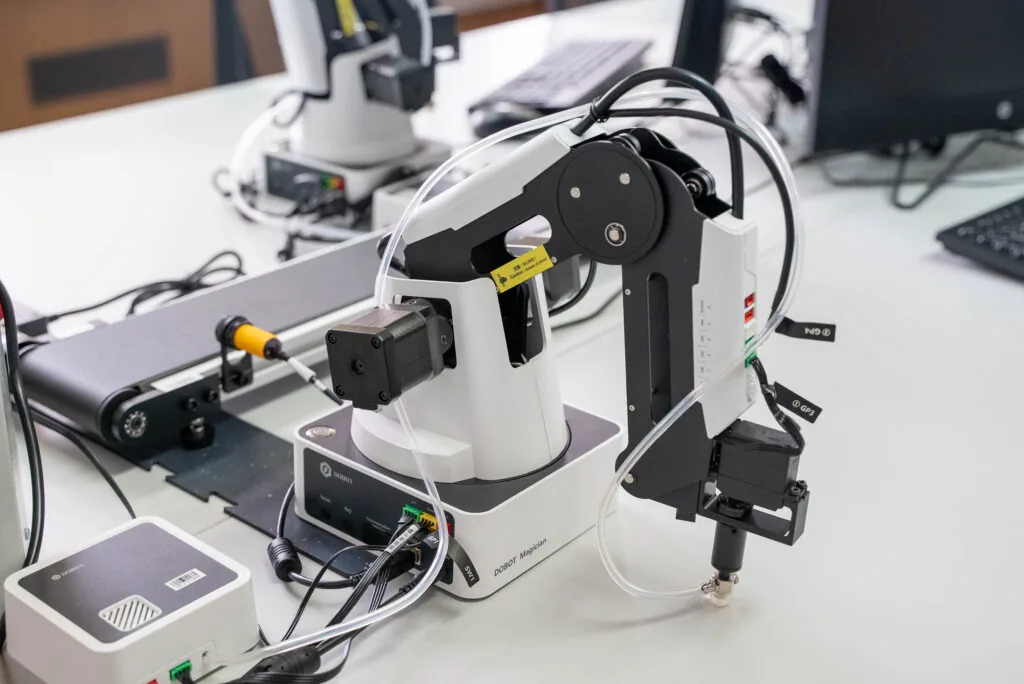
The Intelligent Robotics and Mechatronics Laboratory is focused on researching the application of artificial intelligence in robotics, mobile robots, mobile manipulation, remote control, mechatronics, sensing, and perception.
Cybersecurity Laboratory
The Cybersecurity Laboratory conducts research in cryptography, machine learning, data analysis, network security, and other aspects of information protection. This enables the development of new methods and tools for identifying and countering threats, as well as enhancing the security level of computer systems and networks.
The Tech on Telegram Follow The Tech on Telegram
Keep up with the latest technology and startup news.
Related reading






More from this author

News
zypl.ai begins operations in Japan and focuses on next-generation risk models
Mansur Ismagulov

News
Elon Musk's net worth has exceeded $700 billion for the first time
Mansur Ismagulov

Article Interviews
"Central Asian countries should build a joint ecosystem," — Bekhzod Ismoilov on the development of AI in the region
Mansur Ismagulov

Article Interviews
Bloom's Taxonomy and Engineering Levels: A Practical Growth Model
Mansur Ismagulov

Article Useful
How the IT industry in Azerbaijan developed in 2025: key events
Mansur Ismagulov
News
Tajikistan has become a new member of the regional innovation alliance Central Asian Innovation Hubs
Mansur Ismagulov