IT-oilalar: Odil Muhammadov and Durdona Bahronova
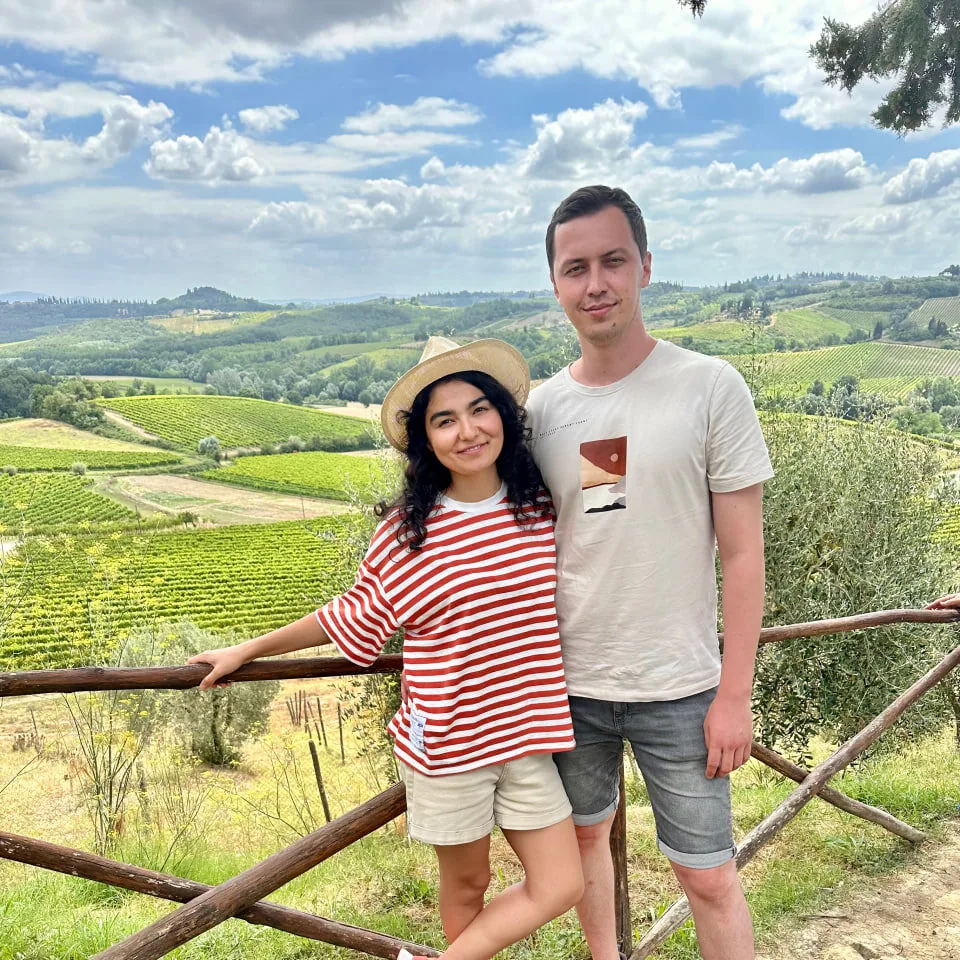
Odil Muhammadov and Durdona Bahronova shared in our interview how they entered the IT field and how technical experience helps them build harmonious relationships.
Author - Mansur Ismagulov
The Tech AI
Get the key points in seconds - a short summary from The Tech AI.
Durdona Bahronova and Odilia Mukhamadova are software engineers from Tashkent who have known each other since 2016. They share household responsibilities and apply IT methods (retrospectives) to address family matters. The couple actively travels and values the flexibility of working for international companies.
Durdona Bahronova, Tashkent, Software Engineer, Instagram
Odil Muhammadov, 28 years old, Tashkent, Software Engineer
About Us
Durdona. I work at Super Dispatch, an American startup with an office in Tashkent and its headquarters in the US. I have been working here for almost four years. I have over five years of experience in the IT industry. Outside of work, I am actively involved in the GDG Tashkent and Women Techmakers Tashkent IT communities.
Odil. I work as a frontend developer for a company based in Dubai, far from Tashkent. I studied at Westminster University together with Durdona. We met there, but we only started dating in 2016.
How they entered the IT industry
Odil. After graduating from university, I planned to start my own business. For half a year, I tried to implement this idea, but without success—I lacked connections and budget, and my plan was not sufficiently thorough.
After that, I needed to start earning money. I decided to become a Python developer and started sending out resumes, but no one hired me because we hadn't learned this language at Westminster.
Then, an acquaintance wrote to me. After seeing my experience with DotNet in my portfolio, he offered me a job at his company. At first, I refused, but he convinced me to give it a try since I was unemployed. I agreed, and thus my IT career began. Initially, I worked with backend, but later I switched to frontend and liked it.
Durdona. I was offered a job at Inha University, where I started as a business analyst, even though I didn't know what the role entailed. It turned out that the main task was writing documentation. I found it boring and left the position without passing the probation period.
Later, I was offered another project, but the situation repeated itself. At the beginning of my career, many girls were thought to be good at working with documents, so I was often assigned such tasks.
Everything changed when an acquaintance offered me help with his project—developing a mobile app. It sounded more interesting than working with documents, so I agreed. Thus, my path in IT began.
Later, I switched to programming, but this project was exactly my first experience in the field. Currently, I work in a hybrid format.
Since the management is in the US, we often have evening meetings, so the workday starts later and ends later.
Distribution of responsibilities
Durdona. In our home, all responsibilities are shared equally. I don't like cooking, so it's my partner's task, while I take care of cleaning. We use the vacuum cleaner together; he washes the dishes, and I clean the bathroom. We have a cat: feeding it is my responsibility, and cleaning up after it is his. Generally, each of us has our own areas of responsibility.
Odil. We immediately created a list of household chores and chose the ones that were convenient for us to perform. If something becomes unacceptable, we review the responsibilities.
We hardly have any free time, so we try to use it for rest. The workday starts around 11:00–12:00 and ends only around 21:00.
Durdona. We started working more and focusing on our careers, but previously, the balance between work and personal life was more stable. We spent more time on active leisure and often went to hockey games.
Odil. Previously, every Saturday morning we would go to a café for breakfast, chat, and hold a retrospective of the week.
Family traditions
Odil. We don't have specific traditions, but we have habits that repeat year after year.
Durdona. For example, every summer we try to travel with our friends.
This has already become a tradition—in the last few years, we have gone on trips together five times. Travel brings joy, and we always choose a new direction. Among the countries we have visited are Kazakhstan, Italy, Turkey, Germany, and Poland. Some trips were taken together, while others separately.
Combining family and work
Durdona. We live separately from our parents, so household tasks do not seem complicated. Of course, caring for older family members would require more responsibility, but currently, we are only responsible for ourselves and our cat. Therefore, combining work and family life is quite easy. Perhaps in the future, when we have children, the load will increase, but for now, we are comfortably managing all responsibilities.
Advice for a happy family life
Odil. The most important thing we did at the beginning of our life together was discussing our expectations, desires, and visions of the future. For example, Durdona wanted to live in Tashkent, and I wanted to live in another city. As a result, we decided to move together, which benefited us both. We honestly told each other our expectations and try to take them into account to make our life together comfortable.
Many men believe in the concept of "the man is the head of the house" and think that his word should be decisive. I do not agree with this. Even if a woman says that submission is convenient for her, it does not always mean she is happy. The key is not dominance, but constant communication and mutual understanding.
Durdona. In our relationship, there is no leader and no subordinate—it is a partnership. We discuss all decisions, analyze the situation, and support each other. Since we work in the same field, it is easier for us to find common ground and even share professional issues.
In family life, it is impossible to maintain a strict 50/50 balance. Everything depends on the situation. Everyone has their strengths and weaknesses. We try to complement each other: for example, I don't like working with documents, while Odil, on the contrary, is detail-oriented and handles this task better. Sometimes one person's contribution is 80%, and the other's is 20%, but over time, everything balances out. The most important thing is to understand your own strengths and help your partner.
How IT families differ from others
Durdona. Retrospectives are important to us—they are a practice we brought from work into our personal lives. In IT companies, a retrospective is a meeting where problems are discussed, processes are analyzed, and ways to improve them are sought. We applied this method in our family: we occasionally sit down and discuss what satisfies us and what can be changed. This is especially useful for couples who work in the same field.
This approach helped us deal with difficulties that arose. When problems appeared, we discussed them as colleagues, using the format of work meetings. This method turned out to be an effective tool for improving relationships and better understanding each other.
Odil. If we compare ourselves with other families, one of our main differences is the opportunity to work remotely. We are not tied to a specific location, and if we want to live in another country, we can simply continue working from a new place.
Another important aspect is working with foreign companies and knowing English. We use it every day, which gives us more career opportunities and expands our professional prospects.
It is also worth noting that we have a high possibility of relocating. Generally, IT specialists have more mobility opportunities, and in our case, they are doubled because each of us has the opportunity to change countries separately.
Additionally, we can discuss professional issues and easily understand each other, even in the technical aspects of work. This creates additional mutual understanding in the family.
The Tech on Telegram Follow The Tech on Telegram
Keep up with the latest technology and startup news.
Related reading







More from this author

News
zypl.ai begins operations in Japan and focuses on next-generation risk models
Mansur Ismagulov

News
Elon Musk's net worth has exceeded $700 billion for the first time
Mansur Ismagulov

Article Interviews
"Central Asian countries should build a joint ecosystem," — Bekhzod Ismoilov on the development of AI in the region
Mansur Ismagulov

Article Interviews
Bloom's Taxonomy and Engineering Levels: A Practical Growth Model
Mansur Ismagulov

Article Useful
How the IT industry in Azerbaijan developed in 2025: key events
Mansur Ismagulov

News
Tajikistan has become a new member of the regional innovation alliance Central Asian Innovation Hubs.
Mansur Ismagulov