Google DeepMind has introduced a tool for checking texts for AI-generated content.
The Tech AI
Get the key points in seconds - a short summary from The Tech AI.
Google DeepMind and the University of Pennsylvania introduced DetectorScope — a tool based on the Gemma 2 model that identifies AI-generated texts with explanations of the detected features. The tool allows users to balance transparency and accuracy, using data on texts from 40 neural networks, including GPT-4o and Llama. The research will be presented at EMNLP 2026; the code is open-sourced under the Apache 2.0 license, but the results cannot be used to make decisions about specific individuals.
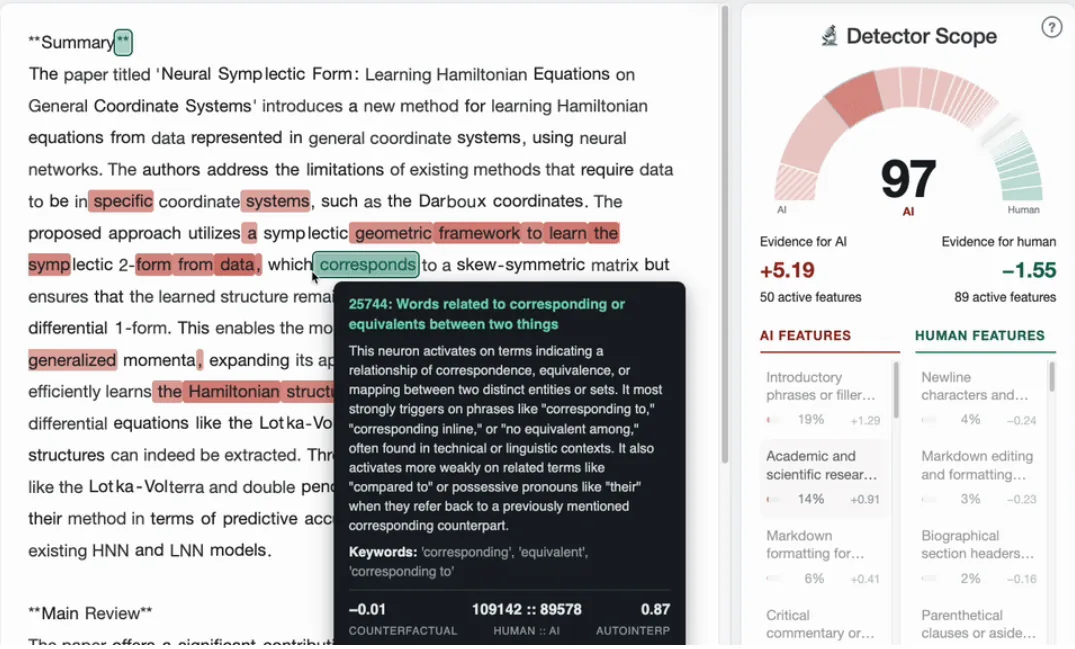
Researchers from Google DeepMind and the University of Pennsylvania have presented DetectorScope. The tool determines whether a text was written by artificial intelligence and explains which specific features influenced the conclusion and where they are located in the text.
Standard AI text detectors work like a “black box”: they provide an overall score but do not explain it. DetectorScope breaks down each decision into understandable features with descriptions. For example, this might be characteristic use of certain words or repeated phrases and sequences.
Each feature has a weight that shows how much it shifted the score toward AI or human. For instance, conversational insertions like “as I already said” instead reduce the likelihood that the text was written by a neural network. In the demo on Hugging Face, you can hover over the text to see the fragments the detector relies on.
Users can choose their own balance between transparency and accuracy. With strict settings, the detector uses fewer features, but each is well-described and easily verifiable. With softer settings, accuracy increases, but explanations become less clear. According to the authors, this transparency hardly reduces recognition quality.
The tool is based on Google’s open Gemma 2 model. The main version is trained on news, essays, reviews, and other texts created by 40 different neural networks. Two additional versions recognize reviews of scientific articles written by GPT-4o and Llama. Developers also offer a way to turn any existing detector into a transparent one.
The authors warn that DetectorScope remains a research tool and is not an official Google product. It makes mistakes, including on texts written by humans, so its results should not be used to make decisions about specific individuals—for example, when checking student work, hiring, or selecting publications.
The code is open under the Apache 2.0 license, and models are available on Hugging Face. The research will be presented at the EMNLP 2026 conference in Budapest.
Source: GitHub Google DeepMind
The Tech on Telegram Follow The Tech on Telegram
Keep up with the latest technology and startup news.
Related reading

More from this author

News IT
The launch of Global Tech Weekend 2027 will take place in Tbilisi.
The Tech
Article Useful
Business Cup, NASA Space Apps, and Startup Week: Opportunities for Startups in November 2026
The Tech

Article Startups
How a guy from Kashkadarya created an IT startup and attracted $40,000 in investments
The Tech

Article Useful
Free tickets to IT conferences in 2027: a list of international events
The Tech

Article Useful
10 platforms with free datasets for AI and machine learning
The Tech
News IT
Northwood Space has raised $375 million in investment to develop its satellite infrastructure.
The Tech