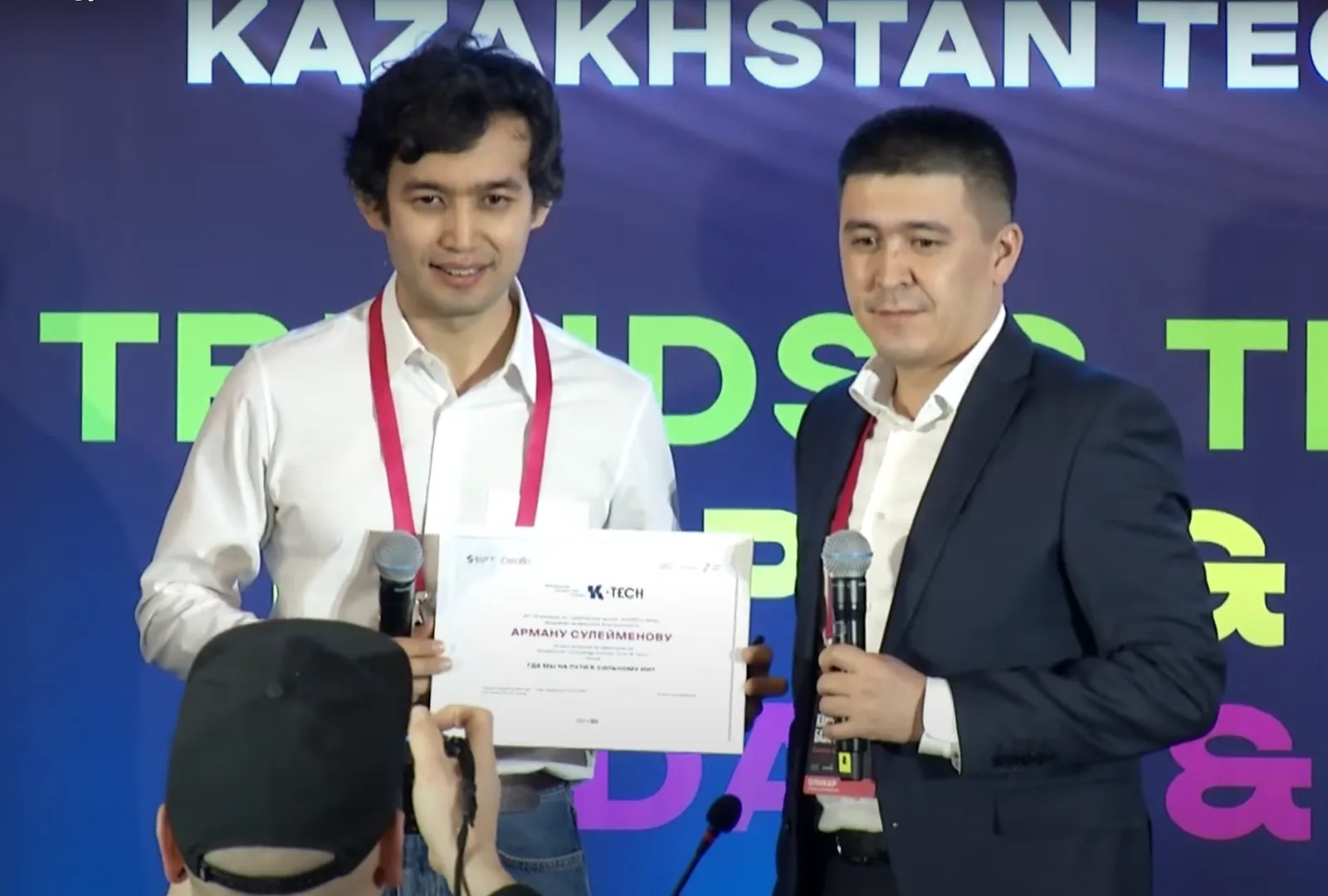
"Where We Are on the Path to Strong AI," Arman Suleimenov's speech at Kazakhstan Technology Summit 2024
At the conference, Arman Suleimenov spoke on the topic "Where We Are on the Path to Strong AI" and demonstrated interesting examples. Read more in our article.
Author - Mansur Ismagulov
The Tech AI
Get the key points in seconds - a short summary from The Tech AI.
Arman Suleimenov, CEO of nFactorial group, defines strong AI (AGI) as a universal system that surpasses humans in everything that has not yet been achieved. Weak AI already outperforms humans in narrow tasks, such as Sergek and Grammarly. Experiments with GPT-4 show progress in common sense and coding, but errors in facts and logic confirm that AGI is still far off.
Arman Suleimenov, founder and CEO of nFactorial group
Strong AI is the Russian translation of the popular English abbreviation AGI — Artificial General Intelligence. The question "Where are we on the path to strong AI?" is complex. I can say that we have definitely not reached it yet. For example, we still wash dishes by hand or in a dishwasher — there are still no robots that do this.
What has happened over the last 10 years is a new era of AI, which began with the creation of AlexNet — one of the first neural networks. The previous 60 years were the AI winter.
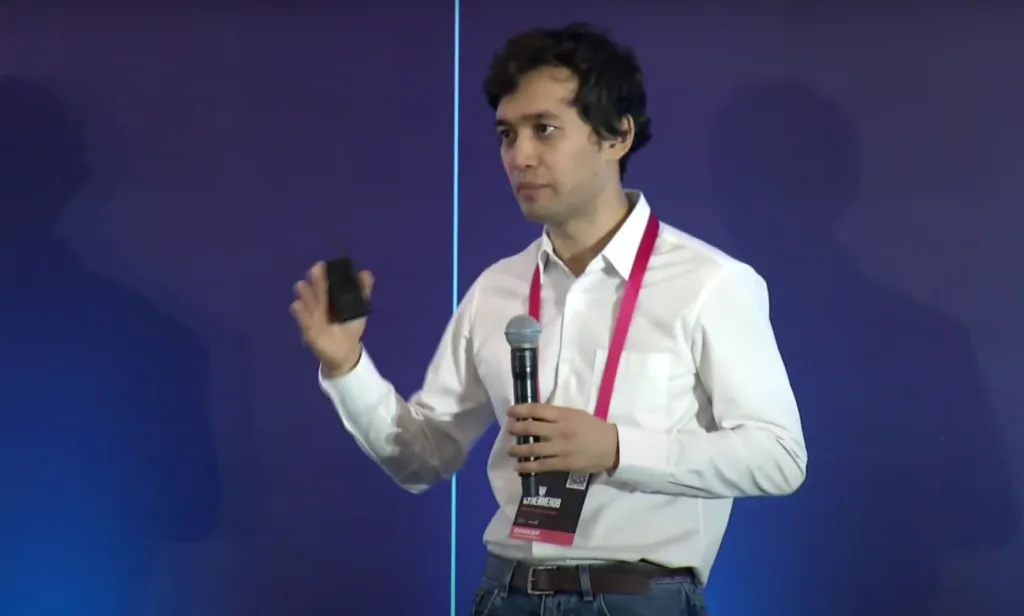
Strong AI and Weak AI
Weak AI is a system that surpasses humans in one specific area. For example, Sergek cameras recognize license plates better than humans, and Grammarly corrects spelling and grammatical errors in text better than we do.
Strong AI is a universal system that can do everything better than a human. We have not reached this yet, but we are close. Humanity is bad at predicting: usually, we overestimate what we can do in a year and underestimate the 10-year period. Therefore, no one knows the timeline yet.
Glimpses of Strong AI: Experiments with GPT-4
I liked an example from Microsoft Research — a demonstration of common sense.

Previously, artificial intelligence lacked common sense. Let's look at an example: we have nine eggs, a book, a laptop, a bottle, and a nail. We need to stack them on top of each other without damaging anything. A primary school student would handle this easily, but GPT-4's answers will differ depending on the language used.
In Russian, the AI suggests first placing the book, then the laptop, bottle, nail, and eggs on top. I'm not sure how you can balance eggs on nails, but at least we see logic: starting with solid objects and placing fragile ones on top.
In the English version, GPT-4 says: place the book, then nine eggs on top, arranged in a 3x3 format to create a stable structure. Then you can place the laptop and everything else. This indicates that the AI knows how to create stable structures.
The most surprising thing is that we are approaching strong AI through language — it is the tool through which the neural network understands the model of the world.
Let's check how well it can "see":
— draw a unicorn in tikz.
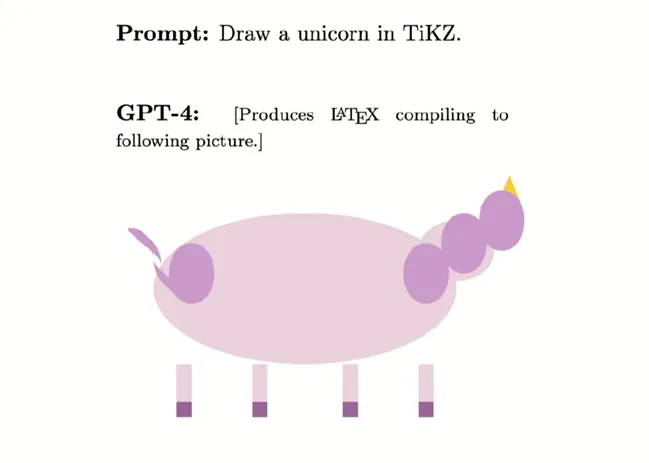
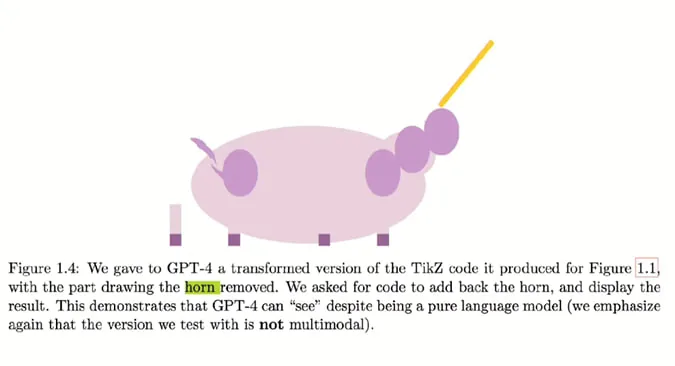
Now let's complicate the task and ask the neural network to first remove the horn, and then redraw it. GPT-4 sees the image as code and independently finds where to place the horn in this code.
Now let's check if GPT-4 passes the Turing test. The question is: "Are machines capable of thinking and imitating humans?"
Let's consider cases where GPT-4 fails the test:
— why is Chalon Letter wine from the Champagne region in France so expensive?
— because it is a small area geographically and the process is very difficult.
But in reality, any person who knows wine would say: "Such wine does not exist."
Another example:
— which of these celebrities has a beard: Will Smith, Chris Pratt, or Kevin Hart?
It thinks it is Chris Pratt. In reality, all of them have beards, but GPT-4 cannot say "all of them."
From these examples, we clearly see that even GPT-4 has not yet reached the stage of strong AI.
The Tech on Telegram Follow The Tech on Telegram
Keep up with the latest technology and startup news.
Related reading







More from this author

News
zypl.ai begins operations in Japan and focuses on next-generation risk models
Mansur Ismagulov

News
Elon Musk's net worth has exceeded $700 billion for the first time
Mansur Ismagulov

Article Interviews
"Central Asian countries should build a joint ecosystem," — Bekhzod Ismoilov on the development of AI in the region
Mansur Ismagulov

Article Interviews
Bloom's Taxonomy and Engineering Levels: A Practical Growth Model
Mansur Ismagulov

Article Useful
How the IT industry in Azerbaijan developed in 2025: key events
Mansur Ismagulov

News
Tajikistan has become a new member of the regional innovation alliance Central Asian Innovation Hubs.
Mansur Ismagulov