Eurasian Startup Hub. How the first IT hub in London for representatives of Central Asia works and how it can help you
Recently, an interview with Nurdaulet Bazylbekov, founder of Eurasian Hub in London, took place in the Telegram channel The Tech. He provided detailed insights into the hub and the hackathon, which received support from global leaders such as Google, Mistral AI, and Antler. We are sharing some of the interesting thoughts in text format.
Author - Mansur Ismagulov
The Tech AI
Get the key points in seconds - a short summary from The Tech AI.
Nurdaulet Bazylbekov founded Eurasian Startup Hub in London to support startups from the CIS. Partners of the hub include Antler, Google, and Mistral; in 2024, projects raised up to $500,000. The AI for Good hackathon brought together around 55 participants, with Scamsense, Newton, and other projects emerging as winners. Large-scale events are planned for London and Amsterdam.
Nurdaulet Bazybekov, Founder Eurasian Hub
About Me
I live in London. I received my education here and began my career at the London Stock Exchange, working in capital markets and trading. I participated in the IPOs of Kaspi and Kazatomprom. Later, I worked at an American asset management company with $120 billion in assets under management.
My interest in venture capital emerged during my collaboration with European and American funds: I helped them find startups from Central Asia. Over time, I developed the idea of creating a space where startups could receive support for their development.
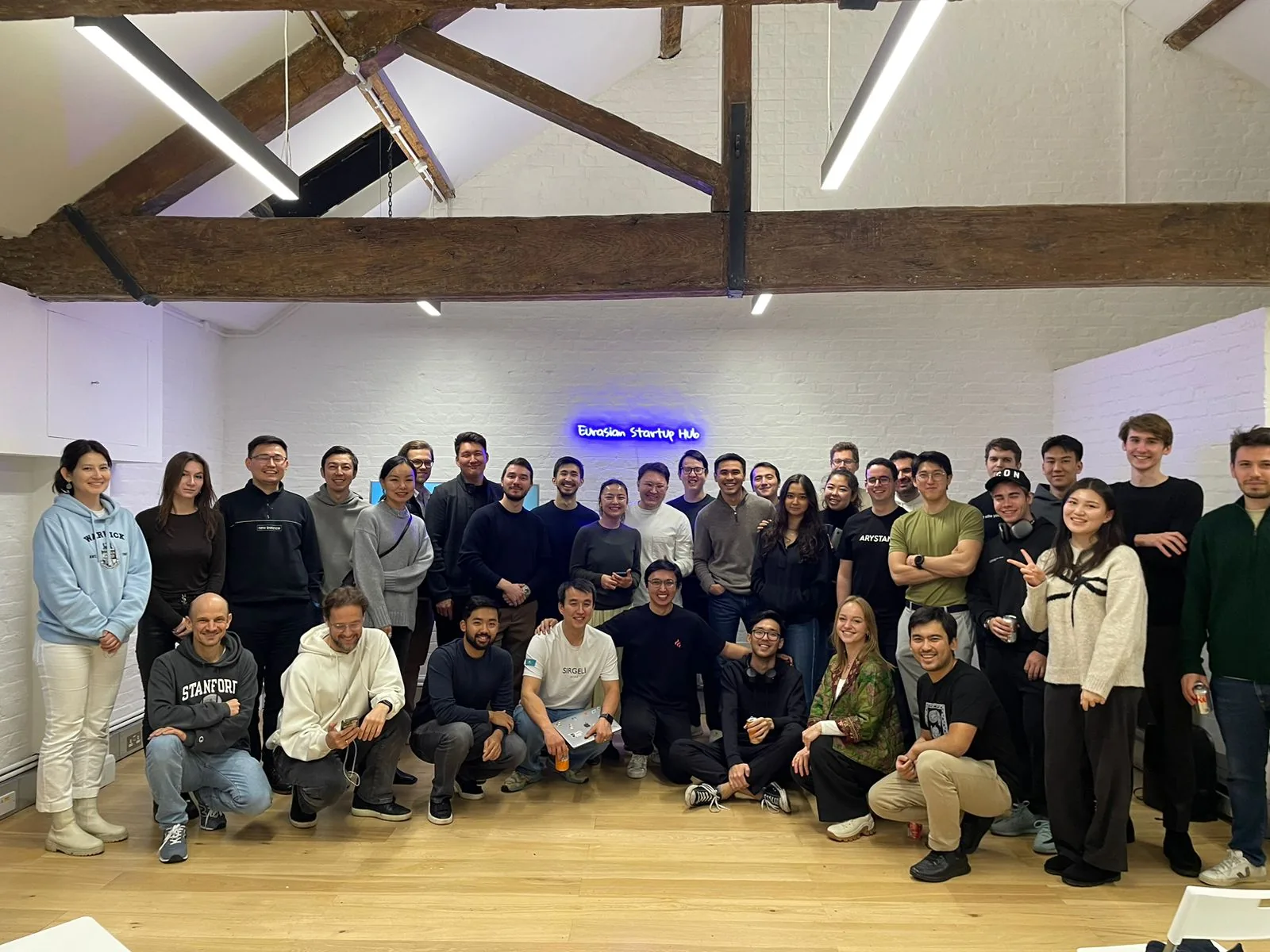
Thus, the Eurasian Startup Hub was born in London — a place where startups from the CIS countries develop their projects through workshops, hackathons, and panel discussions.
About Eurasian Startup Hub
Eurasian Startup Hub is not a new idea for our region. Similar hubs already exist in Israel, Singapore, and other countries. In the CIS, this trend is represented by Astana Hub, IT Park Uzbekistan, the High Technologies Park in Kyrgyzstan, and others.
We were inspired by this idea and created a space to support startups on a large scale. Our partners include Astana Hub, benefactors, as well as technology parks from Latvia. The main goal of Eurasian Startup Hub is to support startups from CIS countries, helping them grow and enter new markets.
The CIS space and Eurasia cover Central Asia, the Caucasus, and Eastern Europe, where Russian is spoken. A common language and a strong technical base define our focus on this region.
Our hub in London provides startups with free workspace and organizes regular events involving venture capitalists, company founders, and researchers. Recently, for example, the head of AI from AstraZeneca spoke at our event.
We support startups at all stages: from immigration assistance to capital raising and connecting with international accelerators such as Antler, Techstars, and others. In 2024, startups supported by our hub raised up to $500,000 in Pre-seed rounds, thanks to our network of venture funds.
About the AI for Good hackathon by Eurasian Hub
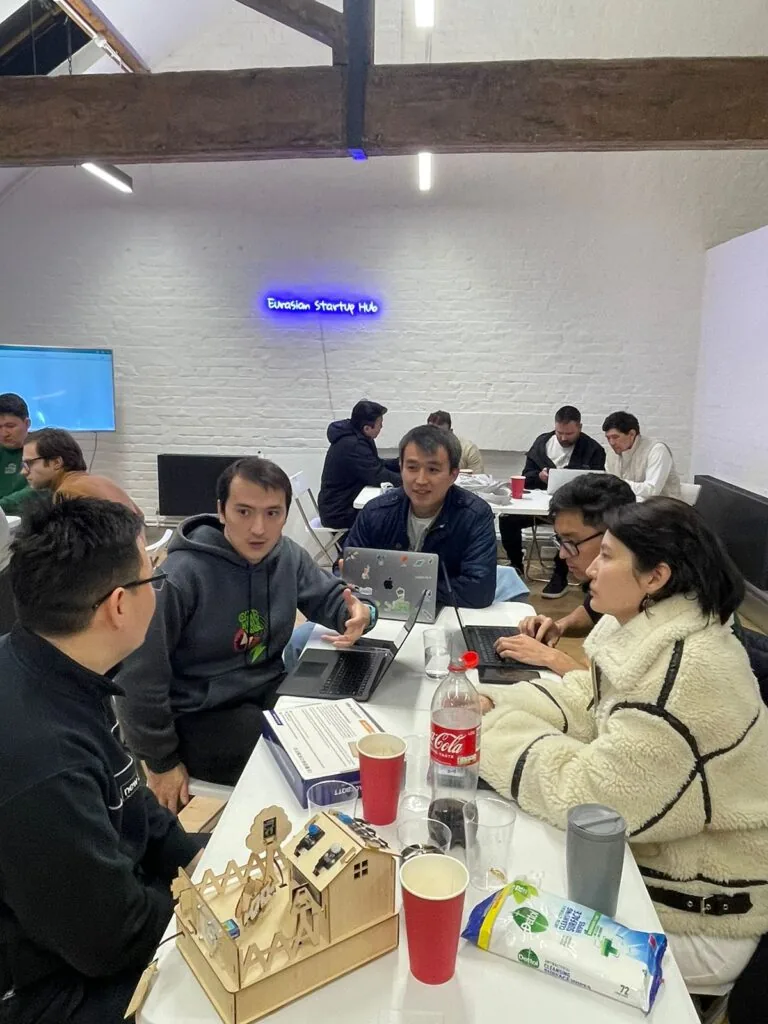
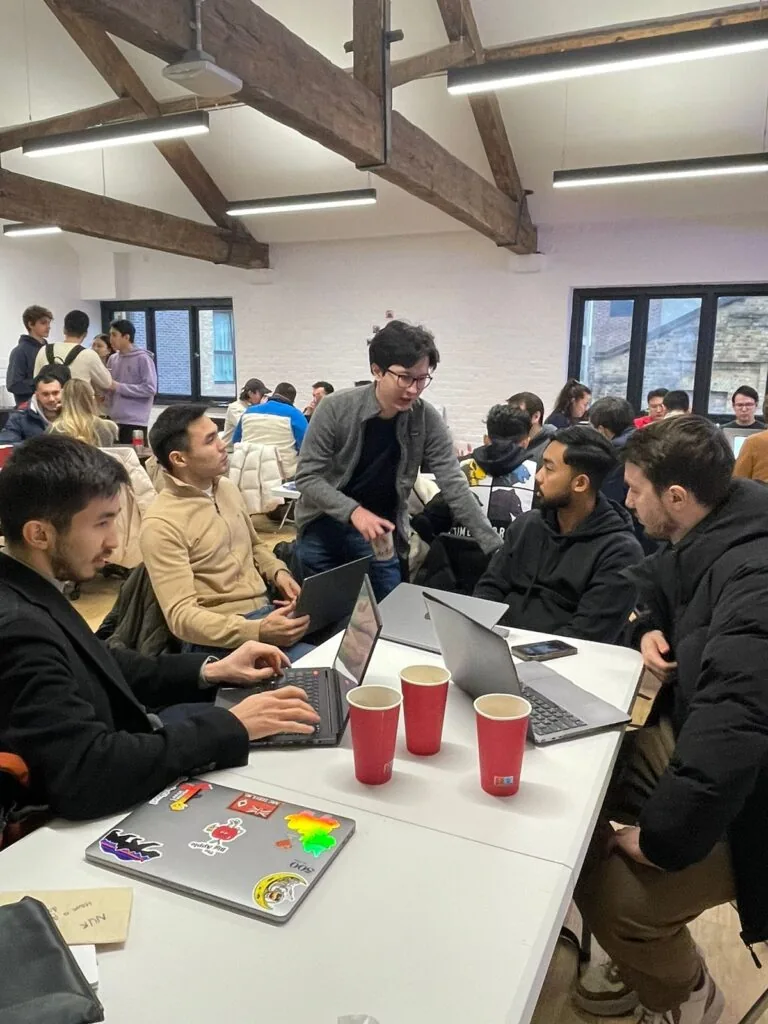
One of the goals of our hub is to attract talent from Europe and the CIS countries. We are experimenting with various approaches to create conditions in which participants can realize their potential. One successful format has been the hackathon, which attracts motivated participants willing to work 48 hours straight on their projects.
A hackathon is not only intensive work but also a celebration: participants get to know each other, form teams, exchange ideas, and find partners for their projects. We organize lunches, dinners, and informal events, creating a comfortable and inspiring atmosphere. The hackathon ends with a big celebration, for example, a dinner with traditional plov, making this event a unique combination of work, fun, and useful networking.
Location and Organization
We chose London because it has the largest number of tech specialists from the CIS. According to our research, 80-90% of students from Kazakhstan studying at leading universities in technical fields choose London due to a simpler visa policy compared to the United States.
Additionally, we already had our own premises, which allowed us to minimize costs when launching the test version of the project. Our partners are also located in London, ready to support events and provide prizes, which significantly facilitates organization.
Our main partners:
— Antler: an accelerator for early-stage startups, ideally suited for participants from Central Asia. We became the hub for Antler in the region, helping to find technical specialists from our database. Antler supports our events by sponsoring prizes and expenses, and hackathon winners get direct access to interviews with partners.
— Google: a long-term collaboration, within the framework of which we became one of 15 "ecosystem partners" in the United Kingdom. This gives us access to their offices, mentoring, and guidance from senior developers. Google also provides credits of up to $25,000 for cloud services and AI tools and sponsors our events, including food and beverage expenses at hackathons.
— Mistral: the European equivalent of OpenAI, which raised $650 million and is close to decacorn status. After getting to know our community, they supported us by offering assistance to startups during and after hackathons.
— People Consulting: our latest partner is People Consulting, representing Arman Shokparov, one of Kazakhstan's leading HR specialists. He became interested in supporting early-stage startups, especially those willing to participate in intensive events such as hackathons.
5
Results and Achievements
Our hackathon covered a broad range of topics but with a unique approach. The main focus was on the use of artificial intelligence; however, each project was required to have a mandatory social focus. We aimed at the United Nations Sustainable Development Goals, such as education and financial literacy, so that participants not only created technological solutions but also understood how their projects could positively impact society. There are many AI developments in the world, but for us, it is important that every project carries a meaningful and useful idea.
The results of the hackathon include not only developments but also the influence of our mentors and judges. We gathered top specialists from the Eurasian region, such as Aliya from Google DeepMind, Aibek — a former TikTok engineer, Jasurbek — from BlackRock, Yersultan — a former Apple employee, as well as judges from the UN and Open Origins.
Mentors such as Azat from McKinsey Quantum Black, Aidarbek — a former Palantir and Bloomberg employee, and Kadirbek from Google added valuable experience. The hackathon attracted over 107 participants, but due to space limitations, we accepted about 55 people, including specialists from Facebook, Stripe, Bloomberg, Palantir, TikTok, IBM, as well as researchers and students from Oxford studying quantum programming.
Hackathon winners:
First place — Scamsense, a startup for preventing fraud, with an AI service for data protection, a team from Kazakhstan and Kyrgyzstan, with experience in machine learning and virtual reality.
Second place — Newton, a project by a student from Kazakhstan studying at Oxford. The full product was already developed by the team of mathematicians and programmers four days after the hackathon.
Third place — two projects: AI Quick Pro, a system to assist examiners, where the team included individuals who previously worked at Indrive, and Always Late, a startup with adaptive fairy tales for language learning. Participants included individuals from Azerbaijan, Kazakhstan, and a schoolgirl from Kazakhstan.
In general, we presented eight projects covering various fields, including MedTech and FinTech. All projects were impressive and demonstrated huge potential.
Plans
We realized that hackathons are useful not only for us in searching for talent but also for participants who are genuinely interested. The next two hackathons, including one in London in the spring, we will make larger-scale, using the resources of our partners such as Google. We plan to attract more participants to avoid the problems we faced earlier when we had to turn people away.
At the end of January, we have already scheduled a hackathon in Amsterdam, where we have partially found sponsors. We expect participation from specialists from companies such as Uber, Booking, and Nebius, who have shown interest.
In addition, several mentors and judges have already been confirmed, including Alibek Datbaev, who will participate as a mentor and judge. We continue to look for other mentors, judges, and participants, and we are happy to welcome new partners and sponsors from our region. In addition to international sponsors, it is important not only to obtain partnerships but also to promote brands from Central Asia alongside giants like Google and Microsoft. This is not only a business goal but also a social mission aimed at the development of the region.
The Tech on Telegram Follow The Tech on Telegram
Keep up with the latest technology and startup news.
Related reading







More from this author

News
zypl.ai begins operations in Japan and focuses on next-generation risk models
Mansur Ismagulov

News
Elon Musk's net worth has exceeded $700 billion for the first time
Mansur Ismagulov

Article Interviews
"Central Asian countries should build a joint ecosystem," — Bekhzod Ismoilov on the development of AI in the region
Mansur Ismagulov

Article Interviews
Bloom's Taxonomy and Engineering Levels: A Practical Growth Model
Mansur Ismagulov

Article Useful
How the IT industry in Azerbaijan developed in 2025: key events
Mansur Ismagulov

News
Tajikistan has become a new member of the regional innovation alliance Central Asian Innovation Hubs.
Mansur Ismagulov