Business Trends 2025-2026: AI, E-commerce, and Sustainable Development
Discover the technologies, strategies, and approaches that will help businesses remain competitive and attract customers in the coming years.
Author - Mansur Ismagulov
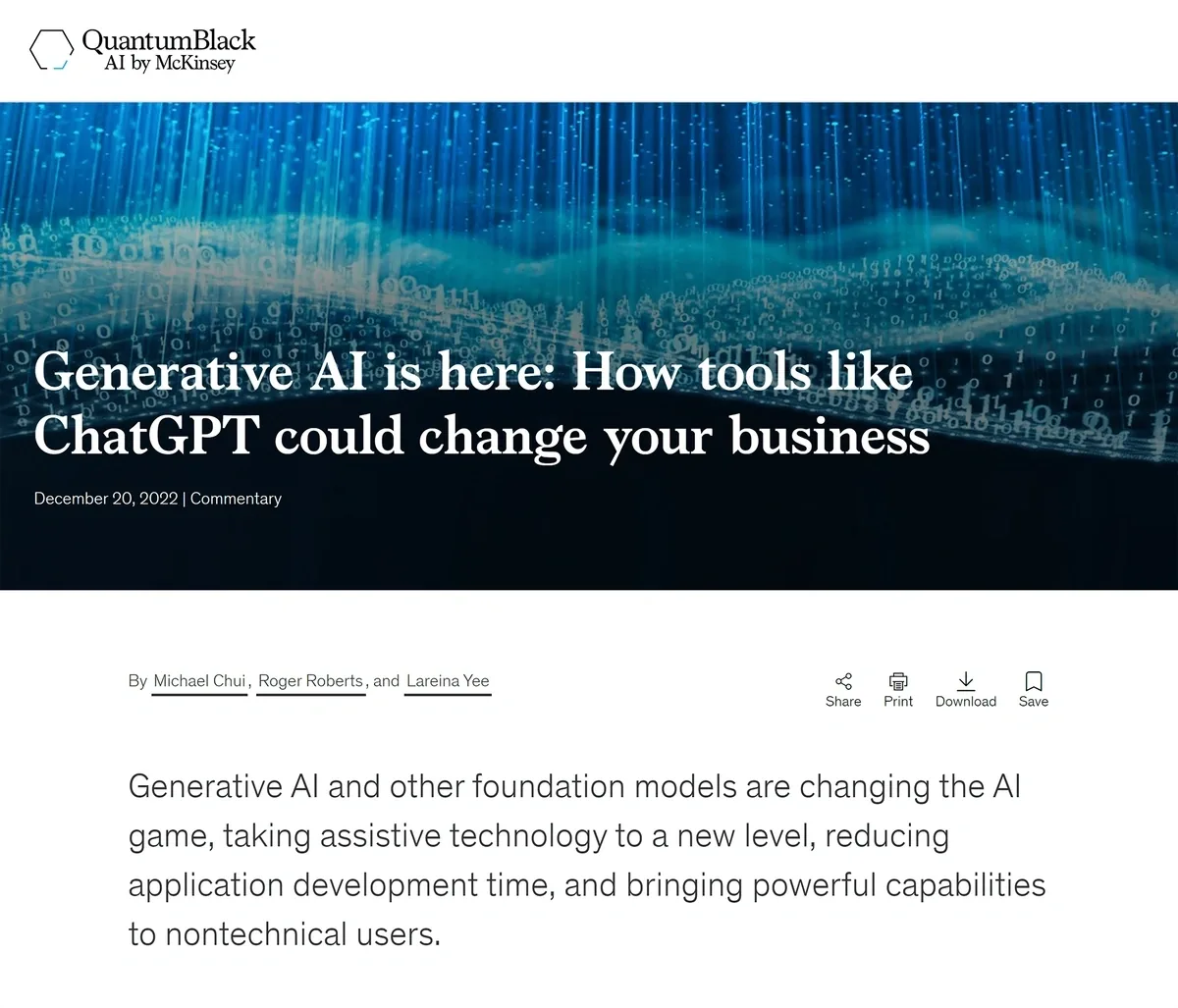
Generative AI boosts business productivity
Generative AI is being actively integrated into business processes. Its market share is projected to reach 30%—approximately $60 billion. Employees report increased productivity thanks to AI tools for writing, editing, and data analysis, while consumers expect an improved customer experience: nearly 70% believe that companies will soon adopt such technologies.
Startups, such as Syntegra from San Francisco, are creating synthetic patient data, accelerating clinical trials while ensuring privacy. Developers are using GitHub Copilot and Cursor AI to automate coding: GitHub reports that AI generates 40% of code, and tasks that previously took 10 minutes are now completed in 30 seconds.
AI is also being applied in advertising: Google and Meta plan to launch models that generate text, images, and videos based on uploaded materials. By 2030, according to Boston Consulting Group forecasts, generative AI will be able to create "final drafts" of content.
E-commerce continues to grow
After the pandemic, e-commerce continues to expand. Global sales reached $6.9 trillion in 2024, with projections of $8.1 trillion by 2026. The share of e-commerce in retail sales increased from 14% in 2019 to over 22% in 2023.
Companies are adapting their marketing and sales strategies. For example, Disney closed 60 physical stores and integrated shopping into Disney+, allowing users to scan QR codes and make purchases directly through the platform. Product categories such as electronics, furniture, and home goods continue to grow: the US furniture industry is projected to generate $208 million in e-commerce revenue in 2025.
5G and AI opportunities
5G provides high speeds, low latency, and reliability, which are crucial for data analysis and automation. In the US, 5G is available in 503 cities, and in China—in 356. The market is expected to grow to $797.8 billion by 2030.
Examples of application include BMW tracking cars, tools, and parts with centimeter-level accuracy, and hospitals using 5G for telemedicine and remote patient monitoring. IoT and 5G enable improvements in supply chains, monitoring of equipment and livestock in agriculture. IBM is testing urban infrastructure monitoring to assess the safety of roads, bridges, and water networks.
Remote and hybrid work
Remote work remains popular: 78% of employees wish to continue working outside the office, and 56% of full-time workers in the US have the option to work from home. Half of them work on a hybrid schedule, while 30% work fully remotely.
Companies are using monitoring technologies—screen activity recording, facial recognition, and keystroke logging. Gartner notes that the number of large companies adopting such technologies has reached 70%. At the same time, remote work saves employees money on lunches and transportation: $432 compared to $863 for office workers.
Social media and social commerce
As of January 2025, there were 5.24 billion users on social media. More than half of CMOs plan to increase their social media advertising spend. TikTok has shown high effectiveness for in-app advertising: it is 23% more memorable than television ads.
Companies are developing online communities and working with micro-influencers, who have higher conversion rates. Social commerce is growing rapidly: it accounts for 4.1% of online sales in the US and 14.3% in China, with sales through social platforms projected to reach $1.2 trillion by 2025.
Sustainability and the circular economy
Half of American consumers are willing to pay more for sustainable products, and 62% are changing their habits to reduce their environmental impact. Companies are implementing ESG practices and developing the circular economy, where materials and products remain in use for longer.
For example, the British company Teemill offers on-demand t-shirt printing and recycling after use, returning the material to production as new yarn. The World Economic Forum estimates the potential savings from the circular economy at $1 trillion per year.
Immersive technologies: AR, VR, MR
Companies are investing in AR, VR, and MR to enhance customer experience and employee training. The technology market was valued at $28 billion in 2021 and may grow to $252 billion by 2028.
For instance, Pinterest allows users to virtually furnish their homes with furniture using AR, which increases purchases fivefold. Startups and large corporations are actively investing in immersive technologies: in 2024 alone, $4.1 billion was invested in training and industrial maintenance.
Last-mile delivery
Last-mile delivery remains critically important, accounting for 41% of total supply chain costs. Consumers demand fast delivery: 80% prefer products with delivery within two days.
Drone delivery and AI-optimized routing help reduce costs and speed up the process. LogiNext processes over 500 million orders annually using AI to calculate delivery times. Wing, an Alphabet subsidiary, has completed over 250,000 drone deliveries.
AI in customer experience
Companies are using AI to improve service and reduce costs. Solutions allow for the automation of up to 65% of customer support tasks. For example, Camping World implemented a virtual agent named Arvee, which reduced average call wait times to 33 seconds and increased customer engagement by 40%.
Companies that track key trends and implement innovations gain a competitive advantage. Investments in technology, social media, sustainability, and customer experience help attract new customers and maintain leading market positions.
Source: explodingtopics
The Tech on Telegram Follow The Tech on Telegram
Keep up with the latest technology and startup news.
Related reading







More from this author

News
zypl.ai begins operations in Japan and focuses on next-generation risk models
Mansur Ismagulov

News
Elon Musk's net worth has exceeded $700 billion for the first time
Mansur Ismagulov

Article Interviews
"Central Asian countries should build a joint ecosystem," — Bekhzod Ismoilov on the development of AI in the region
Mansur Ismagulov

Article Interviews
Bloom's Taxonomy and Engineering Levels: A Practical Growth Model
Mansur Ismagulov

Article Useful
How the IT industry in Azerbaijan developed in 2025: key events
Mansur Ismagulov

News
Tajikistan has become a new member of the regional innovation alliance Central Asian Innovation Hubs.
Mansur Ismagulov