AI agents — the next stage in the evolution of user experience
Author - Mansur Ismagulov

The Tech AI
Get the key points in seconds - a short summary from The Tech AI.
Muhammad Abdugafarov describes AI agents as autonomous systems based on LLMs (GPT, Claude, Gemini), which are changing the way we interact with the digital world. Levels of autonomy from L1 to L5 have been identified; currently, L1 and L2 are actively developing. It is predicted that in 3–5 years, agents will become the standard for automation, which will require addressing ethical and integration challenges.
Muhammad Abdugafarov, city — Khujand, team lead, programmer at Silk Road Professionals, LinkedIn
AI agents are autonomous software systems that perceive the environment, make decisions, and perform actions to achieve set goals without constant human supervision. In recent years, the development of AI agents has become one of the key trends in artificial intelligence, changing approaches to automation, business, and user experience.
The foundation of most modern AI agents lies in large language models (LLMs), such as GPT, Claude, Gemini, and others. It is LLMs that make it possible to understand complex text queries and conduct dialogue in natural language. However, with the emergence of agentic capabilities, LLMs go beyond the familiar chat window: now they can not only answer questions but also initiate actions in the external world — booking tickets, launching processes, managing applications, integrating with services, and automating real business processes.
Evolution of user experience
Before internet applications
In the past, solving everyday tasks required physical presence and manual actions. For example, to buy a train or plane ticket, you had to go to the ticket office, stand in line, explain the trip details to an employee, and pay in cash.
With the advent of internet applications
Internet services radically simplified access to services. A user could visit an airline’s website or an aggregator, select a route, specify the date, compare prices, fill out an online form with passport data, and pay for the ticket with a card. However, this required understanding the interface, navigating between pages, and monitoring data accuracy.
With the arrival of AI agents
AI agents take the next step: now it is enough to describe your task in natural language, and the agent will independently perform all necessary actions. For example, to buy an airline ticket, it is enough to say: “Find me a direct flight from Almaty to Dushanbe for the nearest Friday, with a morning departure and a price not exceeding 50,000 tenge. Book the ticket in my name and send the boarding pass to my email.”
The AI agent itself analyzes schedules, compares prices on different platforms, selects the optimal option, books the ticket, and sends all information to the user. If necessary, it will clarify details or offer alternatives.
This approach saves time, eliminates the need to understand interfaces, minimizes errors, and makes the process as convenient and personalized as possible.
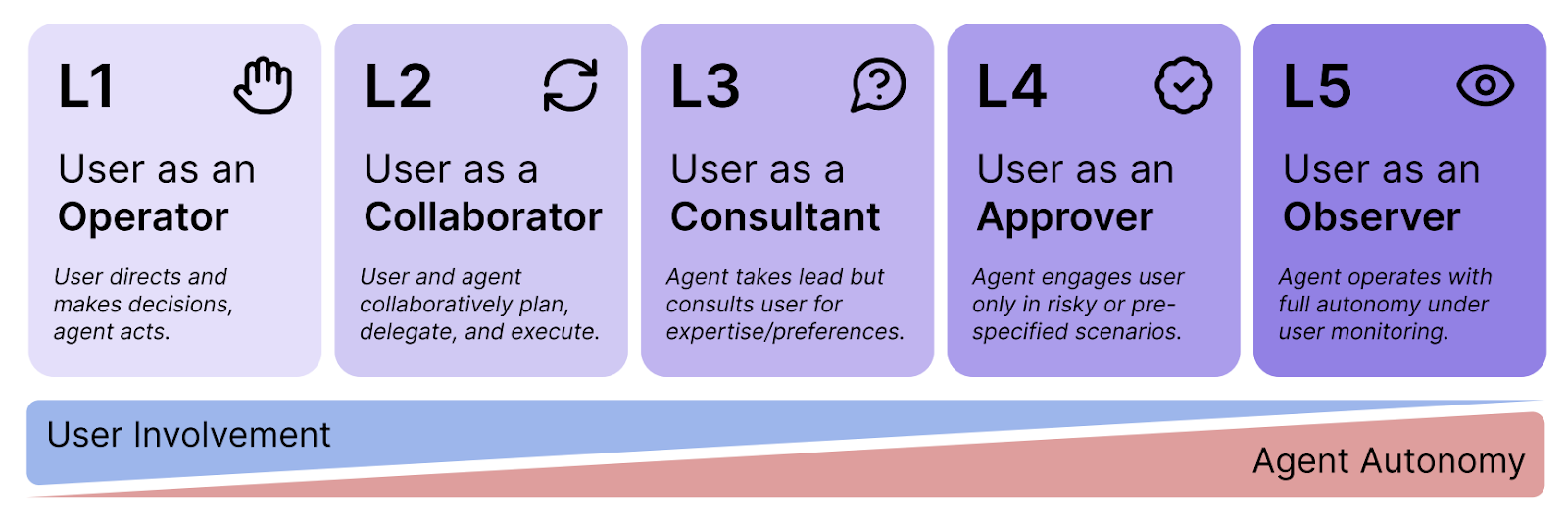
Below is an example of AI agent autonomy to illustrate the levels at which we will interact with them.
Levels of AI agent autonomy
| Level | User Role | Nature of Interaction | Agent Behavior Example |
| L1 | Operator | The user controls everything; the agent acts only on command | Advice/suggestions, such as code auto-completion or search query suggestions, without independent actions |
| L2 | Employee | The agent proposes actions, and the human approves them | The agent plans steps, proposes options — the user selects and launches |
| L3 | Consultant | The agent performs tasks but consults on key decisions | Performing actions with requests for confirmation or clarification from the user |
| L4 | Approver | The agent acts autonomously, and the user only confirms completion/goal | Completes the task and then requests user evaluation |
| L5 | Observer | The agent is fully autonomous; the user only observes ➝ evaluation after completion | Completes the task without intervention and provides a report |
Adapted from LEVELS OF AUTONOMY FOR AI AGENTS
Currently, levels L1 and L2 are actively developing. For example, code-writing assistants like Github Copilot, Gemini Code Assist, Claude Code are at level L1, while more autonomous agents for code creation like Lovable, Bolt are close to level 2. More about AI tools for development can be read here.
How the internet will change with the development of AI agents
The development of AI agents is just beginning. With the strengthening of LLMs and the implementation of technologies in industries, agents will move to higher levels of autonomy and capabilities.
— the interface becomes invisible: more tasks will be solved through dialogue or a short query, without the need to understand the website interface
— integration of services: the agent will be able to combine actions in different systems — booking flights, hotels, and taxis simultaneously
— the entry barrier is lowered: there is no need to learn how to use dozens of websites — it is enough to be able to formulate your tasks
— new automation scenarios: agents will be able to perform complex tasks that were previously too difficult for manual work via web interfaces
— deep personalization: agents will take into account your preferences, history, and context, offering solutions that are most suitable for you.
Forecasts and challenges
Forecasts:
— within three to five years, AI agents will become the standard for automating not only routine but also creative tasks
— the number of multi-agent systems will grow, where virtual employees coordinate complex processes without human participation
— new professions will appear: agent designers, trainers of agent systems, AI ethics auditors.
Challenges:
— ensuring transparency and explainability of agent decisions
— ethical issues: privacy, accountability, fairness
— integration with legacy systems and staff training
— the need to control autonomous decisions and prevent errors at early stages.
AI agents are not just another step in technological development, but a fundamental shift in how we interact with the digital world. They make technology more accessible, natural, and efficient for users of any skill level. For business, this is an opportunity not only to automate routine processes but also to create new products, improve customer experience, and open additional growth sources.
However, the implementation of AI agents requires a conscious approach: it is important to consider issues of transparency, security, ethics, and control over autonomous decisions. Market leaders who can strike a balance between innovation and responsibility will gain a significant competitive advantage in the coming years.
At present, we stand on the threshold of a new era, where AI agents become the link between humans and digital ecosystems. How we realize their potential will determine not only business efficiency but also the overall quality of life.
Sources and additional materials.
LEVELS OF AUTONOMY FOR AI AGENTS.
The Tech on Telegram Follow The Tech on Telegram
Keep up with the latest technology and startup news.
Related reading







More from this author

News
zypl.ai begins operations in Japan and focuses on next-generation risk models
Mansur Ismagulov

News
Elon Musk's net worth has exceeded $700 billion for the first time
Mansur Ismagulov

Article Interviews
"Central Asian countries should build a joint ecosystem," — Bekhzod Ismoilov on the development of AI in the region
Mansur Ismagulov

Article Interviews
Bloom's Taxonomy and Engineering Levels: A Practical Growth Model
Mansur Ismagulov

Article Useful
How the IT industry in Azerbaijan developed in 2025: key events
Mansur Ismagulov

News
Tajikistan has become a new member of the regional innovation alliance Central Asian Innovation Hubs.
Mansur Ismagulov