17 AI assistants that will make the work of PR and communications specialists easier
Akerke Tolegen, PR specialist at Sergek Group, has compiled a list of useful AI services that can significantly simplify the daily work of communication teams. Save and share — it will definitely come in handy.
Author - Mansur Ismagulov

The Tech AI
Get the key points in seconds - a short summary from The Tech AI.
Akerke Tolegen, PR specialist at Sergek Group, uses AI to automate routine tasks: transcription (Whisper AI, Turboscrie AI), meeting minutes (Notta AI, Otter.ai), and data processing. She applies LLMs for work in four languages, Adobe Firefly for visuals, and paid subscriptions for stability. At the same time, she maintains expertise, fact-checking, and confidentiality, considering AI a tool rather than a replacement for humans.
Akerke Tolegen, PR Specialist at Sergek Group
I am an international journalist, branding expert, and strategic communications specialist at Sergek Group—an IT company that makes cities safer and smarter. I explain complex technologies in simple terms and build bridges between engineers, people, and cities. My toolkit includes dozens of press releases, hundreds of interviews, and thousands of posts, and I don’t do it alone: I have a small team of invisible assistants—neural networks and AI services—working alongside me.
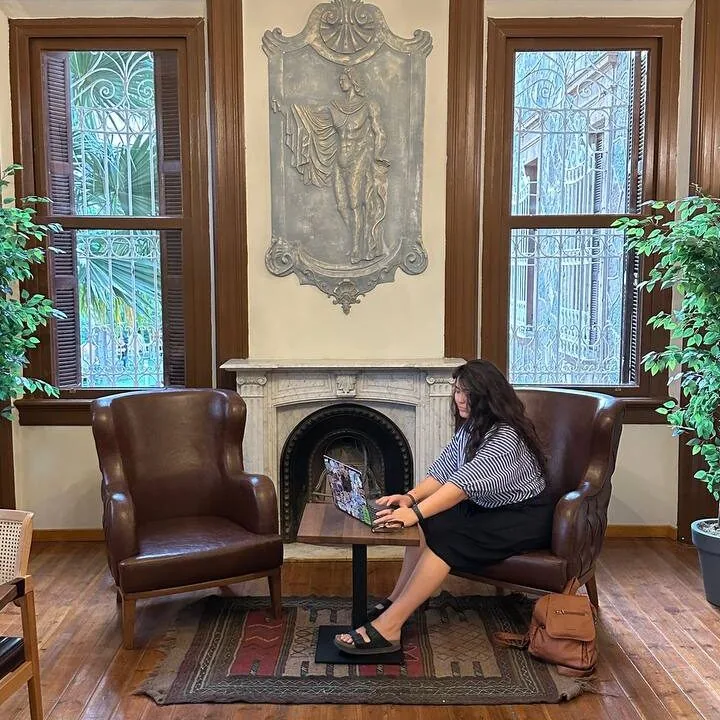
If someone had told me ten years ago that I could run communication projects for a Kazakh IT company from my home in Turkey without getting bogged down in routine, I would have laughed. Back then, artificial intelligence seemed to be about drones, smart cars, or a superhero billionaire’s assistant. Now, AI serves as my extra hands, ears, and, most importantly, a clear mind while I work remotely and manage projects.
How AI Eliminates Routine
The most tedious part of my job is transcribing interviews. Anyone who has ever sat with headphones and typed away on a keyboard will understand. Until April 2025, I struggled with manual transcription because I couldn’t find good services and tried, tried, and tried again. Currently, I simply record the conversation and upload it to Whisper AI, Turboscrie AI, Assembly AI, or any other convenient service. Within a couple of minutes, I have a ready draft. Yes, sometimes I need to correct mixed “Kazakh-Russian-English” text, but even with edits, it’s faster than typing everything manually.
I “train” my LLMs to speak correctly in four languages—Kazakh, Russian, English, and Turkish. Gradually, they adopt my style and make fewer grammatical and stylistic errors. Thus, to get the best out of my assistants, just like in life, they need to be trained. On the other hand, I use AI to learn Spanish and refresh my forgotten French. Unfortunately, it’s difficult due to my workload, but I can easily spare a couple of hours on weekends.
Working remotely, it’s easy to drown in calls and messages. To ensure I don’t lose anything, I integrate Notta AI, Otter.ai, tldv.io, or Fireflies AI directly during Zoom meetings. They take notes and generate meeting minutes: who said what, which tasks were recorded, and who is responsible. Less chaos, more clarity.
In my side gigs for local Turkish companies, I often need summary reports and tables. With Excel Copilot or ChatGPT, I build formulas faster, spot errors, and visualize data in a way that anyone can understand.
Now, even ChatGPT is becoming closer to the reality of Kazakhstan—I use various domestic plugins there. For example, Qazaq Law helps quickly find current legal information about our laws. For me, this is a great example of how AI accelerates the search for basic reference materials, but still leaves final interpretation and strategic decisions to humans. At the same time, I always fact-check on official websites, government and private company sites, and call press secretaries or experts directly to avoid accidentally publishing unverified data. Generative AI, like people, can make mistakes.
For visuals, I use Adobe Firefly, Luminar AI, or neural network photo editors. A couple of clicks, and photos for social media or presentations are ready. Of course, a good designer can still do better, but when you need to quickly pitch and visualize an idea, AI is indispensable. However, I am against using neural networks for creating content for large corporations—for example, when creating advertising materials using generative technologies. I worked as a PR specialist at an animation studio in Kazakhstan and understand well how sensitive this topic is for people in creative professions. In this field, legislative regulation and strict adherence to copyright are necessary.
How My Company Relates to AI
I joined Sergek Group in January 2024—and literally from the first day, I got caught up in a whirlwind of fascinating work. I started by participating in forums on digitalization and urbanism, then worked on ESG projects, delved into safety, transport, and ecology issues, learned from developers, and filmed documentaries about technologies and people. When I switched to remote work, strategic tasks began, along with internal communication projects and packaging complex IT products for a wide audience.
Working in an IT company helped me stop fearing AI faster and start using it every day. When you work alongside developers, project managers, and engineers, you stop seeing neural networks as “magic.” You begin to treat AI as a work tool because you understand how it works, how to protect yourself, and how to optimize your work. I also asked my colleagues tons of questions about technology, then asked them to generate key IT concepts for me to dive into topics faster, because in communications, deep understanding of what you’re talking about is crucial.
At Sergek Group, we learn a lot from each other—and if I can do it, then anyone in communications can too. The main thing is to be curious and not afraid to test. Because neural networks are not about replacing people. They are about being faster, more flexible, and freer.
AI Is Not Just for Work
A neural network can lighten your head in everyday life too. Overall, I am a meticulous person, and I have lists for every occasion in life. Since I love cooking, I have now integrated all my lists into AI—in ChatGPT or Gemini—and they compile shopping lists by category, remind me when things are running low, recognize unfamiliar exotic vegetables or fruits, and suggest healthy recipes. The same goes for sports. Working remotely, it’s easy to get stuck in a chair, so I use FitnessAI, which adjusts workouts to my progress. It’s like a personal trainer who is always at hand.
A separate must-have is AI journals. I write down my thoughts, insights from psychotherapy, and even structure my health history to track dynamics. For this, I use Reflect AI, Mem AI, or Journey AI. It’s like an assistant that stores your ideas and helps you see the big picture.
It’s Normal to Pay
I often hear: “Why pay for AI if there are free options?” But the truth is that a good tool, like quality software, costs money. I buy subscriptions to work without ads and glitches, with normal functionality and support. For me, this is not an expense, but an investment in my efficiency and peace of mind, just as I pay for online libraries, streaming services, music aggregators, and so on. I work in media and with content, so for me, paying for someone else’s labor and product development is normal!
Where AI Ends and My Expertise Begins
I experiment a lot with neural networks, but there are rules that are unshakable for me. For example, I never upload confidential documents or NDA projects to AI. Strategies, reputational risks, crisis cases—I handle all these myself. Because no neural network will take responsibility for subtle meanings and consequences. Moreover, cases of information and client data leaks occur quite often, so I prefer to be safe. Overall, if you work with technology, don’t forget about information security.
AI Will Not Replace Experts Soon—and That’s Good
I don’t believe that AI will fully replace us in the near future, at least not in my field. I was lucky: before the neural network boom, I worked in the profession for over 10 years—I wrote my thesis by hand, worked in all genres and all types of media, in several countries. This foundation cannot be replaced by any algorithm.
Currently, it’s harder for beginners. They need not only to develop hard skills but also soft skills, be flexible, know languages, be able to do deeper analytics than AI, and craft better prompts. Because a neural network doesn’t do all the work for you. It simply relieves you of routine so you can focus on meaning and people. For me, AI is not a competitor, but an ally. But it works for you only when you remain an expert yourself: with experience, critical thinking, and your unique style. Everything else is just a matter of technique.
The Tech on Telegram Follow The Tech on Telegram
Keep up with the latest technology and startup news.
Related reading







More from this author

News
zypl.ai begins operations in Japan and focuses on next-generation risk models
Mansur Ismagulov

News
Elon Musk's net worth has exceeded $700 billion for the first time
Mansur Ismagulov

Article Interviews
"Central Asian countries should build a joint ecosystem," — Bekhzod Ismoilov on the development of AI in the region
Mansur Ismagulov

Article Interviews
Bloom's Taxonomy and Engineering Levels: A Practical Growth Model
Mansur Ismagulov

Article Useful
How the IT industry in Azerbaijan developed in 2025: key events
Mansur Ismagulov

News
Tajikistan has become a new member of the regional innovation alliance Central Asian Innovation Hubs.
Mansur Ismagulov