10 Nvidia Predictions: China, AI, Robotics, and Global Infrastructure
Nvidia has transformed from a niche manufacturer of graphics chips into the most valuable giant in the semiconductor industry worldwide, capitalizing on the explosive growth of artificial intelligence. In 2025, when Nvidia's valuation reached nearly $4 trillion and the company took the top spot in the S&P 500 ranking, Huang continues to develop an ambitious vision for the company's future.
Author - Mansur Ismagulov
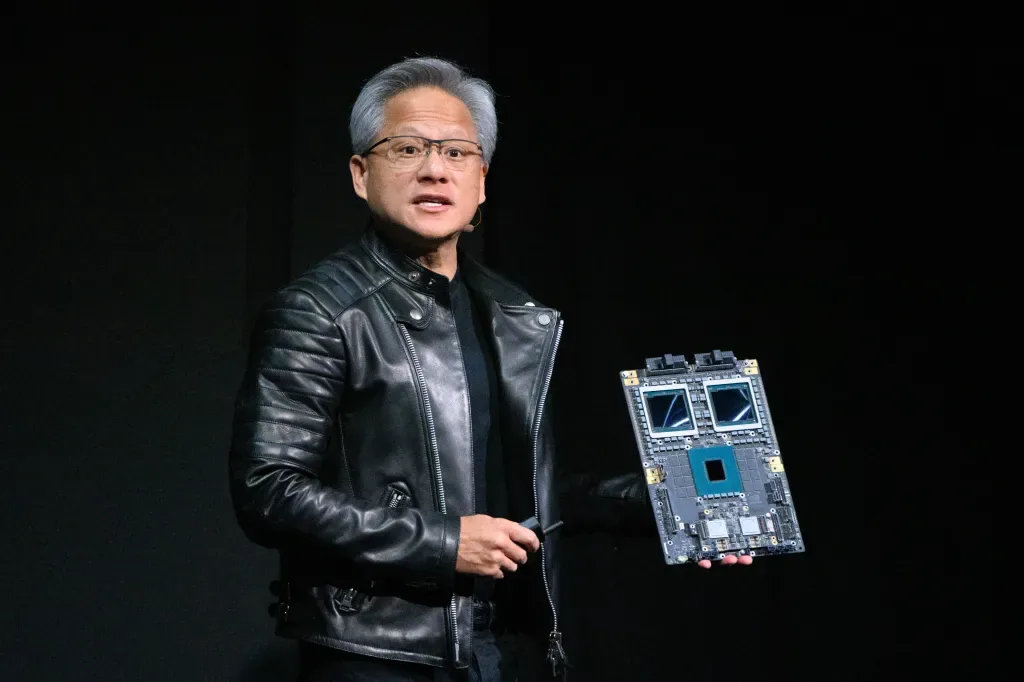
Nvidia CEO Jensen Huang shared 10 key predictions that shape the company’s roadmap and the future of global computing.
1. Challenges and opportunities in the Chinese market
China remains an important market for Nvidia, representing a potential sales volume of tens of billions of dollars. Jensen Huang acknowledges that U.S. trade restrictions complicate the company’s full participation in this market; however, Nvidia is seeking ways to balance Washington’s concerns with Beijing’s demand for advanced artificial intelligence hardware. Huang characterized China as a “$50-billion AI opportunity” this year, with the potential for 50% annual growth under relaxed restrictions. Thus, China has become both a geopolitical challenge and a crucial growth frontier for Nvidia’s future.
2. Agentic AI will drive mass demand for computing power
According to Huang’s forecast, the next stage of artificial intelligence development will move beyond simple chatbots and text generators toward agentic AI. This refers to reasoning systems capable of planning, making decisions, and acting on behalf of humans. Unlike current models that primarily respond to queries, agentic AI will function more like digital colleagues or assistants. Providing such intellectual capability will require 100 to 1,000 times more computing resources than current AI systems. This prediction underscores Nvidia’s commitment to continuing to refine its graphics processing units and data center platforms, as the success of agentic AI directly depends on unprecedented computing power.
3. Robotics as the next multi-billion-dollar market
Artificial intelligence will exist not only in software but also in physical machines. Nvidia is placing a major bet on robotics through its Jetson Thor platform, designed to support everything from warehouse automation to humanoid robots. Analysts predict that the humanoid robot sector alone could grow to $38 billion by 2035. According to Huang, in the future, every industrial company will operate two factories: one traditional and one populated by AI-based robots. He describes robotics as a natural extension of Nvidia’s mission to embed intelligence into all aspects of human life and believes the company’s leadership in accelerated computing makes it the natural platform for this transformation.
4. A trillion-dollar boom in AI infrastructure
Artificial intelligence infrastructure will become the largest area of capital investment in the coming decade. Nvidia estimates that the global market for AI data centers could reach $3–4 trillion over the next five years. Companies and governments are racing to build computing power comparable to power plants, but instead of generating electricity, these facilities generate intelligence. New architectures, such as Blackwell and Rubin, will dominate this space, offering greater efficiency and scalability.
5. Hyperscalers continue to increase AI spending
The world’s four largest hyperscalers—Amazon, Google, Microsoft, and Meta—remain Nvidia’s largest customers. Together, they account for hundreds of billions of dollars in annual capital expenditures, a significant portion of which is directed toward building faster and more efficient AI data centers. By 2025, hyperscalers have already doubled their annual capital expenditures to $600 billion, and industry forecasts suggest this figure will continue to grow throughout the decade. Huang views this as proof that AI is not a fleeting trend but a sustained technological wave. As long as hyperscalers continue to expand, Nvidia will maintain its position as the preferred provider of their advanced computing platforms.
6. Nvidia’s comprehensive advantage over competitors
Nvidia holds a structural advantage over competitors such as AMD and Intel. While other companies produce chips, Nvidia controls the entire technology stack: GPUs, AI servers, networking equipment, and the CUDA software ecosystem, which has become the industry standard for AI development. This combination gives Nvidia up to 95% of the AI chip market share. More importantly, this ensures that developers and companies worldwide will rely on the Nvidia ecosystem rather than alternative solutions. According to Huang, competitors face nearly insurmountable barriers to entry, as Nvidia has already laid the foundation for the AI economy.
7. Networking and connectivity as key growth drivers
Nvidia is today not only a chip manufacturer but also a leader in networking technologies that connect the world’s most advanced AI factories. Spectrum-X Ethernet and InfiniBand platforms provide the high bandwidth and low latency required to run massive AI models. The upcoming release of Spectrum-XGS will enable the interconnection of multiple data centers, creating AI mega-hubs capable of serving entire regions. Nvidia’s networking business has already exceeded $10 billion in annual revenue, and Huang expects its growth rate to accelerate as AI models require increasingly efficient global connectivity.
8. Record financial growth
Nvidia continues to deliver record results quarter after quarter. For the third quarter of 2025, the company forecasts revenue of $54 billion, a figure achieved even without accounting for major sales to China. Analysts predict that Nvidia’s annual revenue in 2025 will reach $207 billion, rising to $272 billion in 2026. These figures highlight not only the company’s dominant market position but also the scale of the global AI revolution. Nvidia’s financial trajectory demonstrates that demand for AI will continue to grow as intelligent systems integrate into all sectors of the economy.
9. Robotics and the expansion of the AI ecosystem
Nvidia is not limited to its own AI and robotics developments. The company has built a global developer community of over two million people and established partnerships with more than a thousand companies, including Amazon Robotics, Boston Dynamics, and healthcare giants like Medtronic. This ecosystem is considered Nvidia’s strongest long-term advantage, as it guarantees a continuous stream of innovations and applications for its platforms. By embedding itself in every industry, Nvidia makes its hardware and software indispensable for the future of automation and intelligent machines.
10. Ensuring long-term market leadership
Jensen Huang is confident that Nvidia will continue to maintain its leadership. He compares the company’s current position to Microsoft’s dominance during the personal computer era, asserting that Nvidia has become the “default choice” in AI. With presence across all segments—from cloud computing to robotics and edge devices—Nvidia has secured a key position at the center of the AI economy. Huang emphasizes that this is only the beginning, as AI will transform all aspects of human life, and Nvidia is ready to provide the critical infrastructure for this future.
The article was translated from The Times of India.
The Tech on Telegram Follow The Tech on Telegram
Keep up with the latest technology and startup news.
Related reading







More from this author

News
zypl.ai begins operations in Japan and focuses on next-generation risk models
Mansur Ismagulov

News
Elon Musk's net worth has exceeded $700 billion for the first time
Mansur Ismagulov

Article Interviews
"Central Asian countries should build a joint ecosystem," — Bekhzod Ismoilov on the development of AI in the region
Mansur Ismagulov

Article Interviews
Bloom's Taxonomy and Engineering Levels: A Practical Growth Model
Mansur Ismagulov

Article Useful
How the IT industry in Azerbaijan developed in 2025: key events
Mansur Ismagulov

News
Tajikistan has become a new member of the regional innovation alliance Central Asian Innovation Hubs.
Mansur Ismagulov