Will AI replace junior developers? Opinions from Meta, Google, and Booking.com
At the Digital Qazaqstan 2026 conference, Kazakh IT specialists and entrepreneurs discussed how the country can leverage its talent and freedom of thought to drive innovation and artificial intelligence.
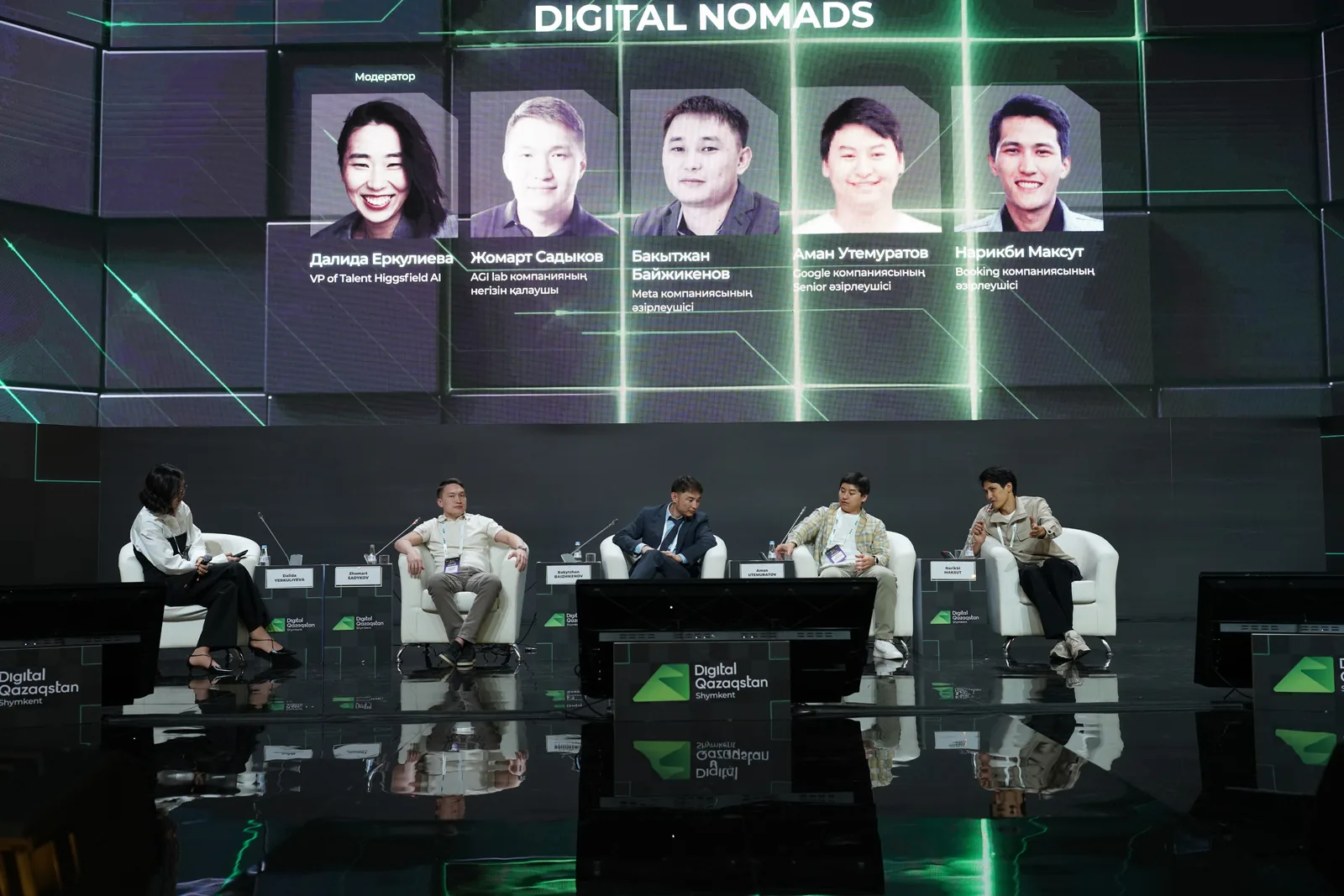
Speakers
Bakytzhan Bayzhekenov, Meta Developer
Zhomart Sadykov, Founder of AGI Lab
Aman Utemuratov, Senior Developer at Google
Narikbi Maksut, Developer at Booking.com
Kazakhstan's Competitive Advantage
Bakytzhan. Although I am a programmer and participate in olympiads, I often make decisions based on intuition. And I believe this is our era.
We Kazakhs are freedom-loving. People call us aggressive, but I always respond: no, we simply know how to stand up for ourselves, are not afraid of conflicts, and know how to establish personal boundaries.
They say Kazakhs are lazy. But that is not true—we simply love optimizing processes and freeing up time for more interesting pursuits.
There is a saying: "Every Kazakh is a Khan." This means that everyone can create, experiment, and be free in their projects.
Many people are talking about the future of solo founders and new unicorns—and I think this suits us well. I look to the future with optimism: everything will be fine for us.
Development of AI and Innovations in Kazakhstan
Zhomart. I disagree with the statement that AI is replacing junior specialists. In my view, current tools enhance programmers rather than replace them. And programmers are among the last professions to be replaced.
If we talk about Kazakhstan, our strength lies in talent. We have many people who are strong in mathematics, computer science, and other exact sciences.
Competing with China, for example, in chip manufacturing is not our niche. But in innovation, we have a chance: by leveraging talent, we can create new solutions and participate in the next AI technological revolution.
Hiring Juniors and the Transformation of Work
Aman. In large technology companies like Google, work has changed significantly with the advent of AI.
Currently, companies are focusing on increasing productivity: senior engineers are given more AI tools to accelerate development several times over.
As a result, many companies have started hiring senior specialists more frequently. However, despite this, the number of vacancies for junior and middle developers is also growing.
For example, at Google, there was a hiring freeze: we did not hire new employees but instead restructured teams—helping junior and middle specialists grow to the senior level.
When the workload increases, companies temporarily reduce hiring for junior specialists, which affects the career ladder.
Now we are hiring again, but the requirements have changed: if a project used to take two months, now it takes two weeks. Everyone is going through an adaptation period to working with AI.
Advice for Youth
Narikbi. Many students say: "We can't get hired as juniors—AI will replace us."
But it is important to understand: when demand for certain roles decreases, demand for others increases.
For example, the workload on testing is currently increasing. There is more code, but its quality is lower, so more QA specialists are required.
New professions are emerging: prompt engineers, AI engineers. The number of specialists is not decreasing—it is transforming. Therefore, it is important not to fall behind trends.
At the same time, fundamental development processes remain: the product creation cycle has not disappeared, it has just become faster and more complex.
Education and AI
Bakytzhan. I think we need to rethink everything—including education.
We are facing large-scale automation for the first time in history. Therefore, we should not simply automate old processes—we need to rebuild the system from scratch.
Questions arise: do we still need schools and universities in their traditional form? Do we need to work as we did before?
I believe education must change fundamentally, and even "fundamental knowledge" will transform.
Aman. The path used to be clear: university → knowledge → work.
Now everything is more complicated. Requirements have increased, and competition has intensified.
But at the same time, AI provides equal opportunities: it accelerates learning.
If it used to take weeks to find an error, now it takes minutes. This shortens the path from junior to senior.
Today, it is possible to become a strong specialist faster if you use AI correctly.
Circulation of Talent
Zhomart. People will always leave and return—it is normal.
But the presence of strong companies in Kazakhstan increases the likelihood that specialists will return.
This is a natural process: some choose to live abroad, others choose to stay home.
Narikbi. I want Kazakhstani citizens to reach a global level.
In other countries, strong diasporas form powerful professional communities. For Kazakhstani people, this is still less developed.
Therefore, it is important to go abroad, gain experience, and bring it back.
And at the same time—preserve the language, culture, and develop education in Kazakh.
Digital Nomad and Freedom
Bakytzhan. We are nomads by nature. It is difficult for us to stay in one place.
If I live in Germany or Japan, I do not stop being a Kazakh.
Therefore, our main underestimated advantage is freedom.
The Tech on Telegram Follow The Tech on Telegram
Keep up with the latest technology and startup news.
Related reading




More from this author

Article Useful
How to protect your accounts from hacking: 8 settings you should check today
The Tech

Article Useful
500 Global: How the Accelerator Works and Who Can Receive Investments
The Tech

Article Interviews
Game Development in Central Asia: Arkady Moldavski on Developing Reverb and the Growth of the Industry
The Tech

Article Useful
Google, Tesla, BlackRock, and the IMF: Where to Apply for an Internship in Fall 2026
The Tech

News IT
Tesla unveiled the flying electric car Roadster
The Tech

News IT
Intero Biosystems startup won the Startup Battlefield at TechCrunch Disrupt 2026
The Tech