Yandex Cloud launched CDN: how it works and what it offers to businesses
The Yandex Cloud CDN service is now available to businesses in Kazakhstan. How it helps optimize infrastructure and reduce traffic costs while delivering content faster and improving user experience — The Tech editor-in-chief Ivan Kabanov, an architect at Yandex Cloud, explained.

The Tech AI
Get the key points in seconds - a short summary from The Tech AI.
CDN accelerates content delivery by caching on nearby servers, reducing load and costs. For example, with Kinopoisk handling over 7000 GB of traffic per month, savings amount to 95% on requests and 38% on traffic. Yandex Cloud CDN offers locations in Kazakhstan and Russia with a capacity of approximately 1 Tbit/s, charging only for outgoing traffic. Customers can configure caching times and analyze metrics through Yandex Monium Metrics.

How CDN Works
CDN, or Content Delivery Network, enables the delivery of content to end users more cheaply and quickly through caching—the temporary storage of frequently used data copies in a special storage system called a cache.
Cached data is delivered not from the service's own servers, but from servers closest to the end user. This ensures instant access to information, as it does not need to be requested from the primary source or recalculated. Additionally, the content is physically closer to the user, so data is transmitted over significantly shorter distances.
As a result, devices and applications work faster, the load on the servers storing the content is reduced, and infrastructure costs are lowered. For content consumers, this means faster loading of websites, images, and videos, resulting in an improved user experience.
Fast content delivery also helps improve a site's ranking in search results and positively impacts SEO metrics.
Savings in Numbers
Using a real-world example: the main page of the online cinema service "Kinopoisk" contains approximately 400 files, totaling 25 MB. With 10,000 visits per day, the monthly traffic exceeds 7,000 GB. With CDN, the cost of requests is reduced by 95%, and the cost of traffic by 38%.
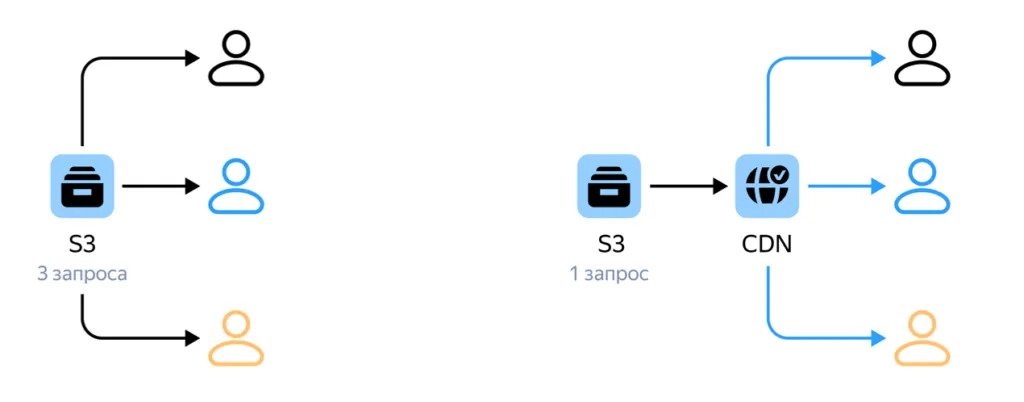
If three separate server requests are combined into a single request via CDN, the cost of traffic transmission is reduced by 1.6 times.
CDN is suitable for any services with diverse content delivery scenarios. For example, online stores and marketplaces, educational platforms, online cinemas, games, applications, media platforms, and so on.
Locality, Pay-Per-Outbound-Traffic Pricing, and Clear Analytics
Currently, Kazakhstani customers of Yandex Cloud CDN have access to locations in Kazakhstan and Russia with a total network capacity of approximately 1 Tbit/s.
Companies pay only for outbound traffic—from the CDN to the content consumer: inbound traffic from Yandex Cloud services and other internet resources is not billed. Any servers can serve as the traffic source, including those outside the Yandex Cloud infrastructure.
Companies can independently configure caching time—how long a content copy is stored on the CDN server—which allows for infrastructure optimization.
A separate control plane installation is available for customers in Kazakhstan, where configuration, logs, and metrics are stored and processed within the country's borders.
The effectiveness of caching, loaded traffic metrics, the number of requests, and errors over a selected period can be analyzed in the Yandex Monium Metrics service.
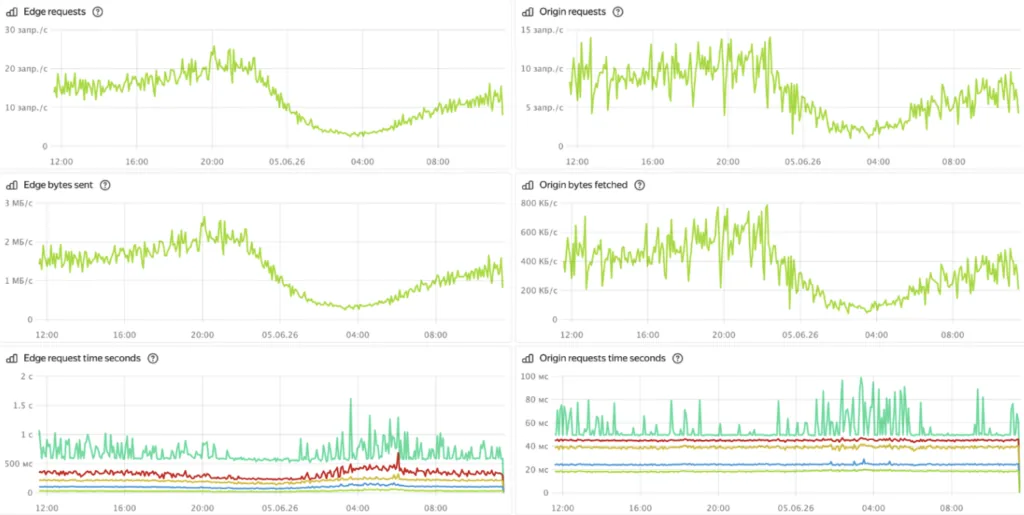
Dashboards with statistics on Yandex Cloud CDN performance in the Yandex Monium Metrics service.
The new service will help businesses improve user experience, reduce infrastructure load, and effectively handle even peak traffic volumes. Furthermore, it is easy to integrate with a company's existing infrastructure and can be used both to accelerate traffic transfer from Yandex Cloud servers and for any external sources.
The Tech on Telegram Follow The Tech on Telegram
Keep up with the latest technology and startup news.
Related reading




More from this author

Article Useful
How to protect your accounts from hacking: 8 settings you should check today
The Tech

Article Useful
500 Global: How the Accelerator Works and Who Can Receive Investments
The Tech

Article Interviews
Game Development in Central Asia: Arkady Moldavski on Developing Reverb and the Growth of the Industry
The Tech

Article Useful
Google, Tesla, BlackRock, and the IMF: Where to Apply for an Internship in Fall 2026
The Tech

News IT
Tesla unveiled the flying electric car Roadster
The Tech

News IT
Intero Biosystems startup won the Startup Battlefield at TechCrunch Disrupt 2026
The Tech